Updated August 2026
The best qualitative data analysis software in 2026 depends on your methodology, your budget, and how many transcripts you have. Academic researchers following traditional methods keep using NVivo, MAXQDA, or ATLAS.ti, but are increasingly looking for alternatives with lower price, better AI-assisted features and easier learning curves. For researchers who need speed without sacrificing rigour, AI-native tools like Skimle (from €20/month, with a free tier) can process 50+ interview transcripts in hours while keeping every finding traceable back to its source quote. For quick summaries without methodological demands, generic LLM tools like ChatGPT work, but they lack the transparency needed to defend findings. (New to Skimle? Start with what is Skimle for a 97-second overview.)
Qualitative analysis software compared: price and capability
Entry prices below are list prices at the time of writing. Academic, student and institutional rates differ substantially from commercial ones, and most vendors negotiate site licences, so treat these as a starting point.
| Tool | Best for | Entry price | AI analysis | Browser-based |
|---|---|---|---|---|
| Skimle | Large interview sets with source traceability | From €20/month; free tier | Full automatic thematic analysis | Yes |
| NVivo | Established academic standard, mixed methods | Academic from ~$125 (€115)/yr; commercial from ~$1,100 (€1,000)/yr | Limited, query-based | No, desktop |
| MAXQDA | Mixed-methods work, identical Mac and Windows builds | Academic from ~$250 (€230)/yr; business from ~$510 (€465)/yr | Some AI add-ons | No, desktop |
| ATLAS.ti | Network mapping, grounded theory, multimedia | Student from $51 (€47)/yr; commercial from $670 (€615)/yr | Some AI coding | Partial |
| Dedoose | Team collaboration on a budget | $13–20 (€12–18)/month | Minimal | Yes |
| Dovetail | UX research repositories and tagging | Free plan; ~$29–39 (€27–36) per editor/month | Summarisation, tagging | Yes |
| Quirkos | Visual, beginner-friendly coding | $5 (€4.50)/month student; $23 (€21)/month commercial | None | Yes |
| Taguette | Free basic manual text coding | Free, open source | None | Yes, self-host |
| QualCoder | Free multimedia coding, technical users | Free, open source | Limited | No, desktop |
Best by category
- Best for AI-assisted analysis at volume: Skimle. Codes the full corpus automatically and keeps every insight linked to the quote that produced it, which is what separates it from a general LLM summary.
- Best established academic standard: NVivo, with MAXQDA close behind for mixed methods. Both are the safe choice if your department, supervisor or methods section expects a named incumbent.
- Best for grounded theory and network mapping: ATLAS.ti.
- Best free option: Taguette for straightforward text coding, QualCoder if you need multimedia and can tolerate a rougher desktop application.
- Best low-cost paid option: Quirkos for solo visual coders, Dedoose for small teams.
- Best UX research repository: Dovetail, though it is a repository and tagging tool first and an analysis tool second.
The honest summary: if you are coding 10 interviews for a dissertation and your department already licenses NVivo, use NVivo. If you are working through 50 or more transcripts against a deadline, manual coding is the constraint, and that is the case the AI-native tools exist to solve. If your corpus is specifically focus group transcripts rather than one-to-one interviews, focus group analysis software: the analysis chain and how 8 tools compare in 2026 covers additional group-specific platforms (Looppanel, Remesh, Civicom) alongside how MAXQDA, ATLAS.ti and Skimle handle multi-speaker data.
Three paths to qualitative analysis
You have interview transcripts, open-ended survey responses, video interviews, contracts, statements or other documents to analyse. Which tool should you use?
After years of working with qualitative data - both at McKinsey where Olli did over 1000 business interviews, and in academia where Henri has published more than a dozen academic studies using qualitative data - we have come to see that the tool question is actually a methodology question. Before comparing features and pricing, you need to decide which approach fits your needs.
There are three distinct paths:
Path 1: Rigorous Manual Analysis - Traditional academic tools require you to systematically code every passage by hand. Transparent, reproducible, but time-intensive. Think NVivo, MAXQDA, ATLAS.ti.
Path 2: Ad-hoc + AI Assistance - This category includes generic LLM tools such as ChatGPT, Microsoft co-pilot, and NotebookLM, as well as coding tools with bolted-on AI features of NVivo, Atlas.ti, and MAXQDA.. These lack the structured rigour of traditional approaches, but lack the coherence and comprehensiveness needed in qualitative research.
Path 3: AI-Native Structured Analysis - Purpose-built for AI from the ground up, but maintaining the transparency and structure of academic methods. This is the approach we took with Skimle.
Each path involves trade-offs. Let us walk through what each offers.
Path 1: Rigorous manual analysis
These are the established tools that have defined qualitative research for decades. They’re built around the traditional workflow: read your data, develop codes, manually tag passages, and build themes.
NVivo
NVivo is the most cited qualitative analysis software in academic publications, now owned by private capital Lumivero. It’s designed for academic institutions and research organisations.
What it does well:
- Comprehensive coding system with hierarchical nodes
- Excellent visualisation tools (word clouds, charts, cluster analysis)
- Strong mixed methods support (qualitative + quantitative)
- Collaboration features via NVivo Collaboration Cloud
- Wide format support including video and audio
AI features (NVivo 15): NVivo has added rudimentary AI through the Lumivero AI Assistant, including text summarisation, coding suggestions, and sentiment analysis. The AI can suggest child codes within existing categories and auto-code for themes.
Limitations:
- Steep learning curve, especially for advanced features
- Interface feels dated to some users
- All coding is still fundamentally manual - AI assists but doesn’t transform the workflow
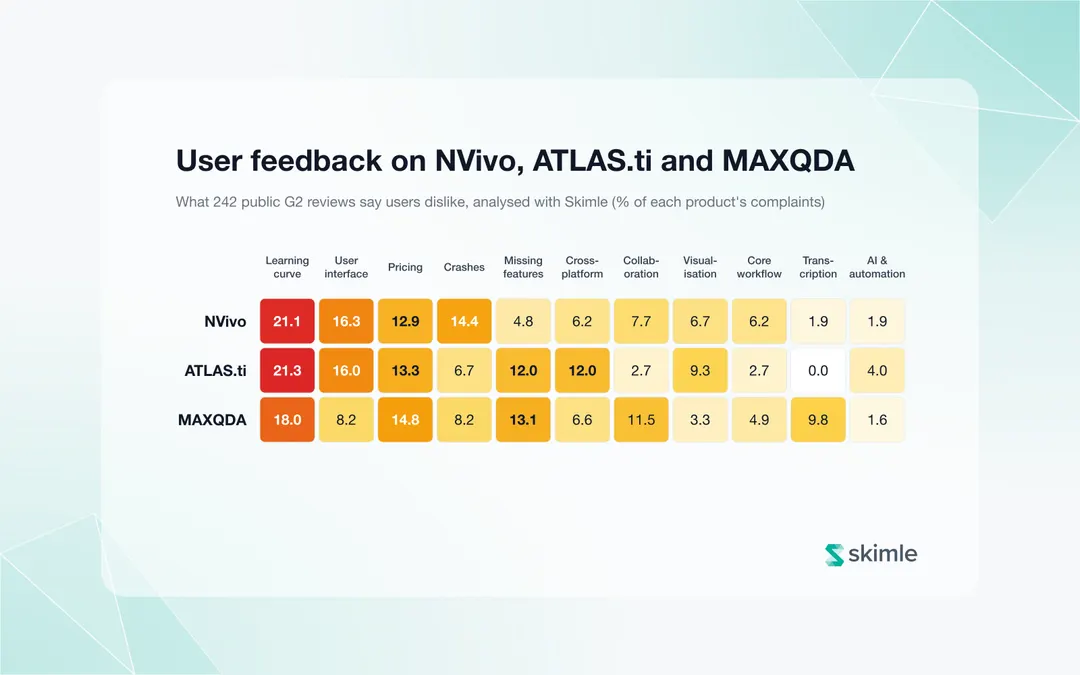
Our analysis of 242 user reviews of NVivo, ATLAS.ti and MAXQDA puts numbers on these limitations, including NVivo's higher share of crash and stability complaints.
Pricing: From $1,200 (€1,100)/year for commercial licences. Student licences around $100 (€90)/year. Worth noting: in September 2024, Lumivero acquired ATLAS.ti, raising concerns on Nvivo pricing.
MAXQDA
MAXQDA is developed in Germany and positions itself as the most user-friendly of the traditional tools. It’s the only classic QDA software offering identical features on Windows and Mac.
What it does well:
- Cleaner, more modern interface than NVivo
- Strong mixed methods tools including statistical analysis
- Good collaborative features
- Visual tools for exploring code relationships
AI features (MAXQDA AI Assist): MAXQDA’s AI assistant helps with document summarisation, coding suggestions, and paraphrasing. It can suggest codes for text segments. Available in the Analytics Pro tier for extra cost. Tailwind is a separate program not integrated with MAXQDA and priced separately.
Limitations:
- The learning curve, while better than NVivo, is still significant
- AI features require the most expensive tier and have limited value in systematic coding
- Core workflow remains manual
Pricing: From $930 (€850) for Base edition to $1,750 (€1,600) for Analytics Pro (commercial). Academic pricing starts around $250 (€230)/year.
ATLAS.ti
ATLAS.ti has invested heavily in AI, particularly through their AI Lab. They’ve been more aggressive than NVivo or MAXQDA in integrating LLM capabilities.
What it does well:
- Intuitive coding interface
- Strong network visualisation for exploring relationships
- Most advanced AI integration among traditional tools
- Web version available for browser-based access
AI features (ATLAS.ti AI Lab): Unfortunately the implementation of AI is clumsy: you get a huge list of disconnected first order codes that you need to manually weed through. After initially working only in the U.S. only, Atlas.ti has now added data residency options (US or Europe) for GDPR compliance.
Limitations:
- Despite AI features, the fundamental approach is still “AI-assisted manual” rather than “AI-native”
- AI does not provide systematic coding and categorisation of your data.
Atlas.ti pricing: Similar range to NVivo and MAXQDA. Student licences around $100 (€90)/year.
Dedoose
Dedoose is a cloud-based tool developed by UCLA researchers. It’s positioned as an affordable alternative for distributed teams.
What it does well:
- Fully cloud-based - works on Mac, Windows, Linux, Chromebook
- Genuinely affordable ($16 (€15)/month individual, less for students)
- Real-time collaboration with team coding
- Good security practices
Limitations:
- No significant AI features - all coding is manual
- PDF coding can be clunky
- Learning curve is still present
- For long projects, monthly costs add up
Pricing: $13–20 (€12–18)/month depending on user type. Group discounts available.
Best for: Budget-conscious research teams who need collaboration and don’t mind manual coding.
When to choose path 1
Choose rigorous manual tools if:
- You are limited to classical methods (e.g., by institution)
- Your institution provides licenses (if not, check out free alternatives like Taguette or use Dedoose)
- You have months (not days) for analysis
- You need detailed audit trails for every coding decision
In practice, these tools offer tremendous power and transparency, but they demand significant time investment. A typical thesis project using NVivo might spend 3-6 months on analysis alone, and the first summer job of many researchers I know has been to manually code data page after page after page using these apps...
Because of this heavy bottom-up component, most users are academic. In the business world the time and cost considerations simply make these tools irrelevant.
Path 2: Ad-hoc + AI assistance
This category includes both the AI-native generic tools that are not designed for qualitative research, such as NotebookLM, as well as the bolted-on AI features of qualitative analysis software, such as NVivo, Atlas.ti, and MAXQDA. Often, the combination of ill-thought AI features and manual coding features means that the user faces a stark time/quality trade-off.
ChatGPT, Gemini, Claude or other LLM models directly
I am adding this to the list as many people are trying to upload files directly (or via some RAG-based database) to LLM's with the instruction to analyse them. This is also the approach used by many workflows which contains an "Analyse with AI" or "Talk with the documents" type of feature as one step as it is simple to implement. Read the full article on where basic LLM-based analysis works and where it fails.
What they do well:
- Universally and instantly accessible via website
- User interface familiar to most users
- Fast analysis
Limitations:
- Lacks transparency: no coding of the files, no tracing of categories to raw text
- Superficial analysis, often biased towards themes from specific texts in the beginning or end of the models context window
- Depending on model and tier, maximum 3 to 20 files can be analysed at any given time. Zipping, merging files etc. can help bypass the limitation.
- Output is not stable: further questions, adding documents or asking probing questions changes the answer each time
Pricing: Starts free, but privacy (e.g., GDPR compliant data storage and no training use) require paid tiers.
Best for: When no real need to analyse the documents, and a simple summary with some themes is enough.
AI features of NVivo, Atlas.ti, and MAXQDA
These tools have added AI features to their existing workflows. Unfortunately, the only real value is summarization. Thus far, the coding features are clumsy and lack the structured rigour of traditional approaches; the AI suggests diverse codes for almost every sentence in the document. Coding a large dataset takes surprisingly long time, as there is no automated way to reanalyse all of your documents.
What they do well:
- All tools have "chat with documents" features that allow you to ask questions about the documents and get answers.
- Some tools, such as MAXQDA, have fairly good closed coding feature, allowing the user to define specific codes that AI looks for.
Limitations:
- Open coding features are clumsy.
- Chat with documents are based on basic RAG-model, searching through the documents for relevant information; they lack comprehensiveness.
- No support for document metadata, and poor integration of chat interface with the rest of the tool.
Dovetail
Dovetail is an Australian company that’s positioned itself as the “AI-native customer intelligence platform”. It’s popular in UX research and product teams at companies like Meta, AWS, and Dyson. For a more detailed side-by-side evaluation of how it stacks up, see our comparison of Skimle, Dovetail, and Condens for UX and qualitative research, or if you're buying for market research and customer insights specifically, our Dovetail and Condens alternatives for that workflow.
What it does well:
- Modern, clean interface designed for non-academics
- Automatic transcription and meeting import
- Good integrations with tools like Zoom, Slack
- AI-powered tagging and sentiment analysis
AI features: Dovetail offers AI-powered highlights, automatic theme detection, and sentiment analysis. Their “Channels” feature uses ML to continuously classify themes in large datasets like support tickets.
Limitations:
- User reviews are mixed on AI quality: “AI features feel tacked on”, “making us only marginally more efficient”
- Per-user pricing makes team collaboration expensive
- Tailored to UX research use case only
- Some researchers find it lacks the rigour needed for academic works
- Pricing has increased significantly with AI features
Dovetail pricing: Starts free, but paid tiers required for most features. Enterprise pricing not publicly disclosed but reported as expensive for teams leading to people looking for alternatives to Dovetail.
Best for: Product and UX teams who need quick insights from customer feedback, app store reviews, and already use modern SaaS tools. For the synthesis step that follows data collection, how to synthesise user research covers structuring findings for product decisions.
The problem with path 2
Tool taking this path (like Dovetail) add AI, but it’s often bolted onto an ad-hoc workflow. You upload documents, the AI suggests themes or summaries, but the underlying approach is “ask the AI a question and see what comes back”. This is essentially the RAG (Retrieval-Augmented Generation) approach that works nicely in demos but falls short in serious analysis.
The result is fast but not rigorous. You get summaries, but you can’t easily trace back to see if the AI considered all relevant passages. You lose the transparency that makes qualitative research credible. Analyses using these tools are simply not passable to any academic publication, but also the quality can be too low for serious business or journalistic analysis.
Path 3: AI-native structured analysis
This is the approach we took with Skimle. Rather than adding AI to a traditional workflow, we asked: what would qualitative analysis look like if designed for AI from the start - while maintaining the transparency and rigour of academic methods?
Skimle
Skimle is an AI-native qualitative analysis tool combining academic rigour with the speed of AI. It can be used by researchers, analysts, legal professionals, consultants and anyone else wanting to make sense of large sets of qualitative data.
How it works: Skimle processes each document systematically during upload using hundreds of atomic LLM calls. This mirrors what a human expert does: reading each section, understanding what it says, and assigning it to categories, but at AI speed.
The result is a structured dataset you can explore, edit, and query. Every insight links back to specific quotes. You can merge categories, split them, add your own, and see exactly which passages support each theme. This two-way transparency is what makes the analysis defensible.
What it does well:
- Fast: what takes weeks manually takes minutes
- Two-way transparency: every categorisation traces to source quotes, and source quotes are traceable to categories
- Editable: you control the categories, not just the AI (see human in the loop is not a checkbox for how to tell whether a tool's editing is genuinely low-friction or just technically possible)
- Rigorous: maintains the structure of academic thematic analysis
- Works in any language and domain
- Built-in transcription: upload audio or video recordings and Skimle transcribes them before analysis, keeping the full workflow in one place
- Anonymisation: AI-powered pseudonymisation and anonymisation with audit trails, cross-file consistency, and a re-identification key, covering direct and indirect identifiers across six categories
- REFI-QDA export: export your coded project in the interoperable REFI-QDA standard, so you can continue work in NVivo, MAXQDA, or ATLAS.ti if needed
- AI-powered interviewing: Skimle Ask lets you run scalable AI interviews that feed directly into the analysis pipeline
Limitations:
- Newer product with smaller user base than established tools
- May be overkill for very small projects (3-5 interviews)
- Not designed for mixed methods (qualitative + quantitative integration)
Pricing: Free tier available for up to 400 pages of analysis. Paid plans for larger projects.
Best for:
Consultants and analysts who need speed without sacrificing the ability to defend their findings. Particularly strong for interview analysis, policy consultation responses, and document-heavy due diligence. For due diligence teams specifically, qualitative analysis in commercial due diligence covers that workflow in detail.
Academic researchers working with large interview datasets who need rigorous anonymisation, structured thematic analysis, and interoperability with established QDA tools.
Customer and market researchers running expert interviews, customer discovery calls, or stakeholder consultations who need to synthesise findings quickly while maintaining a clear audit trail back to the source material.
Researching tools for your specific context? See how Skimle fits academic research workflows, consulting and due diligence, market research and consumer insights, and HR and people teams.
Zonka Feedback (for customer feedback use cases)
Zonka Feedback is a feedback management platform designed to capture, analyse, and act on customer insights.
How it works: Zonka Feedback is a feedback management platform that collects insights through multi-channel surveys, including email, SMS, WhatsApp, web widgets, in-app, and offline modes. It integrates AI capabilities for feedback analysis, automatically categorising sentiments, detecting themes, and recognising entities from unstructured feedback.
What it does well:
- Supports a wide range of collection methods (email, SMS, in-app, offline surveys, etc.), making it highly adaptable to various business environments.
- AI tools like sentiment analysis, emotion detection, and theme categorisation provide actionable insights and enable businesses to quickly identify areas for improvement.
- Integrates with other business tools (Salesforce, HubSpot, Zendesk) and automates workflows based on feedback, closing the feedback loop effectively.
Limitations:
- Analyses feedback arriving through its connected channels, not an arbitrary corpus of interview transcripts, PDFs or focus group recordings
- Built for automated theme and sentiment detection rather than a researcher-defined coding framework with a line-by-line audit trail
- Custom quote pricing with the AI capability sold separately, which makes it costly for smaller teams and hard to compare against published-price tools
- Steep learning curve, especially for integrations and advanced features
- Occasionally users report slowdowns when dealing with large datasets or extensive reports
Pricing: Zonka Feedback now quotes custom pricing rather than publishing tiers, scaled by response volume for feedback management and by data credits for the AI Feedback Intelligence product. The two are sold as separate products and can be bundled, so confirm which one carries the AI thematic and sentiment analysis you are evaluating.
Best for: Zonka Feedback is best suited for mid-market to enterprise businesses that need an AI-assisted feedback management system. It is especially useful for businesses that operate both online and offline and require seamless integration with existing workflows. Treat it as a complement to a qualitative analysis tool rather than a substitute: it is the right choice for always-on VoC monitoring, and the wrong one for a study where every finding has to be traced back to source. For the wider category, see our comparison of Thematic vs Chattermill vs Enterpret.
Choosing your approach
Choose Path 1 (NVivo/MAXQDA/ATLAS.ti etc.) if:
- Your institution provides licenses
- You have months for analysis
- You need mixed methods (qual + quant)
- Methodological purity and sticking to older workflows is non-negotiable
- Best fit for participatory research where researcher holds knowledge beyond the textual data
Choose Path 2 (AI-native generic tools or bolted-on AI features) if:
- Quick insights matter more than rigorous methodology
- You’re working with a tool that already has the AI analysis inbuilt and don't need deeper insights
- You don’t need to defend methodology in detail
- You are happy with "just chatting" with your documents, no need for comperehensive analysis
Choose Path 3 (Skimle or use-case specific tools) if:
- You need speed AND rigour
- You want two way transparency, being able to go from categorties to original data and see how each document has been coded.
- You want to understand your dataset and develop expertise, not just outsource one-off analysis to an AI
- You want to build a reusable research repository — building a research repository that people actually use explains what separates repositories people actually consult from ones that gather dust
- You’re a consultant, analyst, or researcher with deadlines and a high quality bar
- You want AI to handle the mechanical work while you focus on thinking and insights
The tools you choose should match your actual needs, not just feature lists. A PhD student spending three years on a dissertation has different needs than a consultant with a two-week deadline for qualitative analysis. Both are valid - they just require different approaches.
Frequently asked questions
What is the best qualitative data analysis software in 2026?
The best QDA software depends on your context. NVivo and MAXQDA are the most feature-complete for traditional manual coding but cost $295–$595 (€270–€550) per year and require significant training. Skimle (from €20/month, with a free tier) is the strongest choice for AI-assisted analysis where speed matters, processing 50+ interview transcripts in minutes with every insight traceable to its source quote. ATLAS.ti sits between the two. For budget-conscious researchers, Dedoose ($14.99/month or €14) and Quirkos (from $5/month for students) are worth considering, and Taguette and QualCoder are free.
How does Skimle compare to NVivo?
NVivo is built for manual, deep coding workflows with full control over every code. Skimle is built for speed and synthesis — AI identifies themes automatically and every insight is traceable back to its source quote. NVivo suits researchers who need IPA or grounded theory workflows. Skimle suits anyone who needs to process large transcript sets quickly without sacrificing rigour.
Is there a free alternative to NVivo?
Yes. Taguette and QualCoder are open-source alternatives. Taguette handles straightforward text coding; QualCoder goes further with multimedia but is a rougher desktop application aimed at technically confident users. Both lack meaningful AI capabilities. Quirkos is not free but is close, starting at $5 (€4.50)/month for students. Skimle has a free tier, so you can test AI-assisted analysis without committing. For a detailed guide to free and low-cost options, see our free qualitative data analysis software roundup.
Can I export from Skimle to NVivo or MAXQDA?
Yes. Skimle supports REFI-QDA export, which is compatible with NVivo, MAXQDA, ATLAS.ti, and other CAQDAS tools. This means you can start with AI-assisted analysis in Skimle and move to manual refinement in your preferred tool.
How much does qualitative data analysis software cost?
Skimle: from €20/month, with a free tier for smaller projects. NVivo: $295–$595 (€270–€550)/year depending on licence type. MAXQDA: approximately $440 (€400)/year for the standard licence. ATLAS.ti: $395–$595 (€360–€550)/year. Dedoose: $14.99 (€14)/month. Quirkos: $5 (€4.50)/month for students, $23 (€21)/month commercial. Taguette and QualCoder: free and open source. See current Skimle pricing for plan details.
Which tool is best for beginners? For learning qualitative methods, MAXQDA has the gentlest learning curve among traditional tools. For getting quick results without methodology training, Skimle is more accessible. For a full comparison of which tools are easiest to pick up, see our guide to the easiest qualitative data analysis software to learn.
Can I use AI tools for academic research? Yes, but with documentation. Be transparent about your methodology. If using AI-assisted coding, explain how you validated the results. Also check publication and your institution’s guidelines. Tools like Skimle that maintain full traceability make it more defensible to use AI than black-box LLM calls. See our guide on AI in academic qualitative research for a fuller treatment.
What about data privacy? Check each tool’s data handling policies. ATLAS.ti offers data residency options (US/EU). Cloud tools like Dedoose and Dovetail process data on their servers. Skimle stores data in EU-based clouds and also has institutional hosting options available. For sensitive data, anonymising before analysis is good practice regardless of where the tool is hosted.
How long does analysis actually take? With manual tools: months for a substantial project. With AI-native tools like Skimle: hours to days. But remember that analysis is thinking, not just coding. AI speeds up the mechanical work, not the interpretation and theory building. See also our guide on how many interviews you actually need for different contexts.
Do I need to anonymise my data before uploading? It depends on your data governance setup. Many researchers prefer to anonymise first and analyse second. Tools like Skimle Anonymise handle pseudonymisation with AI-powered detection, cross-file consistency, and an audit trail, and the anonymised files feed directly into the analysis workflow. For GDPR or HIPAA contexts, anonymising before sharing with any external tool is good practice regardless of the tool's data handling policies.
Can I export my coded data to use in another tool? Yes, if the tool supports standard export formats. Skimle supports REFI-QDA export, the interoperable standard recognised by NVivo, MAXQDA, and ATLAS.ti, so you can start analysis in Skimle and continue in a traditional QDA tool if needed, or vice versa.
Can I transcribe interviews directly in the tool? Some tools include transcription and some do not. Skimle has built-in transcription: upload audio or video and the transcript is created automatically before analysis begins. This keeps the full workflow, from recording to coded themes, in one place without needing a separate transcription service.
What if I want to collect data as well as analyse it? Traditional QDA tools are analysis-only. Skimle includes Skimle Ask, which lets you run scalable AI-powered interviews and feed the responses directly into the analysis pipeline, so data collection and analysis happen in the same environment.
Ready to analyse your qualitative data with both speed and rigour? Try Skimle for free and see how structured AI analysis compares to manual coding and ad-hoc AI tools. The free tier lets you analyse up to 400 pages before you need to pay anything.
Want to learn more about qualitative analysis methods? Read our guides on thematic analysis methodology, how to conduct effective interviews, and how many interviews you need for your research. For dedicated reviews: NVivo alternatives | Dedoose review 2026 | Best qualitative analysis software in 2026 | How to do thematic analysis in Excel | What is CAQDAS? | Market research tools in 2026: 20 platforms compared
About the authors
Henri Schildt is a Professor of Strategy at Aalto University School of Business and co-founder of Skimle. He has published over a dozen peer-reviewed articles using qualitative methods, including work in Academy of Management Journal, Organisation Science, and Strategic Management Journal. His research focuses on organisational strategy, innovation, and qualitative methodology. Google Scholar profile
Olli Salo is a former Partner at McKinsey & Company where he spent 18 years helping clients understand the markets and themselves, develop winning strategies and improve their operating models. He has done over 1000 client interviews and published over 10 articles on McKinsey.com and beyond. LinkedIn profile