Skimle is an AI-native qualitative data analysis platform. It turns interview transcripts, focus group recordings, open-ended survey responses and documents into a structured, fully traceable analysis: themes, the insights behind them, and the exact quotes behind every insight. Researchers, consultants and insight teams use it to collect, analyse and report qualitative data in one place, in over 100 languages, with data hosted in the EU.
That is the one-paragraph answer. The longer answer is harder to give, because Skimle has grown well beyond "upload transcripts, get themes". When people ask us what Skimle does, the full reply now takes ten minutes. So we made two things that answer it faster: a 97-second product film and an interactive picture of the whole product that we call the Skimle machine.
What is Skimle at a glance?
| Fact | Detail |
|---|---|
| What it is | AI-native qualitative data analysis software (a modern alternative to CAQDAS tools such as NVivo and ATLAS.ti) |
| Data it handles | Interview and focus group transcripts, audio and video recordings, open-ended survey responses, reviews, support tickets, reports and other documents |
| What it produces | A coded dataset of themes, insights and verbatim supporting quotes, plus group comparisons, charts, PowerPoint and Word reports |
| Analysis approaches | Inductive (themes emerge from the data), deductive (your own codebook) and agentic (answers a stated research question) |
| Languages | Over 100, including mixed-language projects |
| Security | EU-hosted, GDPR compliant, encrypted, never used to train AI models; private cloud and SSO available |
| Integrations | REFI-QDA export to NVivo, ATLAS.ti and MAXQDA; MCP server for Claude, Cursor and other agents; REST API |
| Users | 1,500+ researchers and analysts in 50+ universities, government bodies, agencies and companies |
| Price | From around $23 (€20) per user per month, with a free trial |
| Made by | Skimle Oy, Helsinki, Finland, founded by Henri Schildt (Aalto University) and Olli Salo (former McKinsey partner) |
Watch the Skimle product film
The film follows four people who live with qualitative data every day: a market researcher, a customer insights lead, a consultant and an academic. Each arrives with a different pile of material (recordings, survey exports, interview notes, a stack of PDFs) and a different question to answer. The film shows how that material moves through Skimle and comes out the other end as findings they can stand behind.
If you have ever spent a weekend colour-coding transcripts in Word, the middle section of the film is the one to watch. It shows the step most AI tools skip: reading every document line by line and building a structure you can inspect, rather than generating a summary you have to take on trust.
What is the Skimle machine?
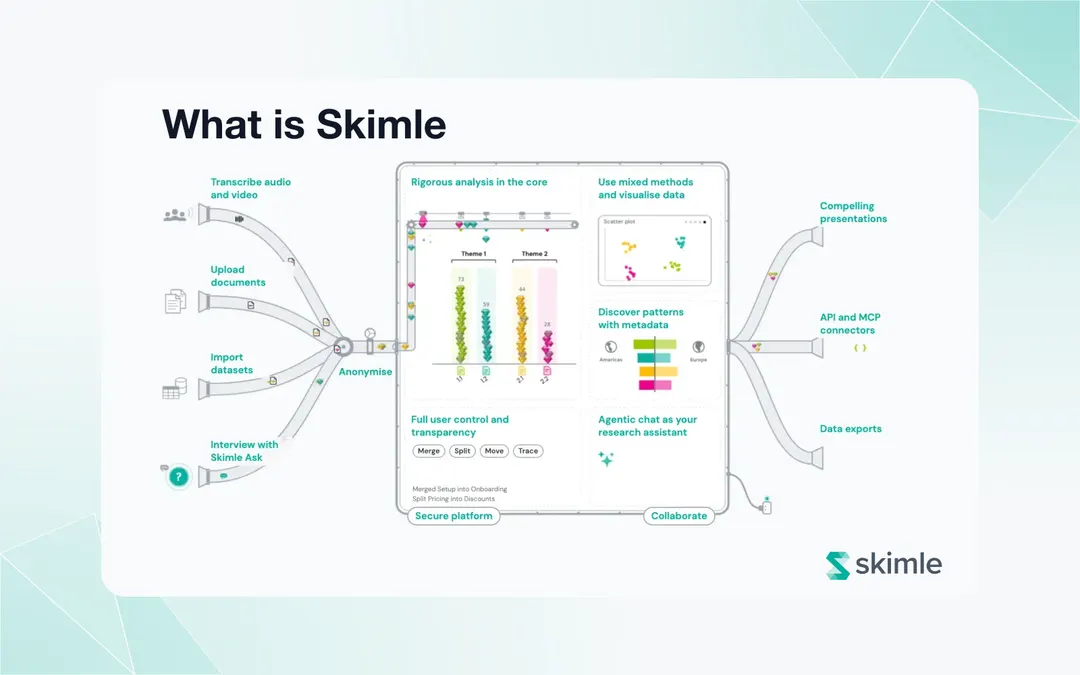
The Skimle machine is an interactive diagram on our features page that shows every part of the product as one connected system. Data flows in from the left through five intake pipes, passes through the analysis engine in the middle, and flows out on the right as presentations, exports and API connections. The whole machine sits on a secure, collaborative platform.
Click any part of the machine and the page scrolls to an explanation of that feature, with an illustration, the relevant help article and further reading. We built it because a list of features hides the most important thing about Skimle: the parts are designed to work together. A survey imported as a spreadsheet keeps its columns as metadata, the metadata drives group comparisons, the comparisons feed the agentic chat, and all of it exports cleanly to PowerPoint or NVivo.
What can you do with Skimle? All 15 features
Here is everything the machine contains, grouped the same way as on the features page. Each link takes you to that feature's section.
- Transcribe audio and video: drop in recordings of interviews, focus groups or meetings and get speaker-separated transcripts in over 100 languages, with the audio kept so every quote can be played back.
- Upload documents: PDF, Word, RTF and text files, from interview transcripts to reports and articles. Every document is read in full.
- Import datasets: bring in thousands of survey answers, reviews or support tickets from Excel or CSV. Each row becomes a document and the other columns become metadata.
- Interview with Skimle Ask: an AI interviewer that talks to hundreds of respondents at once, by text or voice, and asks follow-up questions like a human interviewer would.
- Anonymise: replace names, roles, places, organisations and dates with consistent pseudonyms before analysis, to meet ethics board and GDPR requirements.
- Rigorous analysis in the core: Skimle codes your data systematically, either inductively (themes emerge from the data), deductively (against your own framework) or agentically (answering a stated research question).
- Full user control and transparency: merge, split, rename and move categories, recode individual insights, and trace any finding back to its quote.
- Use mixed methods and visualise data: theme frequencies, word clouds, heatmaps and trends over time, all updating as you refine the analysis.
- Discover patterns with metadata: compare groups by role, region, segment or date. Skimle describes what separates them and ranks every split by the size of its effect.
- Agentic chat as your research assistant: an AI agent that reads and edits the same structured analysis you work on, and cites real quotes in every answer.
- Compelling presentations: PowerPoint decks and Word reports with theme summaries, charts and supporting quotes.
- API and MCP connectors: connect Skimle to Claude, Cursor and other AI agents through MCP, or to your own systems through the REST API.
- Data exports: export coded data to Excel, Word or REFI-QDA, which opens in NVivo, ATLAS.ti and MAXQDA.
Secure platform for collaborating
- Secure platform: data stored in the EU, encrypted in transit and at rest, never used to train AI models. Private cloud and SSO are available.
- Collaborate: invite colleagues, clients or supervisors into one shared project as editors or viewers.
How does Skimle analyse qualitative data?
The core idea is simple to state. Skimle reads every paragraph of every document, identifies the insights in it, and files each insight under a category, keeping the verbatim quote that supports it. The result is a grid of documents against themes that we sometimes describe as Excel for text: every cell can be opened, checked and changed.
For academic readers, this is systematic coding in the sense of thematic analysis: the AI does the first pass of coding at a speed no human can match, and the researcher stays the analyst who decides what the categories mean. Three design choices follow from that, and they are what separate Skimle from a chatbot with a file upload button:
- Every insight is grounded in a verbatim quote. After the AI picks a passage, ordinary code checks that the quote exists word for word in the source. Fabricated quotes cannot get through. We explain the full process in how the analysis works and in our post on hallucinations, limited context and black boxes.
- Every document is read, not sampled. Skimle does not rely on a search step that pre-selects "relevant" passages, so a theme that appears in unexpected wording is still found.
- The structure is persistent and editable. The coding is stored, so you can manage categories by hand, rerun parts of the analysis, and export the whole thing. We call this two-way transparency: from any theme down to its evidence, and from any document up to the themes it shaped.
These choices come from the criteria we set for ourselves before writing a line of code, which we published as design criteria for AI qualitative analysis tools. They matter most when the findings have to survive scrutiny: from a thesis committee, a client, or a board.
If your work is commercial research, see how this fits market research and customer insights teams, where a 30-interview study can go from recordings to a client-ready deck in days rather than weeks.
Who uses Skimle?
More than 1,500 researchers and analysts use Skimle, across 50+ universities, government bodies, research agencies and companies. They tend to fall into a handful of groups:
| Who | Typical data | What they use Skimle for |
|---|---|---|
| Academic researchers | Interview transcripts, field notes, literature | Thematic analysis, grounded theory, systematic coding with an audit trail, REFI-QDA export to NVivo |
| Market researchers and insight teams | Customer interviews, focus groups, open-ended survey answers | Fast thematic analysis, segment comparisons, client-ready decks |
| Consultants and investors | Expert calls, stakeholder interviews, due diligence documents | Synthesising dozens of interviews under deadline, with quotes to back every claim |
| HR and people teams | Engagement survey comments, exit interviews | Finding what drives turnover and engagement, by team or location |
| Product managers | User interviews, support tickets, reviews | Turning feedback into prioritised product themes |
| Public sector and policy | Consultation responses, stakeholder hearings | Analysing thousands of submissions transparently and fairly |
The common thread is volume plus accountability: more qualitative data than one person can read carefully, and a reader at the end who will ask "where does this come from?"
How is Skimle different from NVivo, ATLAS.ti or ChatGPT?
Qualitative tools now fall into roughly three camps, and Skimle sits deliberately between two of them.
| Traditional CAQDAS (NVivo, ATLAS.ti, MAXQDA) | General AI chatbots (ChatGPT, Claude, Gemini) | Skimle | |
|---|---|---|---|
| Who does the coding | The researcher, by hand | Nobody: the model summarises | AI codes every paragraph, the researcher reviews and edits |
| Time for 30 interviews | Weeks | Minutes | Hours, including review |
| Traceability to source | Full | Weak; quotes can be invented | Full; every quote verified verbatim |
| Coverage of long corpora | Full | Limited by context window | Full; every document read |
| Learning curve | Steep | None | Low |
| Exports to other tools | Proprietary formats, REFI-QDA | Copy and paste | Excel, Word, PowerPoint, REFI-QDA, API, MCP |
Skimle automates the coding that NVivo and ATLAS.ti leave to the researcher, while keeping the audit trail from every theme back to its quotes that a chatbot summary lacks. If you are comparing options in detail, our complete comparison of qualitative data analysis tools covers pricing and capabilities across nine products, and can ChatGPT analyse qualitative data? looks closely at where general chatbots fall short.
Skimle also plays well with the traditional tools rather than trying to replace them outright. Many academic users run the first pass of coding in Skimle and export to REFI-QDA to continue in NVivo or MAXQDA.
Why does qualitative analysis need a tool like this now?
Two trends are pushing in the same direction. The first is volume. According to ESOMAR, the global insights industry was worth about US$153 billion (€140 billion) in 2024, and research software was its fastest-growing part, at US$62 billion and 11.5% annual growth. More of that research is qualitative or open-ended than ever, because AI interviewing and online surveys make rich data cheap to collect.
The second is scrutiny. As AI-generated analysis spreads, readers have learned to ask whether a quote is real and whether the conclusion reflects the whole dataset or a convenient slice of it. AI interviews and online surveys have made qualitative data cheap to collect, but analysing it in a way you can defend still takes most of a project's time. That is the problem Skimle was built for, and the reason we connect qualitative research to your AI tools through MCP rather than asking you to paste transcripts into a chat window.
Frequently asked questions
What is Skimle used for?
Skimle is used to analyse qualitative data: interview transcripts, focus groups, open-ended survey responses, customer feedback, consultation responses and documents. It produces themes, insights and supporting quotes, compares groups using metadata, and exports the analysis to PowerPoint, Word, Excel or other qualitative software.
Is Skimle an AI tool?
Yes. Skimle is an AI-native qualitative data analysis platform. AI reads and codes every document, but every insight is checked against a verbatim quote in the source, and the researcher can review, edit and override the full coding structure.
Who makes Skimle?
Skimle is built by Skimle Oy, a Finnish company founded by Henri Schildt, a Professor of Strategy at Aalto University, and Olli Salo, a former McKinsey & Company partner. Read more about the team.
How much does Skimle cost?
Skimle starts from around $23 (€20) per user per month, with a free trial. See current pricing for plans, including team and enterprise options.
Is my data safe in Skimle?
Data is stored in the EU, encrypted in transit and at rest, processed in line with GDPR and never used to train AI models. Sensitive documents can be anonymised before analysis, and private cloud deployment and SSO are available for organisations that need them.
What languages does Skimle support?
Skimle transcribes and analyses data in over 100 languages, and can analyse a mixed-language corpus within a single project.
Want to see the machine for yourself? Explore the interactive Skimle machine, or try Skimle for free with a few of your own transcripts and see every insight traced back to its source.
Related reading:
- Skimle is the Excel for text
- Design criteria for AI qualitative analysis tools
- How to use agentic analysis in Skimle
- Gathering rich data with AI interviews: introducing Skimle Ask
About the authors
Henri Schildt is a Professor of Strategy at Aalto University School of Business and co-founder of Skimle. He has published over a dozen peer-reviewed articles using qualitative methods, including work in Academy of Management Journal, Organisation Science, and Strategic Management Journal. His research focuses on organisational strategy, innovation, and qualitative methodology. Google Scholar profile
Olli Salo is a former Partner at McKinsey & Company where he spent 18 years helping clients understand the markets and themselves, develop winning strategies and improve their operating models. He has done over 1000 client interviews and published over 10 articles on McKinsey.com and beyond. LinkedIn profile