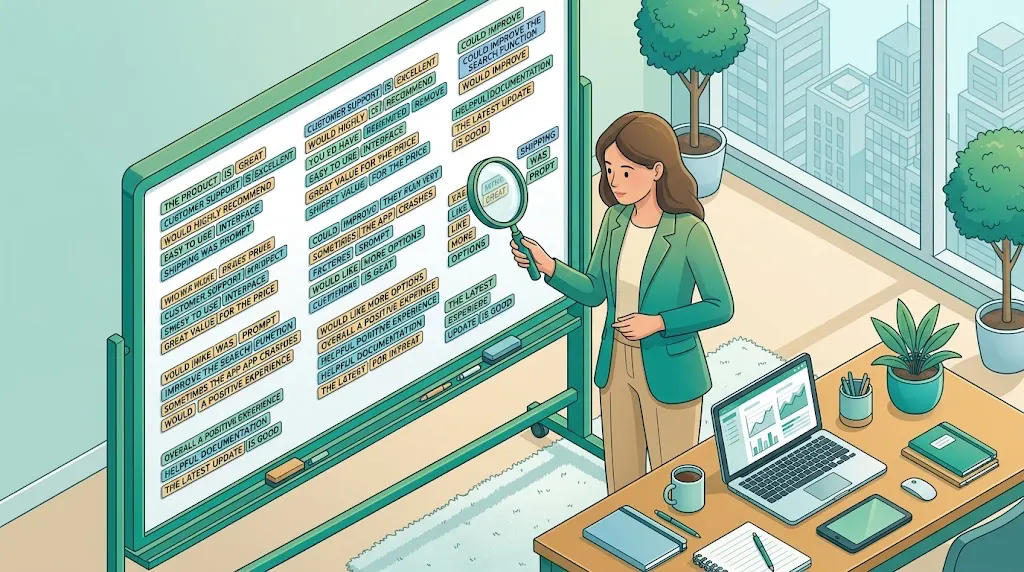
To analyse skip-level meeting notes at scale: collect notes or recordings in a consistent format across every session, code them for recurring themes (workload, manager relationship, growth, tooling, recognition), tag each note with metadata (team, location, tenure, manager), then look at which themes cluster by segment rather than reading notes one at a time. Tools like Skimle can process 40+ sets of skip-level notes and show which themes are systemic versus anecdotal, with every theme traceable back to the exact note it came from.
A VP who runs skip-level meetings properly ends up with a problem that almost no advice on skip-levels addresses: a stack of notes. Thirty, forty, fifty conversations across a quarter, each with a page or two of scrawled or typed observations. Somewhere in that pile is a real, fixable, systemic issue. It is sitting next to a dozen one-off complaints that matter to exactly one person and nobody else. The leader cannot tell which is which by re-reading their own notes, and they certainly cannot show their boss the evidence behind a claim like "three teams are hitting the same bottleneck" without doing what amounts to a research project on the side.
This is the part of skip-level practice that guides on running the meetings themselves tend to skip. Workology's guide to skip-level questions, Insperity's overview, and SHRM's preparation guidance all cover how to ask good questions and how to follow up with the individual employee. None of them cover what to do once you have done this 40 times and need to know what is recurring across the set.
What a skip-level meeting is for, briefly
A skip-level meeting is a conversation between a leader and an employee two or more levels below them, deliberately bypassing the direct manager. The point is to hear what gets filtered out before it reaches the top: workload reality, the actual state of a project, how a manager's decisions land on the ground, friction with tools or processes that nobody escalates because it seems too small to mention.
SHRM frames the practice as serving two functions: casual sessions to gauge sentiment, and targeted interventions when a department shows signs of trouble like turnover or disengagement. PerformYard's guide recommends running them once or twice a year, 30 to 45 minutes each, with the agenda shared in advance so employees can prepare. That cadence is sound for a single leader-employee relationship. It is also exactly what produces the volume problem: a director with eight direct reports, each with five or six people of their own, running even one skip-level per person per year generates 40 to 50 conversations to make sense of.
This post does not repeat that setup advice. For the data collection side, the exit interview and 360 feedback playbooks are close cousins worth reading: exit interview analysis covers structuring sensitive one-to-one conversations for honesty, and how to analyse 360 feedback covers separating one rater's opinion from a pattern across many raters, which is the same problem skip-level notes create at larger scale.
Why skip-level notes are different from exit interviews and engagement surveys
It is worth being specific about what makes this problem distinct, because the three data sources get conflated and the differences matter for how you analyse them.
| Data source | Who talks | When | Main distortion risk | Typical volume per leader per year |
|---|---|---|---|---|
| Exit interview | Departing employee | Once, at the end | Diplomatic answers to protect references | Tied to attrition rate |
| Engagement survey | All employees | Annual or quarterly pulse | Anonymity reduces specificity; closed questions limit depth | Hundreds, but mostly quantitative |
| Skip-level meeting | Current employee, 2+ levels down | Ongoing, scheduled | Filtered through what feels safe to say to a senior leader; notes are unstructured | 20-60+ |
Skip-level notes are unique in three ways. First, the employee is still employed and still reports, indirectly, to the person in the room, so the candour profile is different from an exit interview, closer to careful-but-forthcoming than fully open. Second, the data is collected by the leader themselves, usually as free-text notes taken during or after the conversation, not through a structured survey instrument. Third, and this is the part that creates the analysis problem, the leader is the one who has to make sense of their own notes, usually without any tooling built for the job. A people analytics team rarely owns this data the way they own survey or exit data, so it sits in a leader's notebook or a personal document, un-aggregated and un-coded.
Why 40 sets of notes defeats manual review
Reading is not the bottleneck for one skip-level. It is the bottleneck for forty. A leader doing skip-levels seriously, taking three to five minutes of notes per conversation across 40 to 50 sessions a quarter, accumulates tens of thousands of words of qualitative data with no structure connecting one note to another.
The problems this creates are familiar to anyone who has tried to manually track open-ended feedback at volume:
Recency bias. The themes a leader remembers are the ones from the last five or six conversations, not the ones spread evenly across the quarter. A bottleneck mentioned by three people in February and one person in May looks, from memory, like a single May complaint.
No consistent vocabulary. One note says "the new ticketing system is slow." Another says "IT requests take forever now." Another says "support tickets sit for days." These are very likely the same theme, described three different ways, and without deliberate coding they will never be counted as the same thing.
No segmentation. Even if a leader correctly identifies that "tooling friction" is a recurring theme, they cannot easily answer the next question their own boss will ask: is this everywhere, or specifically in the teams that migrated to the new system in March? Answering that from memory or from a stack of paper notes is not realistic at this volume.
Survivorship of the loudest voice. A vivid, emotionally charged complaint from one conversation sticks in memory far more than a flat, recurring observation mentioned calmly five separate times. The flat, recurring observation is usually the one that matters more.
This is the same structural problem that drives employee survey open-text analysis at scale, and the same reason organisations turn to discovering themes using metadata variables rather than reading every response individually. The volume in skip-level data is smaller than a company-wide survey, but the lack of structure is worse, because nobody designed a coding scheme before the notes were taken.
How does AI analysis tell systemic issues from one-off complaints?
This is the actual question a leader is asking when they say they cannot make sense of their notes, and it has a concrete answer.
Systemic issues show up in the data as convergence: the same underlying theme, described in different words, by different people, in different teams or locations, without those people having coordinated with each other. One-off complaints show up as isolation: a specific, often vivid, concern raised by one person that nobody else mentions, even people in directly comparable roles.
Distinguishing the two requires three things working together:
- Consistent coding. Every note has to be analysed against the same set of themes, not whatever vocabulary each note happened to use. "Slow IT response," "ticketing backlog," and "support requests take forever" need to collapse into one theme before frequency means anything.
- Frequency with denominators. "Five people mentioned this" is meaningless without knowing the mentions came from five different conversations out of 40, versus five mentions across 10 conversations because one team is unusually vocal. The denominator is what separates a real signal from noise.
- Segment-aware counting. The same theme appearing once each in four unrelated teams is a different finding from the same theme appearing four times in one team. The first suggests an organisation-wide issue; the second suggests a team-specific or manager-specific one.
Skimle's thematic analysis does this by processing every skip-level note as a document in a single project, building a shared category structure across all of them, and counting theme frequency against the full set rather than against whatever the leader happens to remember. Each theme stays linked to the specific quote and note it came from, so "this is recurring" is never just an assertion. The categories and insights view shows exactly which notes contributed to a theme and how often, which is the difference between "I think this is a pattern" and being able to show the pattern.
Segmenting by team, location, and tenure
The real value of analysing skip-level data at scale is not the theme list itself. Most experienced leaders could guess the top five or six themes correctly from memory: workload, growth, manager relationship, tooling, recognition, and ambiguity about priorities show up in almost every organisation. The value is knowing where each theme concentrates.
Before importing notes, tag each one with the metadata that will let you slice the findings later: team, location, employee tenure, manager, function, and the quarter the conversation happened in. This is the same approach covered in discovering themes in the data using metadata variables: metadata variables turn a flat pile of qualitative notes into something you can cross-tabulate.
With that structure in place, the questions a skip-level programme exists to answer become directly answerable:
- Is "unclear priorities" a company-wide theme, or specific to the two teams that went through a reorganisation in Q1?
- Do tenure-under-one-year employees raise different concerns than tenure-over-three-years employees?
- Is a tooling complaint concentrated under one manager, or spread evenly, which would suggest the tool itself rather than how a particular manager is rolling it out?
- Did a theme that was prominent last quarter persist, worsen, or resolve this quarter?
A leader who can answer the first question with evidence, rather than impression, is in a fundamentally different position when they raise it with their own boss. "I think there's a tooling problem" invites scepticism. "Four out of five teams that migrated to the new ticketing system in March raised response-time complaints in their skip-levels, and no team that has not migrated raised it" is a finding, not an opinion.
Should leaders record skip-level meetings instead of taking notes?
Where consent and policy allow it, recording (with the employee's knowledge and agreement) produces a meaningfully better data source than notes taken live or reconstructed afterward. Notes are a compressed, filtered version of what was said, shaped by what the leader thought was important in the moment. A transcript captures the actual language, including the hedges, the specific examples, and the things mentioned in passing that a note-taker would have left out as seemingly minor.
The trade-off is candour. Some employees will be more guarded if they know the conversation is recorded, even with assurances about confidentiality, particularly when discussing their direct manager. Skimle Ask is relevant here for a different reason than it is in exit interviews: it is not about replacing the leader's conversation (a skip-level only works because the leader is in the room) but about transcription quality once a recording exists. Uploading a recorded skip-level conversation for transcription, with consent in place, gives you the same raw-language fidelity in your dataset without the leader needing to take detailed notes during the conversation itself, which also means the leader can focus on listening rather than writing.
For organisations that decide notes are the more practical or more appropriate route given trust and policy considerations, the analysis approach in this guide works identically. The input format (note or transcript) matters less than whether it is collected consistently and coded against a shared theme structure.
What recurring themes typically look like across skip-level data
Across organisations that run skip-levels systematically, a small set of theme categories recur. Knowing the categories in advance makes coding faster and more consistent, even with an inductive, bottom-up approach.
Manager-employee relationship quality. Distinct from "is the manager liked" (this is about whether feedback flows both ways, whether the manager follows through on commitments, and whether the employee feels their manager represents their interests upward).
Workload and resourcing. Whether the stated workload matches the resourcing the team actually has, and whether this is acknowledged by leadership or treated as an individual performance issue.
Growth and visibility. Whether the employee believes their work is visible above their direct manager, and whether they see a path to advancement that does not depend entirely on that one manager's advocacy.
Process and tooling friction. Specific, often small, obstacles in day-to-day work that nobody above the immediate team has visibility into, because they are individually too minor to escalate but collectively waste meaningful time.
Decision transparency. Whether the rationale behind decisions that affect the team (reorganisations, priority shifts, resourcing changes) reaches the team, or whether decisions arrive without explanation.
Trust in leadership communication. Whether what leadership says in town halls or all-hands meetings matches what the employee experiences day to day. This is often the most senior-leader-relevant theme, because it speaks directly to whether the leader's own messaging is landing. A Leadership IQ survey of 27,048 executives, managers, and employees found that only 15% believe their organisation "always" openly shares the challenges it faces, and employees who do report this are roughly ten times more likely to recommend their employer. Skip-level conversations are one of the few channels positioned to close that gap directly.
A 2025 Gallup analysis of management span of control found that the average number of people reporting to a manager rose from 10.9 in 2024 to 12.1 in 2025, a nearly 50% increase in typical team size since Gallup began tracking the measure in 2013. Wider spans of control mean each manager has less individual attention to give, which is precisely the condition that makes filtering and information loss between an employee and senior leadership more likely, and skip-level conversations more valuable as a corrective.
Frequently asked questions
How often should a leader run skip-level meetings to get useful aggregate data?
Quarterly cycles work better for trend analysis than once-a-year programmes, because a single annual round only tells you what was true at one point in time. Running even a subset of skip-levels each quarter, rotating through different teams, lets you see whether a theme from Q1 persisted into Q2 or resolved. PerformYard's guidance recommends one or two sessions per employee per year as a baseline; running them on a rolling quarterly schedule across a larger group achieves a similar total volume with better visibility into trends.
How many skip-level notes are needed before a theme counts as systemic rather than anecdotal?
There is no fixed threshold, but a useful rule of thumb is to look for a theme appearing in conversations from at least three different teams or managers, not just three different people on the same team. A theme repeated five times within one team under one manager is evidence about that manager. The same theme appearing once each across five unrelated teams is evidence about something organisation-wide.
Should skip-level notes be shared with the employee's direct manager?
The specific content should not, as a rule, be attributed back to the individual, to protect the psychological safety that makes the conversation useful in the first place. Aggregate, de-identified themes (at the team or department level, once there is enough volume to anonymise individual contributions) can and should be shared, because the manager is usually the person positioned to act on them.
Can skip-level meeting analysis replace an engagement survey?
No. They serve different purposes and have different strengths. Engagement surveys give you breadth, usually anonymous, across the full population, with strong statistical comparability over time. Skip-level conversations give you depth and specificity from a smaller, named sample, with the leader able to ask a direct follow-up question. The two work best combined: use survey data to spot where scores are low, and skip-level conversations to understand the specific mechanism behind a low score in a given team.
What is the best way to keep skip-level data confidential while still analysing it for themes?
Code or pseudonymise direct identifiers before broad analysis, and restrict access to the underlying notes to the leader and whoever directly supports the analysis. Skimle's anonymisation feature can mask names and identifying details in uploaded notes or transcripts while preserving the substance needed for theme analysis, which is useful when skip-level data needs to be shared more broadly than the leader's own files, for example with an HR business partner helping interpret the findings.
Turning a quarter of conversations into evidence
The leadership advice on skip-level meetings is not wrong. Asking good questions, creating psychological safety, following up visibly, all of that matters and a leader who skips it will get shallow, unreliable data no matter how it gets analysed afterward. But good questions and good follow-up only solve the collection problem. They say nothing about what happens once a leader has 40 sets of notes and a board meeting where they need to say something more substantial than "people seem generally okay, though a few mentioned workload."
The leaders who get the most value from skip-level programmes are the ones who treat the notes as a dataset, not a diary. That means consistent format, consistent tagging by team and tenure and location, and a coding process applied evenly across every conversation rather than recalled selectively from memory. Once that structure exists, the question "is this systemic or anecdotal" stops being a judgement call and becomes something you can show, quote by quote, theme by theme, to anyone who asks for the evidence.
For a deeper treatment of how to structure metadata before analysis begins, see discovering themes in the data using metadata variables. For the broader case on presenting qualitative findings credibly to sceptical senior audiences, see presenting qualitative research findings to executives.
Ready to turn a quarter's worth of skip-level notes into evidence? Try Skimle for free and run a thematic analysis across your skip-level conversations, segmented by team, location, or tenure, with every theme traceable back to its source note.
Related reading:
- How to analyse exit interviews: turning departures into a retention strategy
- How to analyse 360 feedback: moving from report to development priorities
- Discovering themes in the data using metadata variables
If you work in HR or people analytics more broadly, see how Skimle fits HR and people teams for the wider set of workflows it supports beyond skip-level analysis.
About the authors
Henri Schildt is a Professor of Strategy at Aalto University School of Business and co-founder of Skimle. He has published over a dozen peer-reviewed articles using qualitative methods, including work in Academy of Management Journal, Organisation Science, and Strategic Management Journal. Google Scholar profile
Olli Salo is a former Partner at McKinsey & Company where he spent 18 years helping clients understand their markets, develop winning strategies and improve their operating models. He has done over 1000 client interviews and published over 10 articles on McKinsey.com and beyond. LinkedIn profile