The most useful win-loss interview questions are open-ended, time-anchored, and organised by topic: buying process, competitive evaluation, pricing perception, internal dynamics, and product fit. A structured bank of 40+ questions, grouped by theme and used in a consistent 30-minute format, makes patterns visible across dozens of calls. Tools like Skimle can then synthesise responses across the full programme and surface what's actually driving wins and losses.
Win-loss research is one of the most underused intelligence sources in B2B. Sales teams debrief deals routinely, but the picture they get is partial. A salesperson who lost a deal to a competitor tends to remember the competitor's pricing. The buyer, if asked, often tells a different story.
Research from Corporate Visions found that sellers and buyers give different reasons for deal outcomes 50 to 70 per cent of the time. Clozd, which runs dedicated win-loss programmes, puts the figure even starker: buyer and seller accounts of lost deals align only around 15 per cent of the time.
The gap exists because salespeople are close to the deal. They interpret signals through their existing beliefs about why deals are won or lost. Buyers, freed from that relationship after the decision, are often far more candid.
Win-loss interviews bridge that gap. But only if the questions are good. This post gives you a bank of 40+ questions you can use directly, organised so you can pick the right ones for your call, along with a guide to running the session, handling surprises, and coding responses consistently across a programme.
For a broader overview of building a win-loss programme from scratch, see our guide on win-loss analysis as a systematic discipline.
What makes a good win-loss interview question?
Four properties separate questions that generate insight from questions that generate noise.
Open-ended. Any question that can be answered with "yes" or "no" will be answered with "yes" or "no." "Was price an issue?" invites closure. "How did you think about pricing as you worked through the decision?" invites reflection. Structure your questions so the shortest possible answer is still a sentence.
Non-leading. Questions that contain their own answer (for example, "did our competitors offer better integrations?") prime the respondent to confirm rather than explore. Keep the options out of the question. If you want to know about integrations, ask "what technical factors mattered most to your team?"
Specific. Abstract questions produce abstract answers. "What was your overall impression?" generates less signal than "when you were walking your CFO through the shortlist, what did you tell her about each vendor?" Specificity grounds the respondent in a moment they can actually recall.
Time-anchored. Memory is reconstructive. Asking someone what they thought six months ago will produce a version of the story shaped by what happened next. Use time markers such as "at the point when you first started evaluating vendors" or "when you got to final negotiations" to pull the respondent back to the decision as it unfolded rather than as they now remember it.
For more on question design across interview types, see our guide on what makes a good interview question and the companion piece on writing a good interview guide.
The win-loss question bank
The questions below are numbered and grouped by topic. A typical 30-minute call will cover 10 to 15 questions at depth. Use the full bank as a reference, then select the questions most relevant to each call type.
Buying process questions
These questions map how the evaluation actually unfolded. Understanding the sequence, participants, and criteria is foundational: everything else is downstream of the process.
- How did the search for a solution start? What triggered the evaluation at that particular point?
- Who was the first person inside your organisation to decide that this needed solving?
- Walk me through the timeline from when you first started looking to when you made the final decision.
- Who was involved in the evaluation process across your team? What roles did they play?
- Were there people whose approval you needed who weren't directly involved in the day-to-day evaluation?
- How did you build your initial shortlist of vendors? What sources did you use?
- What criteria were most important to your team when you were comparing options? How did those shift over the course of the evaluation?
- How formal was the evaluation process? Did you use a scoring framework, an RFP, or something more informal?
- At what point did you feel you had enough information to make a decision?
- Looking back, was there a moment in the process where the outcome felt like it shifted in one direction or another?
- Were there any points where the evaluation stalled or got stuck? What happened?
- How did you communicate the final decision internally, and what information did you use to make the case?
Competitive evaluation questions
These questions surface how your organisation was positioned relative to alternatives and what tipped the balance. For posts on competitive intelligence more broadly, see our guide on CI from customer interviews and win-loss calls.
- Which vendors made it to your final consideration set? How many did you seriously evaluate?
- How did you first hear about each vendor you considered?
- What was your perception of [our company] at the start of the evaluation?
- How did that perception change, if at all, during the process?
- Were there vendors you ruled out early? What made them easy to eliminate?
- How would you describe the differences you perceived between the vendors on your shortlist?
- What did [our company] do particularly well compared to the others you were considering?
- Where did you feel [our company] was weaker than the alternatives?
- Was there a moment when the balance shifted clearly towards the vendor you chose? What happened?
- If you chose a competitor, what would it take for you to reconsider [our company] for a future evaluation?
Pricing perception questions
Pricing questions are among the most sensitive and most valuable. Ask them after you have established rapport and gathered enough context to interpret the answers.
- How did you approach pricing during the evaluation? Was it an early filter or something you worked through later?
- How did [our company]'s pricing compare to what you expected before you saw it?
- When you compared pricing across the vendors on your shortlist, how did you think about value for money?
- Were there aspects of our pricing structure that felt unclear or complicated?
- If you chose a competitor, was pricing a significant factor in that decision? How significant?
- Was there a price point at which [our company] would have been an easy choice, or was it more about the overall value proposition?
Champion and internal buying dynamics questions
Most B2B deals are won or lost inside the buyer's organisation before any vendor gets credit or blame. These questions surface those internal dynamics.
- Was there a particular person inside your team who was advocating strongly for one solution or another?
- How did different stakeholders across your team feel about the options? Were there significant differences in view?
- What objections came up internally about [our company]? How were they handled?
- What did the person most enthusiastic about [our company] find most compelling?
- What gave the people most sceptical about [our company] pause?
- Was there a buying committee or group that had to sign off? How did they reach alignment?
- What would have made it easier for someone inside your team to champion [our company]?
- Were there any concerns raised about risk (implementation risk, vendor risk, or switching risk)? How did those factor in?
Product and feature questions
These questions should be grounded in what the buyer was actually trying to accomplish, not in your feature list. The goal is to understand the job they were hiring the solution to do.
- What were the two or three capabilities your team cared most about when you were evaluating?
- Were there specific features or integrations that were non-negotiable for you?
- During demos or trials, what impressed you most about [our company]?
- Were there things you expected to see in the product that weren't there, or that worked differently from what you anticipated?
- How did the onboarding or implementation experience factor into your decision?
- If you ended up choosing a competitor, what did their product do that ours didn't, or do noticeably better?
- Looking back, is there anything about [our company]'s product that you wish had been communicated more clearly?
- Are there capabilities you're using now (with whichever vendor you chose) that you weren't thinking about at the start of the evaluation?
How to structure a 30-minute win-loss call
A 30-minute call is tight enough that buyers will agree to it, and long enough to get real depth if you plan the time carefully.
Opening (2 minutes)
Thank the interviewee for their time. Explain the purpose briefly: "We're running a programme to understand how buyers experience the evaluation process, so we can improve how we work. There are no right or wrong answers. I'm much more interested in what actually happened than in anything that reflects well or badly on either of us." Set the expectation that you'll be listening more than talking.
Confirm whether they are comfortable with notes or recording. Win-loss calls rarely need verbatim transcripts, but having an audio record means you can concentrate on the conversation rather than capturing every word.
For guidance on the mechanics of conducting the call itself, see our piece on effective business interviews.
Context-setting (3 minutes)
Before diving into questions, briefly restate what you know: the deal timeline, who was involved on both sides, and the outcome. Ask the interviewee to correct or add to your understanding. "I have us as having been in conversation from around March to May, with a decision at the end of May. Does that match your recollection?" This grounds the conversation in the shared reality of the deal.
Main body (20 minutes)
Move through your question set in roughly the order the events happened: how the evaluation started, who got involved, how the shortlist was built, how competitors were evaluated, how the final decision was made. Resist the urge to jump to what you most want to know. Respondents who feel rushed tend to give shorter answers and stay on safe ground.
Allow 3 to 4 minutes per question cluster. For a 30-minute call, plan for 5 to 6 clusters. Build in explicit pauses after each: a beat of silence after a substantial answer usually prompts the most useful follow-up from the interviewee.
Closing (5 minutes)
End with two standard questions. First: "Is there anything I haven't asked about that you think would be useful for me to understand?" This surfaces what the respondent has been holding back or waiting for permission to say. Second: "If you were advising [our company] on one thing to change about how it presents itself to potential buyers, what would that be?"
Thank them, confirm whether they'd be willing to be contacted again if follow-up questions arise, and close.
What to do when the interviewee goes off-script
Win-loss interviews regularly produce unexpected turns. The interviewee starts talking about a relationship problem with your AE, or the way your team handled pricing negotiations, or an internal political dispute that had nothing to do with the product. What you do next matters.
Follow the tangent first. Unexpected topics are almost always signal. If a buyer is volunteering information you didn't ask for, that information is salient to them, which means it influenced the decision even if it doesn't fit your question structure. Let it run for 60 to 90 seconds. Ask one follow-up: "Can you say a bit more about that?" or "How much did that factor into the final decision?"
Steer back deliberately. After the tangent has run its course, return to your structure: "That's really helpful. I want to make sure I ask you about the competitive evaluation before we run out of time. When you were comparing us to the other vendors on your shortlist, what were the biggest differences you perceived?" A firm but natural redirect is always better than abandoning the structure entirely.
Note what triggered it. After the call, record the point in the conversation where the tangent arose. If the same topic comes up unprompted in multiple calls, it is telling you something your question structure isn't capturing.
How to code win-loss interviews consistently across a programme
A single win-loss interview is informative. Twenty of them, coded consistently, start to show which factors actually drive deal outcomes. The difference between an ad-hoc call and a systematic programme is how rigorously you structure the analysis.
Use a fixed codebook
Define your codes before you start analysing. Typical win-loss codebooks include categories such as: product fit, pricing perception, implementation concerns, competitive positioning, champion strength, buying process complexity, relationship quality, and reference quality. Skimle's predefined categories feature lets you build a structured codebook and apply it consistently across every transcript in your programme, so you're comparing like with like.
Each category should have a clear definition and at least one example quote. Without those guardrails, the same quote gets coded differently by different analysts, and your aggregate patterns are noise rather than signal.
Capture consistent metadata on every document
Every call should be tagged with the same set of variables: deal outcome (win / loss / churn), deal size band, industry segment, primary competitor (if known), and region. These variables let you slice the analysis when you have enough calls to see patterns.
"We lose in financial services when the primary competitor is [X]" is an actionable finding. "We sometimes lose on pricing" is not. The difference is metadata. Skimle's metadata system makes it straightforward to add these variables to each document and then filter or cross-tabulate in the analysis view.
Review your codebook regularly
As the programme matures, new themes emerge that your initial codebook didn't anticipate. Build in a quarterly review to check whether categories are still earning their place and whether new codes need to be added. Skimle's agentic analysis can surface unexpected themes across the call corpus and prompt you to refine your framework.
If you're working on a consulting engagement where win-loss interviews are part of a broader primary research programme, see our guide on systematic primary research for consulting projects.
Sample question sequences for 2 common scenarios
The question bank above is a reference. Here are two sequenced sets for specific call types.
Scenario A: Lost deal to a named competitor
Use this sequence when you know which competitor won and want to understand the decision clearly.
| # | Question | Purpose |
|---|---|---|
| 1 | How did the evaluation start, and what was driving the timing? | Establish context |
| 2 | Who was involved in the decision across your team? | Map the buying committee |
| 3 | How did you build the shortlist, and how did [competitor] and we end up on it? | Understand sourcing |
| 4 | At the point when you were comparing us directly to [competitor], what were the main differences you perceived? | Core competitive question |
| 5 | Were there capabilities or aspects of [competitor]'s offering that were particularly compelling? | Product signal |
| 6 | How did pricing factor in? Was it a primary driver or more of a secondary consideration? | Pricing reality-check |
| 7 | Was there a particular moment when the decision tilted clearly one way? | Decision moment |
| 8 | Was there anything about how we presented ourselves or ran the sales process that made the decision easier or harder? | Process signal |
| 9 | If you were to evaluate vendors again for a similar problem, what would we need to do differently to have a stronger shot? | Forward-looking |
Scenario B: Churned customer (lost after 3 months)
Early churn is a different signal from a competitive loss. The questions shift towards onboarding, value realisation, and the gap between expectations and reality.
| # | Question | Purpose |
|---|---|---|
| 1 | Can you walk me through what you were hoping to accomplish when you first started using [our product]? | Establish intent |
| 2 | How did the onboarding process feel from your side? Was it what you expected? | Onboarding experience |
| 3 | At what point did you start to feel things weren't working as you'd hoped? | Identify the inflection point |
| 4 | Were there specific use cases or workflows where the product wasn't meeting your needs? | Product gaps |
| 5 | Was there a particular moment or event that prompted the decision to stop? | Decision trigger |
| 6 | Did you look for alternatives, or did you decide to go without a solution for now? | Competitive context |
| 7 | Was there anything our team could have done differently during the first few months to change the outcome? | Process and support signal |
| 8 | Is there a version of [our product] that you'd consider coming back to? | Retention intelligence |
Frequently asked questions
How many questions should you ask in a win-loss interview?
Plan for 10 to 15 questions across a 30-minute call, but expect to cover fewer in depth. Quality matters far more than quantity. Two follow-up questions on a rich answer give you more signal than five surface-level questions covered quickly. Keep the full bank as a reference and select based on what matters most for each call type.
Who should conduct win-loss interviews: your own team or a third party?
Both approaches work, but they produce different responses. Buyers are often more candid with a neutral third party, particularly about relationship issues and pricing. In-house interviewers, on the other hand, know the deal context well and can ask sharper follow-up questions. For programmes of 20 or more calls, many organisations use a hybrid: a research partner conducts the interviews, while internal analysts do the coding and synthesis. Consultants running win-loss programmes on behalf of clients can find a relevant workflow at the consultants and investors use case page.
For high-stakes programmes where buyer candour is the priority, a third-party interviewer is usually the better choice. Clozd's 2025 State of Win-Loss report found that companies running dedicated win-loss programmes for more than two years reported an 84 per cent win-rate improvement rate, compared to 63 per cent for all programme operators. Structural rigour, including who conducts the interviews, contributes to that gap.
How do you get buyers to agree to a win-loss interview after a lost deal?
Shorter requests get higher acceptance rates. Frame the ask as 20 to 30 minutes, make it clear the conversation is about improving your product and process rather than re-opening the sales conversation, and send the request from someone who wasn't directly involved in the deal (often a product or research function). Where possible, give the buyer a reason to care: many buyers will help if they have a genuine interest in the vendor improving. A third-party researcher making the outreach often increases response rates because it signals that the conversation is about learning rather than selling.
How many win-loss interviews do you need before patterns emerge?
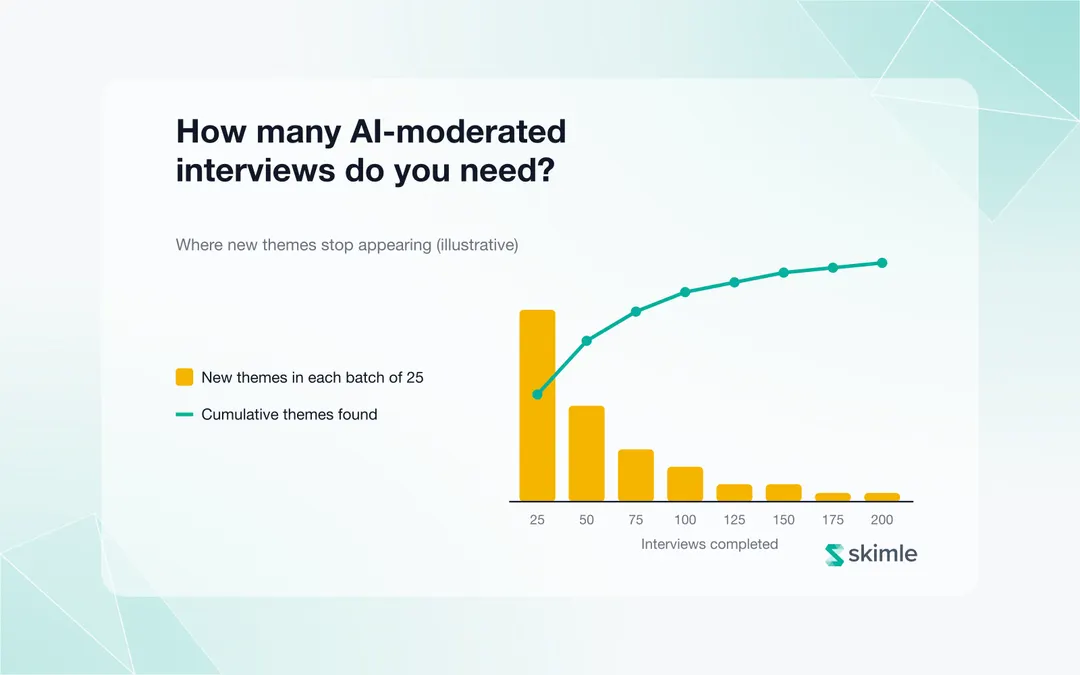
For a first read of patterns, 8 to 10 interviews of the same type (for instance, 10 competitive losses to a specific competitor) usually surfaces the main themes. For reliable trends that can inform strategy, 20 to 30 calls per segment is a more useful threshold. Sample size interacts with segmentation: 20 interviews across five different segments gives you thin evidence in each; 20 interviews within a single segment gives you something you can act on. See our guide on sample size in qualitative research for a fuller treatment of when patterns become reliable.
Start your own win-loss programme
The questions in this post are ready to use. Pick the sequence that fits your next call, add the metadata fields that matter to your programme, and start coding from day one.
Want to synthesise win-loss interviews at scale? Try Skimle for free and see how structured AI analysis turns a corpus of call transcripts into consistent, citable findings, with every insight linked back to the underlying source.
Related reading:
- Win-loss analysis: how to systematically learn from deals
- How to conduct effective business interviews
- Competitive intelligence from qualitative research
- Qualitative pricing research: willingness-to-pay interviews
About the author
Olli Salo is a former Partner at McKinsey & Company where he spent 18 years helping clients understand the markets and themselves, develop winning strategies and improve their operating models. He has done over 1000 client interviews and published over 10 articles on McKinsey.com and beyond. LinkedIn profile