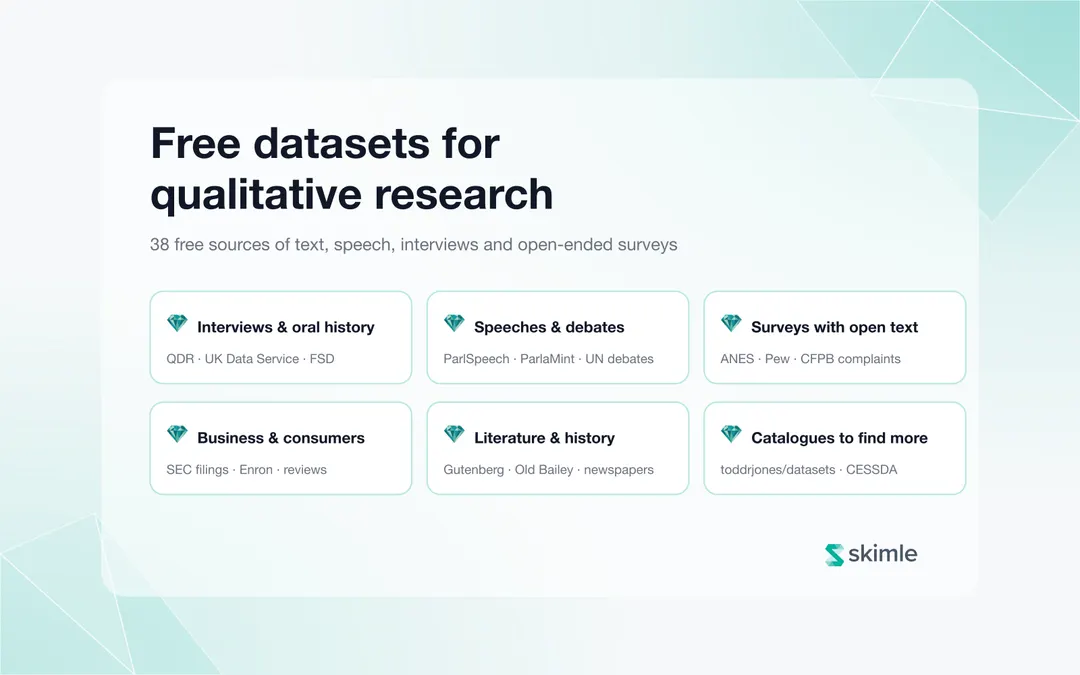
The best free datasets for qualitative research are interview archives such as the Qualitative Data Repository and the UK Data Service, speech corpora such as ParlSpeech and the UN General Debate Corpus, surveys with open-ended answers, public complaint and review collections, and literary archives such as Project Gutenberg. Catalogues like Todd Jones's social science dataset list help you find more.
Collecting your own interviews is not always possible. A thesis may need to start before ethics approval arrives, a methods course needs material students can analyse in a week, and some questions (how parliaments talk about migration over 30 years, what consumers complain about after a price rise) can only be answered from data that already exists. Secondary qualitative analysis has a long tradition, and the amount of text, audio and video now available for free is larger than any single researcher could read.
This guide lists 38 free datasets and 10 catalogues for finding more, grouped by the kind of research they suit: interviews and oral histories, political speech, surveys with open-ended answers, business and consumer text, and literature and history. Most are qualitative or mixed methods; a few purely quantitative datasets are included because they pair well with text as context or metadata.
Why are large qualitative datasets now practical to analyse?
The traditional limit on secondary qualitative work was not access but reading time. Coding a few dozen interview transcripts by hand takes weeks, so a corpus of 6 million speeches or 50,000 open-ended survey answers was out of reach for anyone without a team.
Tools like Skimle change that arithmetic. Skimle reads every document in a corpus, codes it into categories with verbatim quotes that link back to their source, and keeps the structure editable so the researcher stays in charge of what the categories mean. Because spreadsheet columns become metadata, the same project can hold the text and the numbers: party, year and country next to each speech, or a satisfaction score next to each open-ended answer. That makes mixed methods designs practical at scale, comparing how themes differ between groups or shift over time with metadata analysis.
If you work in academic research, see how Skimle fits an academic workflow.
Where can you search for more datasets?
Before the lists, a word on catalogues. No single list stays complete for long, so it pays to know where new datasets are announced.
| Catalogue | What you find there | Best for |
|---|---|---|
| Todd Jones's datasets list | A curated GitHub list of 100+ free social science datasets in 28 topics (crime, education, health, politics, employment and more), maintained and updated over time | Finding the quantitative context to pair with text, and gems such as the LocalView meeting transcripts |
| CESSDA Data Catalogue | One search across Europe's national social science data archives | European surveys and interview collections |
| Harvard Dataverse | Replication data from thousands of published studies | Text corpora released alongside journal articles |
| Zenodo | An open repository run by CERN for any research output | Smaller corpora and project data from European research |
| Google Dataset Search | A search engine across dataset repositories | Checking whether a niche dataset exists |
| Kaggle Datasets | Community-uploaded datasets, many with text columns | Reviews, social media and quickly usable CSVs (check the licence and origin) |
| Hugging Face Datasets | Text and speech datasets prepared for machine learning | Large, cleaned text collections |
| ConvoKit | Cornell's collection of conversational corpora | Dialogue data: court oral arguments, online discussions, film scripts |
| Awesome Public Datasets | A long community list across every field | Browsing for ideas outside the social sciences |
| data.europa.eu | The EU's official open data portal | Public sector documents and consultations |
Todd Jones's list deserves a special mention. It leans quantitative, but that is what makes it useful to a qualitative researcher: the strongest designs often combine a text corpus with structured data on the same people, places or years, and the list is a fast way to find that second half.
Which archives hold interviews and oral histories?
These are the closest substitute for collecting your own interviews. Many archived collections require free registration and an end-user licence, because participants consented to research use rather than open publication. Read the conditions before you download.
| Dataset | What it contains | Good for |
|---|---|---|
| Qualitative Data Repository (QDR) | A US repository at Syracuse University for interview, focus group and document data from social science studies | Political science and sociology secondary analysis |
| UK Data Service | The UK's largest social science archive, including many qualitative collections (interviews, diaries, focus groups) searchable through its QualiBank | Health, work, family and social policy research |
| Finnish Social Science Data Archive (FSD) | Qualitative and survey data from Finnish research, many collections in English as well as Finnish | Nordic comparisons and welfare state research |
| Timescapes Archive | Qualitative longitudinal studies following the same people over years | Life course, family and transition research |
| Global Feminisms Project | Video interviews with activists and scholars in Brazil, China, India, Nicaragua, Poland, Russia and the United States | Social movements, gender studies, video analysis |
| Veterans History Project | The Library of Congress collection of first-hand accounts from US war veterans | Oral history, memory and trauma research |
| StoryCorps Archive | Recorded conversations between ordinary people about their lives | Narrative analysis and everyday experience |
| CORAAL | Audio and transcripts of sociolinguistic interviews with African American speakers | Language, identity and community research |
| Murray Research Archive | Harvard's archive of longitudinal case histories and interview studies, now within Harvard Dataverse | Developmental and life course psychology |
Interview data arrives as transcripts (PDF, Word or text) or as recordings. Both can be analysed directly: Skimle transcribes audio and video with speaker separation before coding it.
Which datasets cover political speech and debate?
Political text is the richest free qualitative resource there is, because parliaments, governments and international bodies publish their own records.
| Dataset | What it contains | Good for |
|---|---|---|
| ParlSpeech V2 | Full text of more than 6.3 million parliamentary speeches from Austria, the Czech Republic, Germany, Denmark, the Netherlands, New Zealand, Spain, Sweden and the UK, with speaker, party and date | Comparative politics, party positions, discourse over decades |
| ParlaMint | Parliamentary debates from 29 European countries and regions, over a billion words, under a CC BY licence with English translations | European comparisons in one consistent format |
| Hansard | The official record of every UK House of Commons and House of Lords debate | Policy debates, single-issue case studies |
| UN General Debate Corpus | Every country's annual General Assembly address from 1946 to 2025 | International relations, how states frame global issues |
| American Presidency Project | Speeches, press conferences, executive orders and party platforms of US presidents | Rhetoric, agenda setting, presidential communication |
| Congressional Record (Stanford) | Parsed speeches from the US Congress, with speaker metadata | Long-run US political language |
| Manifesto Project | Election manifestos of parties across dozens of countries since 1945, many with hand-coded content | Party competition, comparing coded and inductive readings |
| LocalView | The largest dataset of US local government public meetings captured on video, with transcripts | Local democracy, deliberation, community conflict |
| C-SPAN Video Library | Video and captions of US congressional hearings and public affairs events | Video analysis of hearings and testimony |
Speech corpora suit discourse analysis as well as qualitative content analysis. A practical approach is to sample a manageable subset (one country, one decade, one topic) first, build the coding frame on it, then widen the corpus.
Which surveys include open-ended answers?
Surveys with free-text questions are the natural home of mixed methods research: every answer comes with demographic and attitudinal variables that let you compare groups. The purely quantitative surveys in the table are worth knowing as context for text analysis.
| Dataset | What it contains | Type |
|---|---|---|
| American National Election Studies (ANES) | Election surveys since 1948, with released open-ended answers to questions such as what respondents like and dislike about the parties | Mixed methods |
| Pew Research Center datasets | Survey microdata on politics, religion, technology and society, some with verbatim responses | Mostly quantitative, some open text |
| CFPB Consumer Complaint Database | Complaints about US financial products, including consumers' own narratives published with consent, plus product, company and outcome fields | Mixed methods |
| European Social Survey | Attitudes and values across 30+ European countries every two years | Quantitative |
| World Values Survey | Values and beliefs in around 100 countries since 1981 | Quantitative |
| General Social Survey | US attitudes and behaviour since 1972 | Quantitative |
The consumer complaint database is a good training ground for open-ended response analysis: the narratives are short, numerous and come with structured fields, so a researcher can ask both what people complain about and which companies or products draw which complaints.
Which datasets suit business and management research?
Management scholars increasingly work with text organisations produce themselves, and with what customers write about them.
| Dataset | What it contains | Good for |
|---|---|---|
| SEC EDGAR | Annual reports, risk disclosures and shareholder letters of US listed companies | Strategy language, risk framing, corporate narratives |
| Enron Email Dataset | About half a million emails from Enron employees, released during the investigation | Organisational communication, culture and ethics |
| Amazon Reviews 2023 | Product reviews with ratings, categories and timestamps | Consumer experience, review-and-rating mixed methods |
| Yelp Open Dataset | Reviews, ratings and business attributes for local businesses | Service quality, hospitality research |
| Regulations.gov | Public comments submitted on proposed US federal rules | Stakeholder voice, lobbying, consultation analysis |
Review and complaint data behave much like customer feedback in practice, so the methods in our guides on analysing open-ended survey responses transfer directly.
Which collections suit literature, history and the humanities?
Digitised books, newspapers and court records open qualitative questions across centuries.
| Dataset | What it contains | Good for |
|---|---|---|
| Project Gutenberg | Tens of thousands of public-domain books in plain text | Literary themes, character and genre studies |
| HathiTrust Digital Library | Millions of digitised volumes from research libraries, with full text for public-domain works | Large-scale literary and historical study |
| Internet Archive | Books, audio, video, television news and archived web pages | Media studies and web history |
| Old Bailey Online | Proceedings of London's central criminal court from 1674 to 1913 | Crime, justice and everyday life in history |
| Chronicling America | Historic US newspapers digitised by the Library of Congress | Press framing, historical public opinion |
| Cornell Movie-Dialogs Corpus | Conversations extracted from film scripts | Dialogue, gender and representation in film |
Which datasets work for teaching qualitative methods?
Small, purpose-built datasets are better for teaching than archives, because students can read every document.
- TQRMUL interviews: five interviews with undergraduates about friendship, in video and audio with transcripts in two conventions.
- Quirkos workshop materials: a fictional set of interviews about breakfast, in several formats.
- UK Data Service teaching resources: teaching datasets and exercises built from real archived studies.
How do you choose the right dataset?
Five checks save time before you commit:
- Licence and ethics. Is the data open, or released under an end-user licence? Does your institution need to approve secondary use? Archived interviews usually allow research use but not republication of identifiable material, and review collections such as Yelp's are licensed for academic, non-commercial use only.
- Metadata. Speaker, date, group or outcome variables are what let you compare, so prefer a corpus that has them.
- Size and sampling. A corpus that is too large to read is fine for systematic coding, but decide in advance how you will sample or stratify, and report it.
- Fit with your question. The data was collected for someone else's purpose, so check what the original study asked and who it reached before you treat silence on a topic as meaningful. Interview archives suit thematic and narrative analysis, speeches suit discourse analysis, and short open-ended answers suit content analysis. Our thematic analysis guide covers the most common choice.
- Citation. Cite the dataset itself, by its DOI where it has one, as well as any paper that introduced it.
How do you import a dataset into Skimle?
Getting any of these datasets into Skimle takes a few minutes:
- Create a project and add a data source (getting started guide).
- Upload documents as PDF, Word, RTF or plain text, for transcripts, reports and books.
- Import spreadsheets as CSV or Excel. Each row becomes a document, and you choose which columns are content and which are metadata, as described in supported formats and CSV import. This is the route for speech corpora, survey open-ends, complaints and reviews.
- Upload recordings as audio or video (MP3, WAV, M4A, MP4, MOV and more), which Skimle transcribes with speakers separated.
Once the data is in, Skimle can:
- Code the whole corpus with automatic thematic analysis, or against your own framework with predefined categories, keeping a verbatim quote and source link behind every insight.
- Answer a research question with agentic analysis, which builds analytical themes, looks for counter-evidence and writes a report.
- Compare groups and periods using metadata, for example how Conservative and Labour speeches frame the same issue, or how complaint themes change after a regulation.
- Let you question the data in plain language with Skimle's chat, which can test a claim against counts before you write it.
- Keep you in control of the codebook: rename, merge, split and move categories, and add tags and memos.
- Export to Word, Excel or REFI-QDA for NVivo, ATLAS.ti or MAXQDA.
Frequently asked questions
Can I use archived interview data for my thesis?
Usually yes, subject to the archive's end-user licence and your own institution's ethics process. Most archives grant research and teaching use after free registration. Check whether you may quote participants, and in what form, before you plan your write-up.
Are these datasets really free?
Every source listed is free to access, though some need registration, a licence agreement or an institutional login. A few restrict sensitive collections to approved researchers, which the catalogue entry states.
How big a dataset can I analyse qualitatively?
By hand, a few dozen long interviews is a realistic limit for one researcher. With AI-assisted coding, corpora of thousands of documents become manageable, provided you keep a traceable link from every theme to its quotes and check the coding against your own reading of a sample.
Try it on a dataset of your own
Pick a dataset and see what is in it. Try Skimle for free: import a speech corpus, an archive of interviews or a spreadsheet of open-ended answers, and get a coded, quote-linked structure you can explore, compare and export.
Want to go further? Read our guides on mixed methods research, discourse analysis and AI document analysis, or compare free qualitative data analysis software.
About the authors
Henri Schildt is a Professor of Strategy at Aalto University School of Business and co-founder of Skimle. He has published over a dozen peer-reviewed articles using qualitative methods, including work in Academy of Management Journal, Organisation Science, and Strategic Management Journal. His research focuses on organisational strategy, innovation, and qualitative methodology. Google Scholar profile
Olli Salo is a former Partner at McKinsey & Company where he spent 18 years helping clients understand the markets and themselves, develop winning strategies and improve their operating models. He has done over 1000 client interviews and published over 10 articles on McKinsey.com and beyond. LinkedIn profile