Qualitative primary research in PE due diligence means conducting and analysing expert calls, customer references, and management interviews on a 4–8 week timeline. The synthesis challenge (turning 20–30 unstructured conversations into defensible IC-ready findings) is where most teams lose time and signal. Structured coding frameworks, explicit divergence analysis, and tools like Skimle can cut synthesis from three days to a few hours while maintaining the audit trail an investment committee requires.
Private equity due diligence has always involved primary research. What has changed is the volume, the timeline pressure, and the expectation of rigour at the investment committee stage.
A decade ago, a mid-market buyout might have involved ten expert calls and a handful of customer references. Today, larger processes routinely involve 20–35 expert calls, 10–20 customer reference interviews, and several rounds of management meetings, all to be synthesised into a coherent picture within a compressed deal timeline. According to Bain & Company's Global Private Equity Report, deal timelines in competitive auction processes have shortened materially over the past five years, even as the complexity of diligence has increased.
The result is that qualitative primary research is often the bottleneck in a CDD process. Fieldwork happens fast. The analysis struggles to keep pace.
This guide covers how PE and VC teams can run and analyse qualitative primary research in CDD more systematically: from the types of research that matter, through building a coding framework, to handling conflicting views and writing the IC memo section.
What does qualitative primary research look like in a deal?
The term "primary research" in a deal context covers four distinct activities, each with different analytical requirements:
Expert network calls are the largest volume category. Structured conversations with former executives, sector specialists, and independent analysts. Sourced through networks like GLG, AlphaSights, or Guidepoint, typically at $500–$2,500 (€460–€2,300) per call. A typical large-cap CDD might run 25–35 calls; a mid-market deal might run 12–20. The goal is to validate the market thesis, pressure-test competitive assumptions, and surface risks that the data room does not show.
Customer reference calls are the highest-signal source for assessing revenue quality. Conversations with current and former customers of the target company that test satisfaction, switching behaviour, competitive alternatives, and the real reasons for churn. A well-run CDD customer reference programme typically involves 15–25 calls. These are harder to recruit than expert calls (the target company often controls access) and frequently reveal the gap between management's characterisation of customer relationships and the reality.
Management interviews cover the target's leadership team. These assess management quality, strategic coherence, and the credibility of the financial plan. In most PE deals, management interviews are conducted by the most senior deal team members, often alongside financial and operational diligence. The synthesis challenge is smaller in volume but high in stakes.
Channel checks are lighter-touch conversations with distributors, suppliers, industry participants, or competitors, conducted to triangulate specific hypotheses rather than provide comprehensive coverage. In consumer goods, retail, or distribution-heavy sectors, channel checks often surface pricing and inventory dynamics that are not visible in the financial statements.
The analytical challenge differs by type. Expert calls and customer references generate the highest volume of unstructured text and therefore present the steepest synthesis challenge. Management interviews are fewer in number but require different analytical discipline: you are assessing credibility and internal consistency rather than aggregating views. For a deeper treatment of the overall workflow, commercial due diligence qualitative analysis covers the AI-assisted approach in detail.
Why the synthesis problem is acute at deal speed
The synthesis challenge in CDD is not just a capacity problem. Speed creates a quality problem too.
A typical commercial due diligence engagement runs 4–8 weeks from kick-off to IC presentation. Fieldwork in expert calls and customer interviews typically occupies weeks two through five. That leaves two to three weeks for synthesis, alongside financial modelling, market sizing, and deck production.
In practice, the synthesis of qualitative primary research gets compressed to whatever time is left. This means:
- Individual call summaries are written under time pressure by the analyst who conducted the call, without a consistent structure
- The synthesis meeting (where the team reviews findings together) is often the primary synthesis mechanism, meaning the findings reflect collective recall rather than systematic analysis
- A senior team member writes the primary research section of the IC memo based on the synthesis meeting and their own reading of selected call notes
- Important signals that appeared in calls four through twelve (read before the synthesis pressure set in) are underrepresented
According to a survey by Mergermarket, approximately 70% of PE professionals report that time pressure in CDD processes directly affects the quality of primary research synthesis. The finding matches what practitioners describe: the bottleneck is not running the calls, it is turning them into analysis.
Structured approaches to coding and synthesis reduce this bottleneck significantly. Teams that use systematic analysis of qualitative data can compress three-day manual synthesis processes to a few hours without reducing analytical depth. The consulting primary research guide covers the full workflow; what follows is the CDD-specific application.
How to build a coding framework for CDD
A coding framework for a CDD expert call programme is a structured list of analytical categories that map to the thesis questions you are trying to answer. Building it before fieldwork begins forces the team to be explicit about what the primary research needs to establish.
CDD coding frameworks typically cover two domains: demand-side and supply-side themes.
Demand-side themes
| Category | What you are coding for |
|---|---|
| Customer switching costs | Barriers to changing supplier; lock-in through contracts, integrations, or relationships |
| Key buying criteria | What customers actually weight when choosing a supplier; how the target scores versus competitors |
| NPS and satisfaction drivers | What drives satisfaction and dissatisfaction; leading indicators of churn |
| Churn analysis | Who is leaving and why; whether exits are avoidable or structural |
| Customer concentration risk | Dependence on a small number of accounts; negotiating power dynamics |
| Willingness to pay | Price sensitivity; ability of the target to sustain or improve pricing |
Supply-side themes
| Category | What you are coding for |
|---|---|
| Competitive dynamics | Number and strength of competitors; share trends; competitive behaviour |
| Pricing environment | Whether pricing is improving, stable, or under pressure across the market |
| Product differentiation | Whether the target's product gap versus competitors is durable |
| Channel dynamics | How the target reaches customers; channel health and dependency |
| Operational risks | Supply chain, capacity, regulatory, or operational vulnerabilities |
| Management credibility | Whether expert and customer views align with management's narrative |
This framework should be built by the engagement lead before the first call, reviewed against the investment thesis, and distributed to all analysts who will conduct calls. Every analyst should know what they are coding for before the conversation begins.
The most common mistake is building the framework after fieldwork. That means the framework is reverse-engineered from the calls you happened to conduct rather than from the thesis you need to test.
For the coding process itself, the choice between inductive and deductive approaches matters. In CDD, a predefined framework (deductive coding) is usually right for the core thesis areas, supplemented by open coding for material that falls outside the framework. Skimle supports both in one mode: you can set up predefined categories that match your framework, and the subcategories underneath still emerge from the data.
How do you handle conflicting expert views in due diligence?
Conflicting expert views are the most analytically demanding part of CDD primary research, and the most common source of under-analysis.
The temptation is to resolve conflict by averaging: "most experts were constructive on pricing but a few flagged pressure, overall the picture is mixed." This is not analysis. An investment committee cannot make a decision from it.
The better approach has three steps:
Step 1: Quantify and characterise the split. How many experts hold each view? What is their profile? A split between former operators and independent analysts on the question of competitive pressure is structurally different from a split between US-based and European experts. The characterisation of who holds which view is often as informative as the view itself.
Step 2: Find the structural explanation. Why do the views diverge? Three common structural reasons: different time horizons (short-term vs long-term outlook), different vantage points (supplier vs customer vs competitor view), or information asymmetry where one group has seen something the other has not. Identifying which type of divergence you are looking at determines what weight to assign each view.
Step 3: Represent divergence explicitly in the deliverable. Do not paper over it. An IC memo that says "Expert views on competitive pricing diverged materially. Former operators (particularly those in the SMB segment) described sustained pressure over the past 18 months. Independent analysts and enterprise-focused experts characterised pricing as stable. This likely reflects segment-level differences in competitive dynamics rather than a fundamental factual disagreement" is credible and useful. One that says "experts were broadly constructive on pricing" suppresses material information.
For the expert call synthesis side of this, the step-by-step synthesis guide covers divergence analysis in detail.
What does the IC memo need from qualitative primary research?
The investment committee memo is the end product of all the CDD work, including primary research. Understanding what the IC needs from the qualitative section shapes how you conduct and synthesise the research.
IC memos need four things from primary research:
Evidence, not assertion. "Customers describe switching costs as high" is an assertion. "15 of 22 customer reference calls described switching costs as high or very high, driven primarily by ERP integration complexity; 3 had switched in the past five years and all three cited integration costs as a major friction in the decision" is evidence. The difference is specificity and traceability.
Confidence levels. How well-supported is each finding? A finding from 28 of 30 calls in consistent terms warrants higher confidence than a finding from 4 calls. IC memos that present all primary research findings with equal confidence misrepresent the underlying data quality.
A clear account of uncertainty. Where expert views were materially divided, say so explicitly. Where the customer reference sample was limited by access constraints, say that too. Investment committees make better decisions when they understand the epistemic status of the evidence, not just its content.
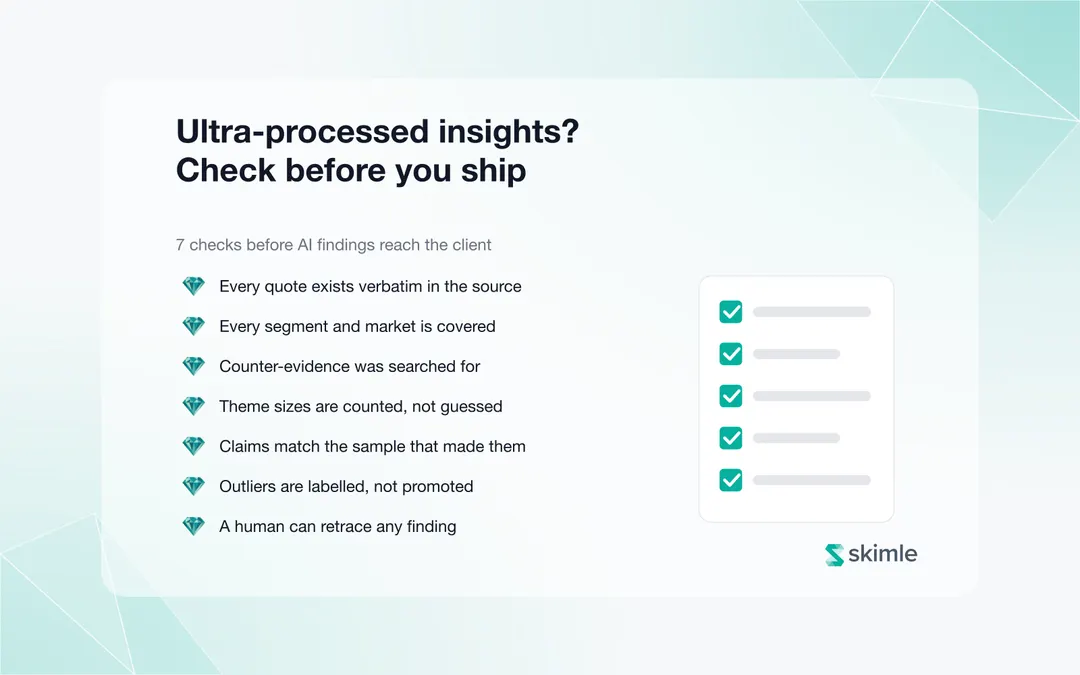
Traceability. IC members, legal teams, and future reviewers will occasionally ask "what is the basis for this claim?" The answer should not be "the expert call programme." It should be traceable to specific calls and quotes. This is where structured coding pays dividends: every finding in a Skimle analysis is linked directly to the source document and quote, which means the traceability requirement costs no additional time to satisfy.
Tools like Skimle are built for this traceability requirement. The two-way transparency model means every AI-surfaced insight links back to the exact passage in the source call notes or transcript. That audit trail is what separates defensible primary research from a narrative that exists only in a deck.
For a worked example of how qualitative findings feed into a strategy deliverable, see from expert calls to client deliverable. If you are working on win-loss research alongside the CDD process, systematic win-loss analysis covers the complementary approach.
For PE and VC teams who run this kind of qualitative primary research regularly, see how Skimle fits the consultants and investors workflow.
4 common mistakes in CDD qualitative research
Mistake 1: Starting synthesis too late. Synthesis should begin during fieldwork, not after it. The first five to eight calls should be analysed as they come in, partly to check that the coding framework is working and partly to identify emerging themes that should be probed in subsequent calls. Waiting until all calls are complete compresses synthesis into an impossible timeframe.
Mistake 2: Letting access constraints shape the sample silently. When the target company controls customer reference access, the sample is likely biased toward satisfied customers. This should be documented and disclosed in the IC memo, not silently accepted as representative. Where access is constrained, channel checks and expert calls from the demand side become more important.
Mistake 3: Treating management interviews and expert calls as equivalent sources. Management and independent experts have fundamentally different information and incentives. Expert views that contradict management claims deserve explicit treatment, not averaging. The IC memo should characterise where management and experts agree and where they diverge.
Mistake 4: No standard note structure across analysts. When eight analysts are running calls in parallel using whatever format they personally prefer, the resulting documents are impossible to analyse systematically. Five minutes of upfront alignment on note structure saves hours of synthesis headaches. See the step-by-step expert call synthesis guide for a recommended structure.
Frequently asked questions
How many expert calls are enough for a CDD engagement?
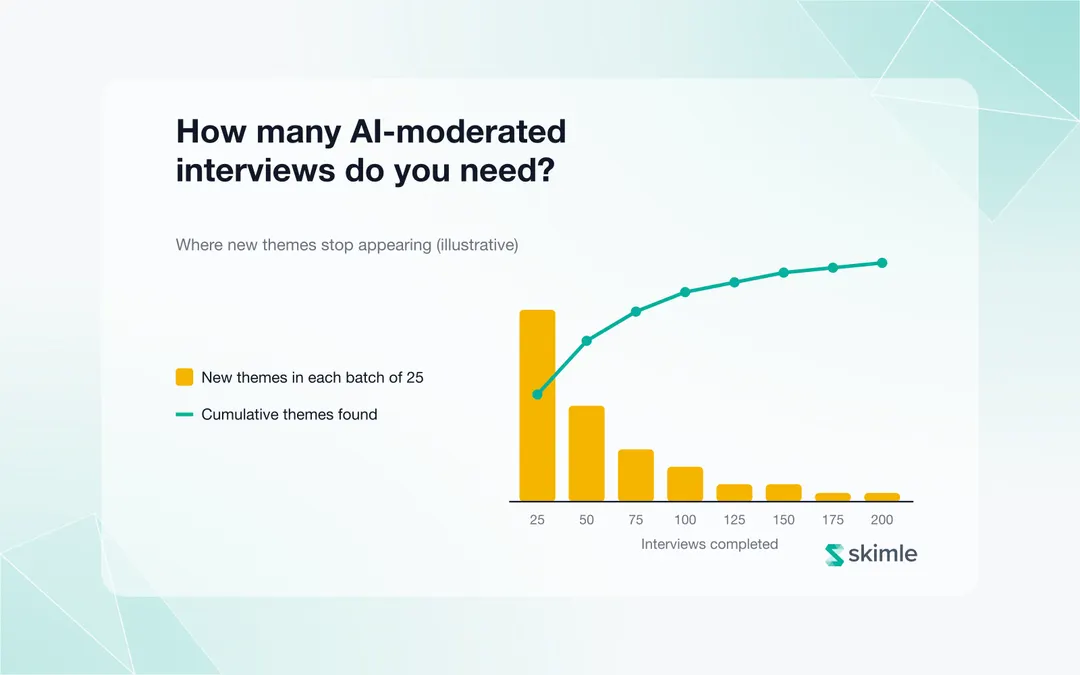
Sample size in qualitative research follows the principle of thematic saturation: you have enough when additional calls stop surfacing new themes. In practice, most PE teams find that 15–25 expert calls cover the main thesis areas for a focused sector question, and that returns diminish rapidly beyond 30 unless the expert universe is heterogeneous across multiple dimensions (sector, geography, function, time period). The quality of expert selection matters more than raw call volume.
How do you analyse customer reference calls when the target controls access?
Acknowledge the selection bias explicitly rather than treating the sample as representative. Supplement with independent outreach where possible: former customers identified through LinkedIn or industry contacts, customer churn data requested from management, and channel checks with distributors who interact with customers. Where access is materially constrained, frame the customer reference findings accordingly in the IC memo: "customer references, drawn primarily from management-provided contacts, were broadly positive; independent sources suggest a more mixed picture."
What is the difference between expert call synthesis and customer reference synthesis?
The analytical goal differs. Expert call synthesis is primarily about building a picture of market dynamics, competitive positioning, and sector risks by aggregating informed outside-in views. Customer reference synthesis is primarily about revenue quality: understanding the real depth of the target's customer relationships, the durability of retention, and the risk of churn. Customer references require more direct quote-based evidence because the committee will probe individual customer stories; expert call findings can be presented at a higher level of aggregation.
How do you present primary research findings when expert views conflict materially?
Present the conflict structurally: quantify the split, characterise who holds each view and their basis for holding it, and identify what structural factor explains the divergence. Then assign a probability-weighted view, documented with a clear rationale. "The bear case (6 of 20 experts) appears to reflect segment-level dynamics in SMB that are not representative of the enterprise business at current scale. We assign low weight to the bear case but flag it as a monitoring point post-close" is an acceptable treatment. "Views were mixed" is not.
Running qualitative primary research on a deal timeline? Try Skimle for free and see how fast structured synthesis of expert calls and customer references can be, with a full audit trail for the investment committee.
Related reading:
- Step-by-step expert call synthesis guide
- Commercial due diligence: AI in qualitative primary research
- How to analyse interview transcripts
About the authors
Henri Schildt is a Professor of Strategy at Aalto University School of Business and co-founder of Skimle. He has published over a dozen peer-reviewed articles using qualitative methods, including work in Academy of Management Journal, Organisation Science, and Strategic Management Journal. His research focuses on organisational strategy, innovation, and qualitative methodology. Google Scholar profile
Olli Salo is a former Partner at McKinsey & Company where he spent 18 years helping clients understand the markets and themselves, develop winning strategies and improve their operating models. He has done over 1000 client interviews and published over 10 articles on McKinsey.com and beyond. LinkedIn profile
Sources
- Global Private Equity Report 2024 — Bain & Company
- M&A Due Diligence Survey — Mergermarket / Datasite
- AlphaSights: Expert Research and the Due Diligence Process (AlphaSights)
- Qualitative Research in Management: A Methodological Overview — Journal of Management (Sage)
- Diligence at Speed: Primary Research Practices in PE — Greenwich Associates