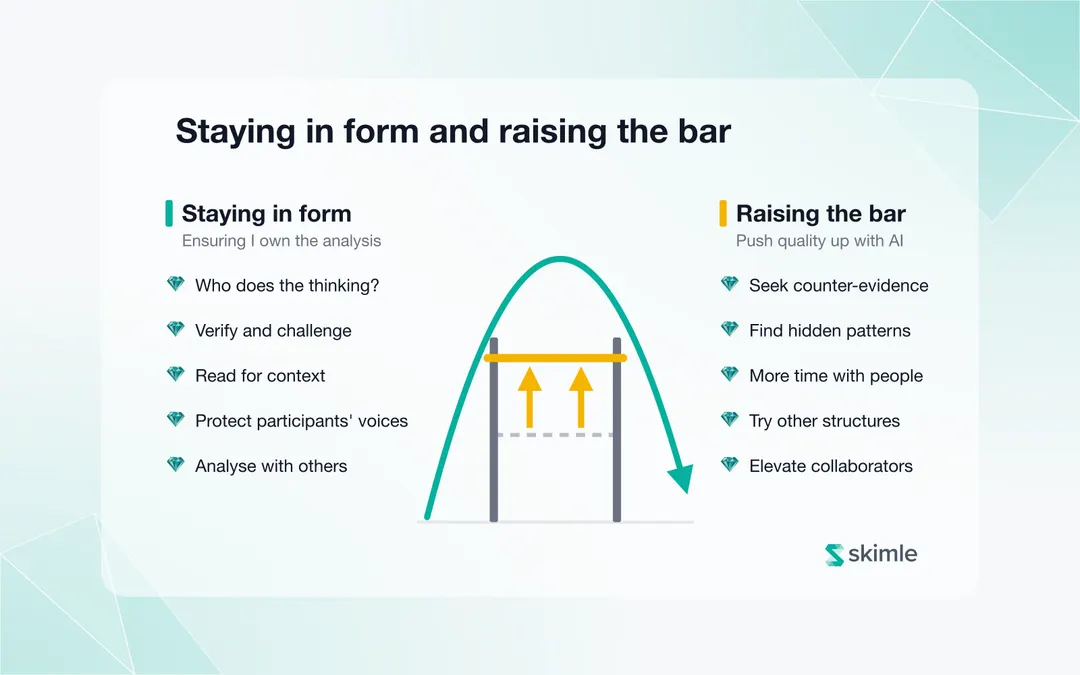
AI tools can now read thousands of pages of qualitative data, identify recurring patterns, and generate structured themes in minutes. They handle the mechanical labour of coding and aggregation well. What they cannot do is interpret meaning in context, apply ethical judgement, or understand the significance of what a participant chose not to say. The right way to use AI in qualitative research is as a coding and synthesis engine that the researcher directs, reviews, and interrogates — not as a replacement for analytical thinking.
What is AI doing in qualitative research today?
The most practical application of AI in qualitative research is at the coding and theme-identification stage. Traditionally, a researcher working with 40 one-hour interviews would spend several weeks reading, coding, and organising before any interpretive analysis could begin. AI can compress that first pass to hours.
Current AI tools for qualitative research fall broadly into three categories:
General-purpose large language models (ChatGPT, Claude, Gemini). Researchers use these for transcription, summarisation, and exploratory coding via prompt-based interaction. They are flexible but unreliable for systematic coding: outputs vary by prompt, there is no audit trail, and the model may hallucinate findings not present in the data. See can ChatGPT analyse qualitative data? for a detailed assessment.
Dedicated AI-native qualitative data analysis tools (Skimle). These tools apply structured analytical processes to uploaded datasets, maintaining traceability between findings and source data. The analysis pipeline is consistent and documented, which matters for methodological transparency.
AI features in legacy tools (NVivo, Atlas.TI etc.). The established tools have sprinkled AI elements to their traditional workflows, but as comparisons show the features are less useful than one would hope. Researchers who find these tools too expensive or complex may find our roundup of NVivo and MAXQDA alternatives a useful starting point.
What can AI do well in qualitative research?

Recommended reading
Designing AI that augments qualitative researchers instead of replacing them
Processing large volumes of text. A dataset that would take a human researcher two weeks to code can be processed in under an hour. This matters for scale — AI makes it feasible to work with 100 or 200 interviews rather than 15 or 20, which changes the analytical possibilities.
Consistent first-pass coding. AI applies the same criteria consistently across the entire dataset. A human coder working on day 15 of coding 50 interviews may apply codes differently than they did on day 1 — fatigue, shifting interpretations, and evolving understanding all introduce variation. AI does not have this problem on the first pass.
Surfacing patterns across metadata. Skimle's metadata analysis allows researchers to slice findings by participant attributes — comparing themes across departments, age groups, job levels, or interview dates. Patterns that would be invisible in manual analysis become visible when AI can cross-reference codes and metadata simultaneously.
Transcription. Accuracy rates for AI transcription of clear audio in English now exceed 95% for most tools. Uploading audio files for transcription takes seconds; the result is a formatted transcript ready for analysis.
Summarisation. Long interviews can be summarised at the document level before broader synthesis. This helps researchers navigate large datasets and identify which transcripts deserve closer reading.
What can AI not do in qualitative research?
Interpret meaning in context. A participant who says "the process worked fine" in a tone of resignation is saying something very different from one who says it enthusiastically. AI reading the text sees the same words. The researcher who conducted the interview, or who reads the transcript with the context memo open, hears the difference. Context, subtext, and non-verbal information are largely invisible to text-processing AI.
Apply theoretical frameworks with nuance. Deductive coding with a sophisticated theoretical lens — applying Bourdieu's field theory, or a specific organisational change model — requires the researcher to understand the theory deeply enough to make judgement calls about ambiguous passages. AI can apply broad category labels but sometimes struggles with fine-grained theoretical application where expert judgement is needed.
Generate original insight. AI finds patterns in what is present in the data. A skilled qualitative researcher also notices absences — what participants conspicuously avoided mentioning, what topics produced unusual brevity or deflection. These observations require the kind of holistic understanding that comes from immersion in the data, not pattern-matching across text.
Maintain ethical judgement. Decisions about how to handle sensitive disclosures, whether a participant seems distressed, and how to present findings about vulnerable populations require human ethical reasoning. AI has no basis for these judgements.
What are the ethical considerations when using AI for qualitative research?

Recommended reading
Hallucinations, limited context and black boxes? Not with Skimle
Data privacy and confidentiality. Interview participants share information in confidence. Before uploading transcripts to any AI tool, researchers need to understand where that data is processed, stored, and retained. Reputable research tools process data within defined geographic regions and do not use research data to train their models. Skimle's anonymisation feature pseudonymises participant information before analysis begins, which is important for sensitive research contexts.
Transparency in methods reporting. If you use AI assistance in your analysis, your methods section should say so. Academic publishing norms are evolving on this point, but the current consensus in most disciplines is that AI assistance is acceptable if disclosed, documented, and not presented as human analysis. The AI qualitative analysis checklist covers what good disclosure looks like and Henri Schildt's recent paper on Designing AI for qualitative research gives some theoretical and practical considerations worth noting.
Avoiding the "black box" problem. AI tools that return themes without showing which passages generated those themes create a verification problem: you cannot check the findings. Two-way transparency from insight to source quote and back is not a nice-to-have feature — it is what makes AI-assisted analysis auditable and credible. Before choosing any AI tool for research, confirm that it can show you the evidence behind every finding.
How do you choose an AI tool for qualitative research?
The choice depends on your context. For academic researchers, the critical factors are auditability (can you trace every finding to source data?), data residency (where is your data processed?), and compatibility with qualitative rigour standards in your field. If learning curve is a priority, our guide to the easiest qualitative data analysis software to learn compares options by how quickly a new user can get started.
For consultants and strategy teams, the priorities shift: speed, the ability to work with large volumes of expert interview transcripts, and a clear output that can go directly into a client deliverable.
For HR and people teams analysing open-ended survey responses or exit interview data, ease of use and the ability to segment by employee metadata are often more important than methodological flexibility.
The comparison post qualitative data analysis tools: a complete comparison covers the main options in detail. For AI-specific considerations, AI qualitative analysis: hallucinations, context limits, and the black box problem explains how different tools handle the three most common failure modes.
How should AI be integrated into the research workflow?
Rather than replacing the research process, AI fits most naturally into specific stages:
- Transcription. Use AI to convert audio to text, saving hours of manual transcription.
- First-pass coding. Let AI generate an initial set of codes across the full dataset.
- Researcher review. The researcher reviews AI-generated codes, merges or splits them, challenges interpretations that seem wrong, and adds codes the AI missed.
- Theme development. Working from the reviewed codes, the researcher constructs themes — this is the interpretive step that remains firmly human.
- Verification. Trace themes back to source quotes. Are there enough supporting passages? Are there disconfirming cases the AI did not flag?
- Write-up. Produce the analysis, disclosing AI assistance and describing the verification steps.
This hybrid approach — AI handles the mechanical first pass, researcher handles interpretation and verification — is how tools like Skimle are designed to be used. It preserves rigour while eliminating the parts of qualitative research that are time-consuming without being intellectually demanding.
For market researchers running multiple projects simultaneously, this workflow means an analyst can manage four times the volume of qualitative data they could handle manually — not by lowering standards, but by automating what was previously mechanical.
Frequently asked questions
Does using AI in qualitative research compromise rigour?
Not inherently. Rigour in qualitative research comes from systematic methodology, transparent reporting, and careful verification of findings against the data. AI assistance is compatible with all three, provided the researcher uses AI to support their analytical process rather than bypass it. The risk of compromised rigour comes from accepting AI outputs without review, not from using AI at all.
Can AI replace a qualitative researcher?
No, and tools that claim otherwise are overselling. AI handles pattern recognition across text. Qualitative researchers provide theoretical framing, contextual interpretation, ethical judgement, and the ability to recognise the significance of what is absent or unexpected in the data. These are not automatable in any meaningful sense.
Is AI assistance acceptable in academic qualitative research?
Increasingly, yes — with disclosure. Most major journals and institutional review frameworks have moved toward accepting AI assistance when it is properly documented in the methods section. The norms are still evolving, so check the specific guidelines for your target journal or institution.
How do I make sure an AI tool is not hallucinating my qualitative findings?
The safeguard is traceability: every theme or finding should link directly to the source passages that support it. If an AI tool cannot show you the quotes behind a theme, you have no way to verify the finding. Before relying on any AI-generated analysis for research, check that you can inspect the evidence behind each output.
Ready to add AI to your qualitative research workflow? Try Skimle for free — AI-assisted coding and theme identification with full traceability from every insight to source quotes.
Further reading:
- Can ChatGPT analyse qualitative data?
- AI qualitative analysis: hallucinations, context limits, and the black box problem
- How to use AI in qualitative research: a guide for academic researchers
About the authors
Henri Schildt is a Professor of Strategy at Aalto University School of Business and co-founder of Skimle. He has published over a dozen peer-reviewed articles using qualitative methods, including work in Academy of Management Journal, Organisation Science, and Strategic Management Journal. His research focuses on organisational strategy, innovation, and qualitative methodology. Google Scholar profile
Olli Salo is a former Partner at McKinsey & Company where he spent 18 years helping clients understand the markets and themselves, develop winning strategies and improve their operating models. He has done over 1000 client interviews and published over 10 articles on McKinsey.com and beyond. LinkedIn profile