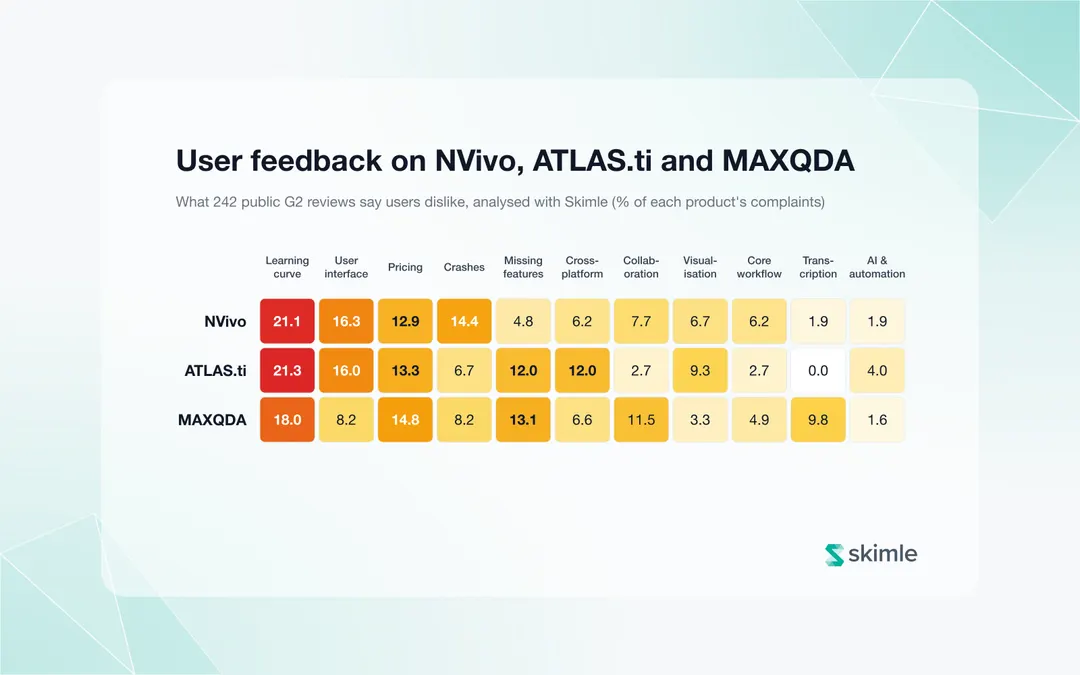
The best interview analysis software for most teams in 2026 is either Skimle or Dovetail, depending on your context: Skimle suits market research agencies, consultancies, and HR teams who need rigorous AI theme extraction with full traceability back to source quotes and EU data residency; Dovetail fits UX and product teams focused on user interview repositories with video highlight reels. NVivo and MAXQDA remain the academic standard but carry steep learning curves and high costs. For transcript-only needs, Otter.ai is cheap and fast but stops short of analysis.
If you regularly analyse interview transcripts, you already know the problem: reading 20 interviews in a spreadsheet is possible; reading 60 is a weekend you cannot afford. The right software turns a multi-week manual task into structured findings in hours.
This comparison focuses specifically on software for analysing interview transcripts, covering the tools that researchers and research-adjacent teams actually use in 2026. It is not a full QDA software survey (for that, see our complete qualitative data analysis tools comparison); it is a practical guide for anyone who runs interviews and needs to turn them into findings quickly and credibly. If your interest is broader than interviews specifically, customer research analysis tools: the 2026 landscape by category covers survey analytics, VoC platforms, UX repositories and AI-native tools side by side.
Traditional manual analysis runs at roughly two to four hours of coding per hour of interview material. A study with 25 one-hour interviews can take 50 to 100 hours of analyst time to code thoroughly. At that rate, the economics of qualitative research break down long before the insights do.
The 7 tools compared
The shortlist covers a deliberate range: a purpose-built AI analysis platform (Skimle), two research repository tools (Dovetail, Condens), a transcription-first tool (Otter.ai), two traditional QDA platforms (NVivo, MAXQDA), and the manual baseline most teams start with (Excel).
Comparison table
| Tool | Best for | AI theme extraction | Traceability to source | Multi-interview synthesis | Team collaboration | GDPR / EU hosting | Price (annual) |
|---|---|---|---|---|---|---|---|
| Skimle | Market research, consultancies, academics, general curious professionals | Full AI analysis with inductive and predefined coding | Every insight links to source quote(s) | Synthesises across all uploads in a project | Yes, shared projects and insights | EU hosting, GDPR-compliant | From ~€20/month (~$22month) |
| Dovetail | UX and product teams | AI clustering, auto-tagging | Video/transcript highlight links | Yes, across notes and transcripts | Strong (built for team repos) | US servers; GDPR mechanisms available | ~$29/user/month (~$32) |
| Condens | UX freelancers, small teams | AI auto-tagging, theme suggestions | Clip and quote links | Yes | Good for small teams | EU hosting available | From $15/user/month (~€14) |
| Otter.ai | Transcription only | None | Transcript search only | None | None | US servers | Free–$30/user/month (~€28) |
| NVivo | Academic researchers not using AI | Rudimentary AI sentiment and auto-coding | Full node/reference structure | Yes, across files | Limited (licence-per-user model) | US/UK servers; enterprise options | ~$1,200–$1,800/year (~€1,100–€1,650) |
| MAXQDA | Academic researchers not using AI, mixed methods | Rudimentary AI in Pro tier | Codes linked to segments | Yes | Limited | German company, GDPR-compliant | ~$930–$1,750/year (~€850–€1,600) |
| Excel (manual) | Very small datasets | None | Manual tracking only | Only if you build it | Via shared files | Wherever you host the file | Part of Microsoft 365 |
Skimle
Skimle is a purpose-built AI analysis platform for qualitative research. You upload transcripts (or let it transcribe your audio directly), and it runs a full AI analysis: extracting themes, coding passages to categories, and surfacing insights with direct links to the source quotes. Every finding traces back to the specific transcript passage that supports it.
The platform's predefined categories mode works both ways: let the AI suggest the categories and discover themes from the data without a pre-set framework, or specify the coding framework in advance. For market researchers running repeat studies with consistent topics, naming the categories yourself lets you apply the same framework across waves of interviews for trend analysis.
For teams doing interview analysis at volume, the metadata analysis feature is particularly useful: you can tag each interview with attributes (customer segment, geography, tenure, deal size) and slice findings by those variables to see how themes differ across subgroups. This is something Excel cannot do systematically at scale, and it is what most research deliverables actually need.
Pricing: Starter from €20/month (~$22/month). No per-user seat costs at the project level, which makes it economical for agencies running multiple simultaneous client projects.
GDPR: Hosted in the EU. Data does not leave the EU. Skimle does not use customer data to train models. Terms of service and DPA available.
Limitations: Skimle is not a video highlight reel tool (there is no clip-to-video feature). For teams whose primary deliverable is a showreel of user interview clips, Dovetail or Condens fit better.
If you work in market research, see how Skimle fits customer and market research workflows, and if you work in consulting, see the consultants and investors use case page.
Dovetail
Dovetail is the dominant research repository platform for product and UX teams. It accepts transcripts, video recordings, and notes, and gives teams a shared space to highlight, tag, and synthesise across sessions.
Its AI features cluster feedback and auto-tag themes across a corpus, which is useful for a team managing an ongoing stream of user interviews. The video integration is Dovetail's strongest differentiator: researchers can link insights directly to video moments, making it easy to share clips with product stakeholders.
Where Dovetail is weaker: it was built as a repository first and an analysis tool second. The AI analysis is less structured than Skimle's: it surfaces tags and clusters rather than a coherent, codebook-level thematic structure. For rigorous, methodology-grounded analysis (the kind that needs to be defensible to a client or in a published report), that matters.
Dovetail pricing: ~$29/user/month (~€27) billed monthly; lower on annual plans. Five researchers costs around $1,740/year (~€1,595). For teams of 10, that is $3,480/year (~€3,185).
GDPR: US servers. GDPR mechanisms are available but data sits in the US by default. EU-hosted option is not available.
For a direct feature-by-feature comparison, see our Skimle vs Dovetail vs Condens comparison or our Dovetail alternatives guide.
Condens
Condens is a smaller, leaner research repository, positioned between a full-featured platform and a note-taking tool. It transcribes automatically, lets researchers highlight and tag clips, and has AI-powered theme suggestions.
It is the fastest to set up of the three repository tools: an experienced UX researcher can go from fresh account to first analysis in under an hour. AI auto-tagging handles much of the initial synthesis work, and the clip-highlight workflow is smooth. For freelance researchers or small in-house teams running primarily usability studies, it is a strong option.
Where it falls short for larger teams: the analysis layer does not support the kind of cross-study, segmented synthesis that agencies or enterprise research teams need. There is no equivalent to Skimle's metadata-driven subgroup analysis or NVivo's node hierarchy.
Pricing: Free (limited), Starter $15/user/month (~€14), Professional $25/user/month (~€23). EU hosting is available.
Otter.ai
Otter.ai is primarily a meeting transcription tool. It sits in meetings (Zoom, Teams, Google Meet) and produces searchable transcripts automatically.
For interview analysis purposes, it is best understood as a transcription layer, not an analysis tool. It can search across transcripts and flag speaker turns, but it has no thematic coding, no category extraction, and no synthesis across interviews. For pure transcription needs on a tight budget, it is hard to beat at the free-to-low-cost tier.
Teams often start with Otter for transcription and then do the actual analysis in Excel, which is the combination that eventually drives teams toward dedicated tools.
Pricing: Free (300 min/month); Pro ~$8–$17/user/month (~€7–€16) depending on billing cycle; Business ~$20–$30/user/month (~€18–€28).
Limitations: No interview analysis features beyond transcript search. US data residency by default. Not suitable for GDPR-sensitive research without additional data processing agreements.
For transcription specifically, see our best AI transcription tools comparison.
NVivo
NVivo is the long-standing standard for academic qualitative analysis. It has been the tool of record in many university departments for two decades, and its analysis features are comprehensive: full node hierarchies, multiple coding passes, query functions, and visualisations.
For interview analysis specifically, NVivo gives researchers the most control over their coding structure. You can build complex, multi-level codebooks, run matrix queries across demographic attributes, and export REFI-QDA packages for interoperability with other QDA tools.
The AI features, added relatively recently, cover sentiment analysis and some auto-coding but are not the core of what NVivo does. Most researchers using NVivo are there for the manual coding rigour, not AI automation.
Pricing: Individual academic licence: ~$1,200–$1,400/year (~€1,100–€1,285). Individual commercial: ~$1,800+ (~€1,650+). NVivo Teams: ~$2,500+/year (~€2,290+). The pricing is the most common reason researchers look for alternatives.
GDPR: US and UK servers. Enterprise versions can negotiate data location.
See our NVivo alternatives guide for academic researchers if cost is a concern, and our NVivo pricing deep dive for a full cost breakdown.
MAXQDA
MAXQDA is the other major academic QDA tool, and in many respects a stronger choice than NVivo in 2026: better value for academic pricing, a German company with inherently stronger GDPR positioning, and an increasingly capable AI assistant in the Analytics Pro tier.
MAXQDA's AI assistant (available as an add-on or in Analytics Pro) helps with document summarisation, coding suggestions, and paraphrasing. It does not replace a structured AI analysis workflow, but it meaningfully accelerates manual coding.
For teams that need REFI-QDA interoperability (moving data between NVivo, MAXQDA, and ATLAS.ti), MAXQDA is the most reliable option. Skimle also exports to REFI-QDA format for researchers who want AI-assisted analysis first and then want to transfer into a traditional QDA tool for final coding.
Pricing: Academic Base: ~$250–$275/year (~€230–€250). Academic Analytics Pro: ~$625/year (~€575). Commercial Base: ~$930/year (~€850). Commercial Analytics Pro: ~$1,750/year (~€1,600).
GDPR: German company, GDPR-compliant. Data processed in Germany.
For a direct NVivo vs MAXQDA comparison, see NVivo vs MAXQDA 2026.
Excel (manual baseline)
It is worth including the manual baseline because most teams start here and many stay longer than they should.
A typical manual Excel setup for interview analysis: one row per quote, columns for interview ID, participant attributes, code, and theme. You read each transcript, copy representative quotes, label them, and then pivot by theme to see patterns. If you have built and maintained a well-structured sheet, you can do creditable analysis across 10 to 15 interviews.
The limits are predictable. Reading and tagging 30 interviews by hand takes three to five days of full-time analyst work. Inter-rater reliability is hard to track. Finding the source passage later (for a client query or peer review) means searching across the original transcripts. And nothing stops two analysts from using the same code label for different things.
For a step-by-step guide to what the manual Excel process actually involves, see how to do thematic analysis in Excel.
How do the tools differ on AI theme extraction?
The most significant product difference in 2026 is not which tool has AI, but how deeply the AI is integrated into the analysis workflow and how transparent the output is.
Skimle's AI analysis runs across the full dataset (all interviews in a project), extracts themes inductively or against a predefined framework, and links every theme to the specific passages that generated it. You can inspect exactly which quotes support a finding and which interviews contributed them.
Dovetail and Condens offer AI clustering and auto-tagging, which is faster for a single session but produces a flatter output. You get tags, not a structured codebook.
NVivo and MAXQDA have added AI features, but they are supplements to manual coding rather than replacements. You still do the bulk of the analytical work yourself.
The deeper difference is about trust and traceability. For research that needs to be defended (to a client, a peer reviewer, or an ethics board), knowing exactly which passage produced which finding is not optional. It is what two-way transparency in AI analysis means in practice.
Which tool handles multi-interview synthesis?
All the tools in this comparison support analysis across multiple interviews to some degree. The meaningful differences are in how far each tool goes.
Skimle synthesises across an entire project: you upload 50 interviews and run a single analysis that looks across all of them, producing themes that represent the full dataset. Visualisations show frequency counts of how often each theme appears across interviews, and metadata analysis breaks those frequencies down by participant segment.
NVivo and MAXQDA give you multi-file coding (you code across all files using the same codebook) and matrix queries (frequency of code A in interviews where participant attribute B is present). These are powerful, but require substantial analyst time to set up and run.
Dovetail and Condens synthesise across sessions in a repository, but the synthesis is more tag-based than thematic. Finding a deep pattern across 40 interviews (rather than surfacing frequently appearing tags) requires more manual work.
For how to approach the synthesis process methodologically, see how to find themes across interviews.
What about GDPR and EU data residency?
For European teams, data residency is a real procurement concern, particularly for research involving sensitive topics (HR, health, commercial intelligence) or when handling participant data under GDPR.
The table above summarises the hosting positions. In short: Skimle (Finland), MAXQDA (Germany), and Condens (EU option) are the strongest positions for EU-based teams. NVivo and Dovetail run on US infrastructure by default, which requires additional legal mechanisms under GDPR (Standard Contractual Clauses at minimum) and may be a blocker for some public sector or healthcare clients.
If your team works with sensitive participant data, see our guide to anonymising interview transcripts before uploading to any platform.
How to choose: a decision guide
The right tool depends on three factors: the analytical rigour you need, your team size, and your regulatory environment.
Choose Skimle if: you run market research, consulting, or HR research at volume; you need structured AI analysis with full traceability; or your clients require EU data residency. Particularly well-suited to agencies running multiple parallel client projects.
Choose Dovetail if: you are a product or UX team whose deliverables are video highlights and a shared insights repository, and your data does not need EU residency.
Choose Condens if: you are a freelance UX researcher or small team and want the fastest setup with a lower per-seat cost.
Choose NVivo or MAXQDA if: you are in academic research, need the full depth of manual coding with AI supplements, or must produce output that satisfies a traditional peer review process. MAXQDA is usually the better value.
Use Excel if: you have fewer than 10 interviews, no repeat methodology, and no client reporting requirement. Then upgrade.
Frequently asked questions
What is the best interview analysis software for a small market research agency?
For a small agency (3–10 people running client interview projects), Skimle is the strongest fit in 2026. It is priced by project credits rather than per-seat, which keeps costs predictable when team size changes, and the AI analysis is structured enough to produce client-ready deliverables. EU hosting matters for many European clients. Dovetail is a reasonable alternative if the team primarily serves product clients who want video highlights.
How accurate is AI interview analysis?
The accuracy of AI theme extraction depends on the tool and the dataset. Purpose-built tools like Skimle, which run AI against a full structured dataset, outperform general-purpose AI tools (like ChatGPT) on consistency and traceability. No AI analysis is infallible: in practice, researchers typically review AI-generated themes, add notes, and sometimes recode passages. The gain is speed and consistency, not a replacement for researcher judgement. See our AI qualitative analysis checklist for what to verify before publishing.
Is GDPR compliance different for AI tools vs traditional QDA software?
The key question for GDPR is where the data is processed and stored, and whether it is used to train models. Traditional tools like NVivo and MAXQDA have well-established data handling policies. For AI tools, the critical questions are: (1) does the data leave the EU for processing? (2) is participant data used to train models? For Skimle, the answer to both is no: data is processed in the EU and not used for model training.
Can these tools work for team collaboration on interview analysis?
All the tools in this comparison support some form of team access, but the collaboration models differ. Dovetail and Condens are designed from the ground up for team use (shared repos, commenting, role-based access). NVivo Teams adds cloud-based collaboration on top of a traditionally single-user tool. Skimle supports shared project access and collaborative insight-building. Excel is collaborative only in the sense that you can share a file. For teams of more than two or three analysts, the dedicated tools pay for themselves in avoided coordination overhead alone.
Want to go deeper on qualitative analysis methods? Read our guides on how to analyse interview transcripts, interview transcript analysis methods, and our complete qualitative analysis software comparison.
About the authors
Henri Schildt is a Professor of Strategy at Aalto University School of Business and co-founder of Skimle. He has published over a dozen peer-reviewed articles using qualitative methods, including work in Academy of Management Journal, Organisation Science, and Strategic Management Journal. His research focuses on organisational strategy, innovation, and qualitative methodology. Google Scholar profile
Olli Salo is a former Partner at McKinsey & Company where he spent 18 years helping clients understand the markets and themselves, develop winning strategies and improve their operating models. He has done over 1000 client interviews and published over 10 articles on McKinsey.com and beyond. LinkedIn profile
Sources
- NVivo Alternatives 2026: 7 Best Tools for Qualitative Research - UserCall
- Best UX Research Repository Tools in 2026: Dovetail vs Marvin vs Condens vs Koji
- Otter.ai Pricing 2026 - Otter.ai official
- Scaling Customer Research: How to Interview 100+ Users - Resonant
- Inside the $153bn Insights Industry - Research World / ESOMAR