Delve is a cloud-based qualitative coding tool built for researchers who find tools like NVivo and ATLAS.ti too complex for their needs. It excels at getting teams coding quickly with minimal setup, offering clean collaborative workflows and transparent pricing. Its main limitations: Delve is a manual-coding-first tool, text-only, and its AI features are assistive rather than analytical. Researchers who need the AI to do the first coding pass, work with audio or video data, or run complex cross-tabulation queries should consider alternatives. For those evaluating the full QDA software landscape, Delve sits at a distinct point in the market: simplest onboarding, clean collaboration, published pricing with no sales call required, and deliberately constrained scope.
What is Delve?
Delve is a US-based qualitative data analysis tool that launched with a deliberate philosophy: make the core task of coding interview transcripts as straightforward as possible, without the feature complexity that makes legacy CAQDAS tools (NVivo, ATLAS.ti, MAXQDA) feel intimidating. The interface resembles a Google Doc more than traditional QDA software. You upload transcripts, highlight passages, and assign codes from a panel on the right. The codebook is centralised, accessible to all team members, and updates in real time.
That simplicity is a deliberate design choice, not an incomplete feature set. Delve has added AI features in recent years, but the underlying philosophy remains: the researcher stays at the centre of analysis, with the software supporting rather than replacing their judgement.
For context on where Delve fits in the broader category, what is CAQDAS? explains the landscape Delve operates in and why tools like it exist.
What data types does Delve support?
Delve is a text-first tool. It handles:
- Interview transcripts (pasted or uploaded as text files)
- Focus group transcripts
- Open-ended survey responses
- Video transcripts with timecode integration
It does not natively support audio or video files for coding. If you need to code multimedia data (video clips, audio segments, images), Delve is not the right tool. NVivo and MAXQDA both offer significantly stronger multimedia support for that research design. Dedoose handles video and photo datasets better than Delve, despite being an older tool.
For text-based qualitative research, the supported formats cover the most common use cases: researchers typically collect interviews, transcribe them, and then code the text. Delve fits neatly into that workflow.
Delve's key features in 2026
Coding and codebook management
The core coding interface is Delve's strongest feature. You read a transcript, highlight a passage, and assign it to an existing code or create a new one. The codebook appears in a right-hand panel, and codes can be nested up to three levels deep. You can merge codes, add memos to codes, and browse all excerpts assigned to any code in a single view.
One limitation users consistently raise: three levels of code nesting is the maximum. Researchers working with fine-grained deductive coding schemes sometimes want four or five levels, and Delve cannot accommodate that. For most thematic analysis projects, three levels is sufficient, but it is worth knowing before you commit.
Collaboration and intercoder reliability
Multiple team members can code the same transcript simultaneously from any browser, and the codebook stays centralised. Team members can code independently (useful for intercoder reliability studies) and then compare their coding side by side.
This is included in the standard price rather than being a paid add-on, which is a meaningful difference from NVivo where the Collaboration Cloud is an additional cost. For distributed teams or research projects that need to demonstrate coding consistency for publication, the included collaboration features are a practical advantage.
Intercoder reliability is supported, though less elaborately than Dedoose's dedicated IRR tools (Cohen's kappa, percentage agreement). Delve allows you to compare coding between researchers, but the statistical calculation layer is simpler.
Rudimentary AI assistant features
Delve added rudimentary AI features in recent versions, and the current offering has three components:
AI Chat with transcripts: You can ask the AI to summarise an interview, connect a passage to a research question, or brainstorm initial codes. This works as a research thinking partner rather than an automated coder.
Apply codes with AI: Feed your existing codebook to the AI and it will suggest where to apply codes across your transcripts. You review and validate its suggestions. Users report mixed results here: one Capterra reviewer noted "the AI coding tool needs improvement... it only used 'some' of the coding and made choices I did not agree with." The feature is useful for getting a first pass on straightforward deductive coding, but requires careful review.
Peer debriefer: The AI reviews your coded work and raises questions about ambiguous codes or potential gaps in your codebook. This is the most distinctive AI feature and mimics the methodological role of a peer debriefer in rigorous qualitative research.
The important framing: Delve's AI features are designed to assist, not to replace the researcher. The company's position is explicit: "understanding context, constructing meaning, interpreting lived experience... we don't believe AI can do something as nuanced." This is a considered philosophical stance, not a capability gap they are working to close. If you want AI to do the initial analytical pass across your full corpus, Delve is not designed for that.
Read more about AI assisted document analysis and why staying at Tier 2 level analysis could be a dangereous gap.
Educational resources and search
Delve publishes one of the better free educational resources on qualitative coding methodology. Their blog covers how to code qualitative data, thematic analysis, and practical tool comparisons. The search functionality lets you locate keywords across your full corpus, which saves time when tracking a specific concept across 20 or 30 interviews.
Delve pricing in 2026
Delve uses two pricing tiers, both billed monthly with a 14-day free trial (no credit card required).
| Plan | Price | Best for |
|---|---|---|
| Education | $18 (€16) per user/month | Students, academic researchers, dissertation projects |
| Standard | $50 (€46) per user/month | Professional researchers, market research teams, consultants |
Both plans include unlimited projects, unlimited transcripts and codes, collaboration features, and customer support.
Annual pricing is available and works out to $200 (€185) per year on Education, and approximately $432 (€400) per year on Standard.
The Education tier at $18 (€16)/month is competitive with Dedoose's standard rate and significantly cheaper than any NVivo or MAXQDA licence. For a student or early-career researcher on a short project, it is a practical option.
The Standard plan at $50 (€46)/month is higher than many researchers expect. Over a 12-month project, that is $600 (€555) per user, which starts to compare less favourably with MAXQDA's team pricing or a Skimle team plan that includes AI analysis.
The monthly model lets you pause or cancel at any time, which suits dissertation researchers coding in bursts. On long-running projects of 18–24 months, costs accumulate and erode the initial affordability advantage.
The free qualitative data analysis software guide for 2026 covers zero-cost alternatives for researchers whose budget rules out any subscription.
What Delve does well: 4 real strengths
1. The fastest onboarding of any legacy / non-AI CAQDAS tool
This is Delve's clearest competitive advantage. The platform estimates researchers can set up a project and start coding in under 10 minutes. That claim matches user experience: reviewers consistently describe setting up "within minutes" and finding the initial coding workflow "a breeze."
Compare that to NVivo or MAXQDA, which typically require days for one to become productive. For a researcher who needs to start coding quickly, or who is new to QDA software and dreads the learning curve, Delve delivers something no other tool matches. Skimle is another tool with quick onboarding, and additionally the automated first pass of coding means the user can start to immediately work on insights not raw documents.
For UX researchers and consultants who need results quickly and lack time for extended software training, Delve's quick-start model suits typical sprint timelines. See how product and UX teams typically structure their research workflows.
2. Clean, included collaboration
Distributed research teams can code the same project simultaneously from any browser, with a centralised codebook that stays consistent for everyone. No installation, no file-sharing confusion, no version conflicts.
Collaboration is included in both pricing tiers. This is not standard across the QDA category: NVivo requires additional licences for the Collaboration Cloud, ATLAS.ti charges for cloud features on top of desktop licences, and Dedoose's collaboration is included but its interface is older. Skimle is another tool where all users can invite others and collaborate on the same project in real time.
For teams studying interview insights at scale, this matters: everyone sees the same codebook, and code application is consistent across team members.
3. Transparent and cheap pricing
Monthly billing with no commitment, published prices on the website, a 14-day free trial with no credit card required. For a category where pricing is notoriously opaque (NVivo requires institutional pricing quotes, ATLAS.ti has complex tier structures), Delve's transparency is refreshing and similar to Skimle's clear tiers with unlimited features in each tier.
The ability to cancel or pause at any time is also valuable for researchers on short projects. A dissertation student who codes intensively for three months and then writes up can pay for three months and stop, rather than committing to an annual licence they will not fully use.
4. Excellent customer support
Delve's support response time is consistently praised across review platforms. Users specifically note that responses come from humans rather than automated systems, which is notable. For a small research team encountering a workflow problem mid-project, fast responsive support has real value. The 4.9/5.0 customer support rating across 201 Capterra reviews (184 five-star ratings) reflects a consistent pattern across a large review set.
Where Delve falls short: 4 real limitations
1. Manual coding is still the whole model
Delve's AI features are assistive, but the core workflow is still: researcher reads transcript, researcher highlights passage, researcher assigns code. For an academic study with 10–15 interviews, that is manageable. For a study with 40, 60, or 100 transcripts, the time investment becomes significant and starts to limit the depth of research possible (who actually would test an alternative angle if they just spent 3 weeks coding the text...)
Research on manual coding time suggests an experienced researcher typically spends 4–8 hours per hour of interview material when coding thoroughly. A project with 30 one-hour interviews can therefore represent 120–240 hours of coding work. Delve makes that process cleaner and more collaborative, but it does not fundamentally change it.
AI-native tools take a different approach: they analyse the full corpus first, extract themes and supporting evidence across all documents simultaneously, and then invite the researcher to review what the AI found. That shift in workflow model is the meaningful difference between Delve and tools like Skimle. For researchers whose projects are large enough that manual coding time is a real constraint, the workflow model matters as much as the interface.
2. Text-only: no audio or video coding
If your research involves video data, audio segments, images, or social media content beyond text, Delve cannot accommodate it. You would need to transcribe audio and video externally before importing, which creates an additional workflow step and means you lose the connection between coded text and its original audio/video context.
For researchers who want to import audio or video, consider tools like Skimle with integrated transcription of media, as well as anonymisation and pseudonymisation included in the same workflow.
3. Limited analysis depth beyond coded excerpts
Delve is very good at helping you code material and retrieve coded excerpts. It is less strong on what happens after that. There are no complex query tools for finding co-occurring codes, no matrix queries to cross-tabulate themes against participant variables, and limited visualisation beyond basic code frequency.
For mixed-methods research that needs to connect qualitative codes to demographic variables or survey data, Dedoose handles this considerably better. For research that needs rich visualisations (word clouds, network diagrams, model maps), MAXQDA, Skimle and ATLAS.ti offer substantially more.
Delve positions this as a feature rather than a limitation: "your data and codes with minimal clutter." For researchers who want a clean coding workspace and then move to other tools for visualisation and reporting, that position holds. For people who want to dig deeper to their data... it's a real gap no matter how it's positioned...
4. No REFI-QDA export
Delve does not currently support the REFI-QDA standard, which means you cannot transfer a Delve project to another tool with all coding intact. You can export coded excerpts and codebooks as CSV or Excel, but the full project structure does not transfer.
For a researcher who starts in Delve and later needs to move their project (because a collaborator uses a different tool, because their institution requires archiving in a specific format, or because the project outgrows Delve's scope), this creates friction. NVivo, MAXQDA, ATLAS.ti, and Skimle all support REFI-QDA. The guide to manual coding and REFI-QDA export explains why this matters for long-term data portability.
How does Delve compare to the main alternatives?
| Delve | Dedoose | NVivo | MAXQDA | Skimle | |
|---|---|---|---|---|---|
| Platform | Cloud | Cloud | Desktop + cloud | Desktop + cloud | Cloud |
| Onboarding time | ~10 minutes | Days | 5–7 days | 3–4 days | ~30 minutes |
| AI analysis | Assistive only | None | Limited | Limited | Full first-pass analysis |
| Multimedia support | Text only | Video, photo | Extensive | Strong | Text, PDF, DOCX |
| Mixed-methods | Limited | Good | Extensive | Excellent (Analytics Pro) | Metadata cross-tabulation |
| REFI-QDA export | No | No | Yes | Yes | Yes |
| Education pricing | $18/month (€16) | ~$13/month (€12) | $295+/year (€270+) | $230+/year (€210+) | ~€20/month |
| Free tier/trial | 14-day trial | Trial available | Trial available | Trial available | Trial available |
| Collaboration | Included | Included | Extra cost | Extra cost | Included |
Delve vs NVivo
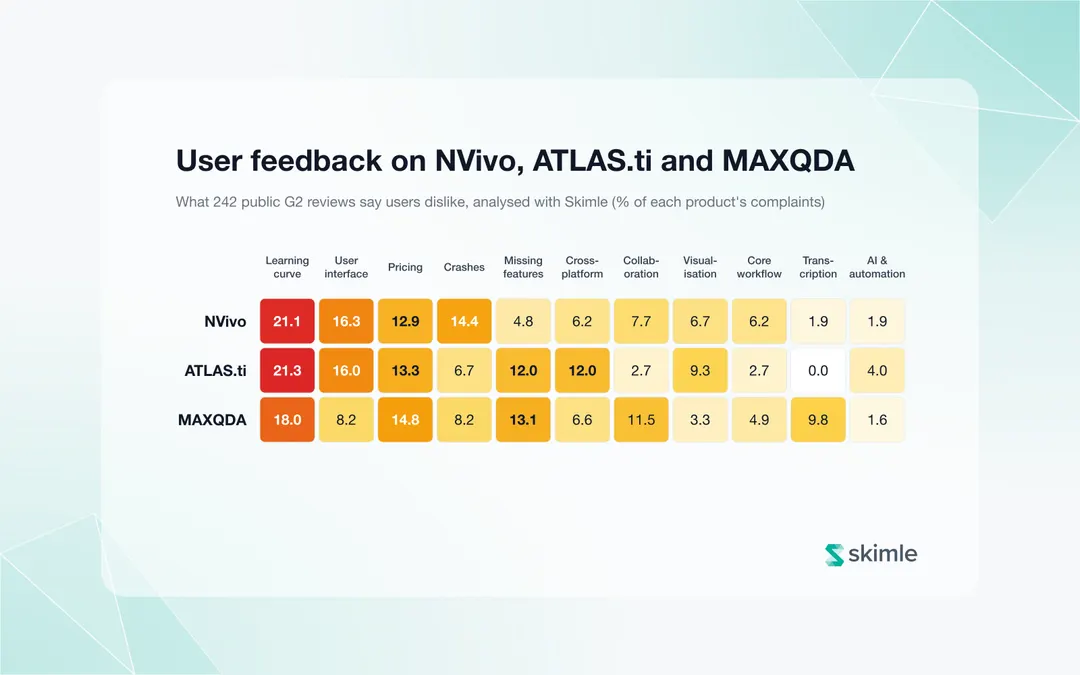
NVivo is the most feature-rich manual coding environment available, built up over 35 years. It handles multimedia data, complex matrix queries, and has deep analytical tools that Delve cannot match. The trade-off: NVivo's learning curve is steep and its commercial pricing is substantially higher.
For a student or early-career researcher comparing the two, NVivo pricing 2026: is it worth it? covers the full cost picture, including when institutional access changes the calculation.
Choose Delve over NVivo if your institution does not provide NVivo access, your project is text-based and straightforward, you need immediate collaborative access across a distributed team, and the learning curve of NVivo is not justifiable for your project scope.
Choose NVivo over Delve if your institution provides access at no cost, you work with multimedia data in a significant way, your analysis requires complex queries or visualisations, or your field treats NVivo as the methodological standard in peer review.
Delve vs Dedoose
Both are cloud-based and competitively priced. Dedoose is older and more established in academic mixed-methods research; it handles multimedia better and has stronger intercoder reliability statistics. Delve has a cleaner interface, better customer support, and simpler onboarding. See the Dedoose review 2026 for the full picture.
Choose Delve over Dedoose if ease of use matters more than analytical depth, your project is text-only, and you value responsive customer support.
Choose Dedoose over Delve if your project involves video or photo data, you need the statistical interrater reliability tools, or your mixed-methods design requires connecting qualitative codes to structured variables.
Delve vs MAXQDA and ATLAS.ti
MAXQDA and ATLAS.ti are both significantly more powerful than Delve for complex analytical work. MAXQDA's Analytics Pro tier handles mixed-methods integration at a depth Delve cannot approach. ATLAS.ti has a strong network of academic users and extensive visualisation tools. Both have steeper learning curves and higher costs. For an overview of how these tools compare to each other, see NVivo and MAXQDA alternatives 2026 and ATLAS.ti alternatives 2026.
Choose Delve over MAXQDA/ATLAS.ti if your project is relatively contained in scope, speed of setup matters, and you do not need the advanced analytical features the legacy tools offer.
Choose MAXQDA or ATLAS.ti over Delve if your analysis requires complex queries, network visualisations, or deep mixed-methods integration.
Delve vs Skimle
Delve and Skimle represent different approaches to the same underlying task. Delve is the eloquent manual tool for a task that Skimle does automatically. With Skimle the focus can be on interpretation, deeper exploration and theory building, not coding.
In Delve, the researcher reads every transcript and assigns codes. The tool manages the codebook and makes the process cleaner, but the analytical work of going through the data is entirely yours. For a 30-interview study, you are looking at hundreds of hours of reading and coding time.
In Skimle, the AI analyses your full corpus first. It reads all documents simultaneously, identifies themes and supporting evidence, and produces a structured thematic representation. The researcher's role then shifts to reviewing that structure: interrogating whether the themes are accurate, looking for what has been missed, and refining the interpretation. Every insight links back to the source excerpt, which links back to the original document, giving you the audit trail needed for rigorous research. The two-way transparency approach matters for researchers who need to defend AI-assisted findings.
Skimle also supports inductive and deductive coding in a single mode, metadata cross-tabulation, REFI-QDA export, and audio transcription. These features address several of Delve's main limitations.
On pricing, Skimle's academic plan comes to approximately €20/month, making the cost difference from Delve's Education plan ($18/month) modest relative to the difference in analytical capability.
Choose Delve over Skimle if your methodology or institution requires fully manual coding with no AI involvement in the analytical pass, or if intercoder reliability with multiple human coders is a core methodological requirement.
Choose Skimle over Delve if you want AI to handle the initial coding pass and concentrate your time on interpretation rather than data processing, your project involves 20 or more transcripts, you need transcription, anonymisation, or REFI-QDA export, or you want traceability from every finding back to source data.
For academic researchers who need to defend their methodology in peer review, the traceability that AI-native analysis offers is increasingly important. The AI qualitative data analysis checklist covers what documentation you need when AI tools are part of your workflow.
Who should choose Delve in 2026?
Delve is well-suited for a specific type of researcher and project.
Students and dissertation researchers who need a functional coding environment quickly, at an affordable price, and without a week of software training. The Education plan at $18 (€16)/month and 14-day free trial make it a low-risk starting point. For students choosing their first QDA tool, the easiest qualitative data analysis software guide covers the comparison in detail.
Small distributed teams doing straightforward qualitative coding projects. If you have two or three researchers in different locations who need to code the same transcript set collaboratively and compare results, Delve handles this as well as any tool at its price point.
UX researchers and product teams running interview programmes where speed of setup and clean collaborative output matter more than analytical depth. A team analysing 15–20 user interviews to feed a product sprint will find Delve faster to set up and easier to export from than the legacy CAQDAS tools.
Researchers with short-term projects (three to six months) who want monthly flexibility rather than an annual licence commitment.
Delve is probably not the right fit for:
- Projects with 20+ transcripts where manual coding time becomes a bottleneck
- Research involving audio, video, or image data
- Mixed-methods research requiring quantitative–qualitative integration
- Studies that need complex analytical queries or publication-quality visualisations
- Researchers who want REFI-QDA compatibility from the start
- Experts who want to explore what is possible with rigorous AI tools instead of sticking to previous generation methods.
If your project sits in this second category, the best qualitative analysis software overview covers a wider range of options with the relevant trade-offs.
Frequently asked questions
Is Delve free to use?
Delve is not free, but it offers a 14-day free trial with no credit card required. After the trial, you choose between the Education plan ($18/€16 per user/month) or the Standard plan ($50/€46 per user/month). There is no permanent free tier.
Does Delve have AI coding features?
Yes, but they are assistive rather than autonomous. Delve's AI can apply your existing codebook to transcripts (you review the suggestions), summarise interview content, help brainstorm subcodes, and act as a peer debriefer by raising questions about your coding. The AI does not independently analyse your corpus or generate themes from scratch. For AI that does the first analytical pass across all your documents, Skimle's automatic thematic analysis is a different approach.
Can Delve analyse video or audio data?
No. Delve is designed for text-based data: interview transcripts, focus group transcripts, and open-ended survey responses. If you have audio or video recordings, you need to transcribe them before importing into Delve. Tools like NVivo, ATLAS.ti, and MAXQDA offer direct video and audio coding. Skimle includes built-in transcription so you can upload audio directly.
How does Delve's pricing compare to NVivo and MAXQDA?
Delve's Education plan ($200/€185 per year) is substantially cheaper than NVivo academic pricing ($295–$595/€270–€545 per year) and cheaper than most MAXQDA academic licences ($230+/€210+ per year). The Standard plan ($432/€400 per year per user) is more competitive on price with MAXQDA but offers significantly less analytical depth. The key difference: NVivo and MAXQDA are annual licences with perpetual-access options; Delve is month-to-month, which suits short projects but accumulates on multi-year studies.
Is Delve suitable for academic research?
Yes, particularly for qualitative studies using thematic analysis or grounded theory on text-based data. Delve's workflow supports systematic coding, codebook development, and collaborative research teams. Its main academic limitation is the absence of REFI-QDA export, which creates friction if your institution or journal requires project archiving or if collaborators use different tools. For academic researchers who need AI assistance without sacrificing methodological rigour, the guide to using AI in qualitative research covers the relevant considerations.
What are the best alternatives to Delve?
The best alternative depends on what you need. For AI-assisted analysis with full traceability: Skimle. For mixed-methods integration at a similar price: Dedoose. For advanced analytical depth: NVivo or MAXQDA. For a full breakdown, the NVivo and MAXQDA alternatives comparison and the complete QDA tools comparison both cover the landscape.
More reading:
- The complete qualitative data analysis tools comparison for 2026
- Dedoose review 2026: features, pricing, and alternatives
- Free qualitative data analysis software in 2026
About the authors
Henri Schildt is a Professor of Strategy at Aalto University School of Business and co-founder of Skimle. He has published over a dozen peer-reviewed articles using qualitative methods, including work in Academy of Management Journal, Organisation Science, and Strategic Management Journal. His research focuses on organisational strategy, innovation, and qualitative methodology. Google Scholar profile
Olli Salo is a former Partner at McKinsey & Company where he spent 18 years helping clients understand the markets and themselves, develop winning strategies and improve their operating models. He has done over 1000 client interviews and published over 10 articles on McKinsey.com and beyond. LinkedIn profile
Sources
- Delve qualitative data analysis software - delvetool.com
- Delve AI features - delvetool.com/delve-ai
- Delve for students - delvetool.com/for-students
- Delve pricing - Capterra
- Delve reviews - Capterra
- Delve reviews - Software Advice
- Dedoose vs NVivo vs Delve - delvetool.com
- ATLAS.ti vs Dedoose vs Delve - delvetool.com
- Which qualitative data analysis software is easiest to learn? - delvetool.com
- Delve vs full-lifecycle platforms - Listen Labs
- How much time does manual coding take? - ResearchGate
- Delve - University of Arizona LibGuides