Consulting research synthesis means combining expert calls, management interviews, and documents into a coherent client deliverable. The workflow has six stages: set up a unified synthesis project across all source types, run a first-pass thematic analysis, triangulate across sources to find where they agree and conflict, write a structured primary research section with evidence footnotes, and defend the findings to a partner review. Tools like Skimle handle the cross-source aggregation; the analytical judgement remains with the team.
The gap between good primary research and a good client deliverable is wider than most consultants expect when they start a project.
You can run excellent expert calls. Management interviews can be probing and well-documented. You can have a strong data room analysis and a good read of the industry literature. But if you cannot synthesise across all of those sources into a coherent, evidence-backed narrative, the research quality does not matter. The deliverable will reflect the last conversation you had, the documents you remember best, and the senior person's prior views about what the research should show.
This guide covers the end-to-end workflow for consulting research synthesis: how to set up a synthesis project that works across multiple source types, how to build and refine a thematic structure, how to triangulate across expert calls, management claims, and public documents, and how to write and defend a primary research section that earns client trust.
What is the multi-source problem in consulting research?
Most strategy consulting projects and commercial due diligence engagements involve primary research that spans at least three types of sources:
- Expert calls: structured conversations with sector specialists, former executives, and independent analysts. Typically 15–30 per engagement.
- Management interviews: conversations with the target's or client's leadership team. Typically 5–15 per engagement, but each one is high-stakes.
- Documents: data room materials, industry reports, earnings call transcripts, regulatory filings, and public market analyses. These can run to hundreds of pages.
Each source type has different epistemic status. Expert calls give you informed outside-in views that are independent of the client or target's interests, but experts have limited and sometimes outdated visibility. Management interviews give you the inside view, but the inside view comes with obvious incentives to present the business favourably. Documents give you verifiable facts, but facts without interpretive context are often not enough to anchor a recommendation.
The synthesis challenge is that these sources live in different places (separate documents, different formats, different analytical tools), and the team that synthesises them is often not the same team that collected them. Expert calls were run by one set of analysts. Management interviews were led by a different senior. The data room was read by someone who has since moved to a different workstream.
When synthesis happens in this fragmented environment, the result is almost always a deliverable that reflects each source in isolation rather than the picture that emerges when they are read together. That picture (where sources agree, where they conflict, and what the conflicts reveal) is the most valuable thing primary research can produce. It is also the hardest thing to generate under time pressure.
The evidence-based strategy guide covers the analytical foundations for working with mixed qualitative sources; what follows is the operational workflow.
How to set up a synthesis project that works across all source types
The first decision is whether to synthesise in a single unified project or maintain separate projects per source type. The answer depends on the scale and timeline of the engagement.
For most strategy and CDD projects: a single unified Skimle project works best. Import all source documents into one project, and use metadata tags to identify source type (expert call / management interview / data room document / industry report). This makes cross-source synthesis possible in a single view. The metadata analysis and metadata tagging docs explain how to set this up.
For very large programmes (40+ expert calls plus 200+ pages of documents): consider running expert calls and documents as separate projects, running analysis on each separately, then doing a manual triangulation pass. The risk is that you miss cross-source patterns. For most engagements, a single project with clear metadata tagging is preferable.
Regardless of structure, a few setup decisions matter:
Agree on document naming conventions. Every document should be named clearly by source type, subject, and date: Expert_Call_JohnSmith_CompetitiveDynamics_2026-06-12.pdf. This is a small upfront investment that pays off significantly when you are navigating 40 documents in synthesis.
Capture key metadata before analysis. For expert calls: expert type, recency of role, geography, and topics covered. For management interviews: function, seniority, and key themes discussed. For documents: document type, date, and source institution. These metadata variables become analytical filters that make the synthesis much richer.
Mark source type explicitly. This is the most important metadata variable. The ability to ask "what do expert calls say about competitive dynamics, versus what management says, versus what the public documents show" is the analytical move that produces the most valuable output. It requires source type to be captured consistently before analysis begins.
First pass: what themes emerge across all sources?
The first analytical pass should be inductive, letting the themes emerge from the data rather than imposing a framework. This is true even if you have a predefined coding framework for the engagement. Predefined frameworks, by definition, code for what you expect to find. The first-pass inductive analysis tells you whether your framework is right.
In Skimle, the automatic thematic analysis runs across all uploaded documents and produces an initial category hierarchy. For a typical consulting research project, this first-pass output will include:
- Themes that map neatly to your predefined framework: these confirm that the primary research covers the ground you expected
- Themes that appear prominently but were not in your framework: these are the most valuable output of the first pass, because they represent things the research discovered rather than confirmed
- Themes that appear in your framework but not in the data: these are signals that certain hypotheses were not well-tested by the research design and may need additional fieldwork
Do not rush past this step. The first-pass inductive output often changes the structure of the deliverable in ways that make it more accurate. A theme that appears across 25 of 30 expert calls but was not on your original hypothesis list is important regardless of whether it fits your framework.
Once the first pass is complete, you can refine the category structure using Skimle's category management to merge, split, or rename themes, and then map the final structure to your deliverable outline.
Second pass: where do sources agree and where do they conflict?
Triangulation is the step that transforms a synthesis from a compilation to an analysis. It asks, for each major finding, whether the sources agree or conflict, and if they conflict, what that conflict reveals.
A useful triangulation framework for consulting research:
| Source | What it typically supports | What to be cautious about |
|---|---|---|
| Expert calls | Market dynamics, competitive landscape, sector risks | Variable recency; expert vantage points differ |
| Management interviews | Internal strategy, operational capabilities, financial rationale | Incentive to present positively; incomplete on external dynamics |
| Data room documents | Historical financials, contracts, operational data | Historical; may not reflect current trajectory |
| Industry reports and filings | Market sizing, regulatory context, competitor positions | Often lagging by 6–18 months; may not capture recent shifts |
For each major theme in your synthesis, a structured triangulation check looks like this:
- Expert calls say: [summary of expert view with supporting quotes]
- Management says: [summary of management view with supporting quotes]
- Documents show: [what the data room or public documents corroborate or contradict]
- Assessment: [where the sources agree and why; where they conflict and what the conflict reveals]
This four-part structure is the most useful template for writing the primary research section of a strategy deliverable or IC memo. It is also the most defensible format when a partner or client challenges the findings.
The most valuable triangulation outcomes are not agreements but conflicts. When expert calls describe competitive pricing pressure but management's IC presentation projects price improvements, that conflict is not an inconvenience to be smoothed over. It is the most important finding in the primary research. What management projects and what the market thinks are different things; the investment thesis needs to account for that gap.
For more on finding and working with divergent views, see expert call synthesis step-by-step and how to find themes across interviews.
How to write a primary research section with evidence footnotes
The primary research section of a consulting deliverable should be structured around findings, not sources. A common mistake is to organise the section by source type: "here is what the experts said, here is what management said, here is what the documents show." This is a reporting format, not an analytical format. It puts the burden of synthesis on the reader.
The better structure organises around findings, with sources cited as evidence:
Finding 1: [Headline claim, specific not vague] [Two to three sentences of synthesis across sources, with confidence level stated]
- Supporting evidence: [quote from expert call, citing source] / [management statement, citing interview] / [document reference]
- Conflicting evidence: [where evidence diverges, if applicable]
- Assessment: [your analytical interpretation of the evidence]
Finding 2: [Headline claim] [Same structure]
This format has three advantages for client deliverables. It is readable: a senior client can skim the headline findings without reading the supporting evidence. It is auditable: anyone who wants to know "where does this come from?" can follow the evidence chain. And it is defensible: claims are explicitly qualified by confidence level and conflicting evidence is represented rather than suppressed.
Evidence footnotes in consulting deliverables serve a different function from academic citations. They are not there to demonstrate that you read widely. They are there to allow your claim to be verified. The minimum viable footnote for a consulting primary research finding is: source type, source reference (call number, interview participant code, document name), and the verbatim quote or data point being cited.
Skimle makes this straightforward: every insight in the analysis links directly to the source document and quote. When you draft the primary research section, you can copy the relevant quotes with their source references from Skimle's document view or categories view directly into the deliverable.
For guidance on structuring a full qualitative research section for client audiences, see presenting qualitative research findings to executives and the consultant's guide to qualitative data analysis.
How to run a partner review and defend the synthesis
The partner review is the most important quality gate in the consulting research synthesis workflow. It is also the step most likely to expose synthesis that was built on impressions rather than evidence.
A good partner review of primary research findings is not a presentation. It is a structured challenge. The partner's job is to ask: "What is the evidence for this claim? What would have to be true for it to be wrong? Where is the expert view most uncertain?" These questions should be anticipated in how the synthesis is written.
Three preparation moves make the partner review go better:
Prepare your confidence map. Before the review, go through each major finding and assess: how many sources support this? Is there material conflicting evidence? What is the weakest point in the argument? Make these explicit in your notes, even if not in the deck. When the partner asks "how confident are you in this?", you need an answer that references the underlying evidence, not your gut feeling.
Anticipate the "so what?" question. Each primary research finding should connect to the investment thesis or strategic recommendation. A partner will ask "what does this mean for the deal?" about every finding. If the answer is "it is a risk we should monitor," that is an acceptable answer, but it needs to be explicit. If you cannot articulate the implication, the finding may not belong in the primary research section of the deliverable.
Know where the data is thin. Every primary research programme has gaps: hypotheses that were not well-tested, source types that were inaccessible, calls where the expert had limited visibility. The partner review will probe these gaps. Knowing them in advance, and having a clear statement of what the implications are for the overall confidence in the synthesis, is much better than being caught flat-footed.
The goal of the partner review is not to defend the synthesis. It is to stress-test it. The synthesis that survives a rigorous partner challenge is the one that should go in the deliverable. The one that does not survive the challenge needs more work.
For consulting teams who run this kind of multi-source synthesis regularly, the Skimle consultants and investors page covers how the tool fits the end-to-end workflow.
What makes consulting research synthesis defensible
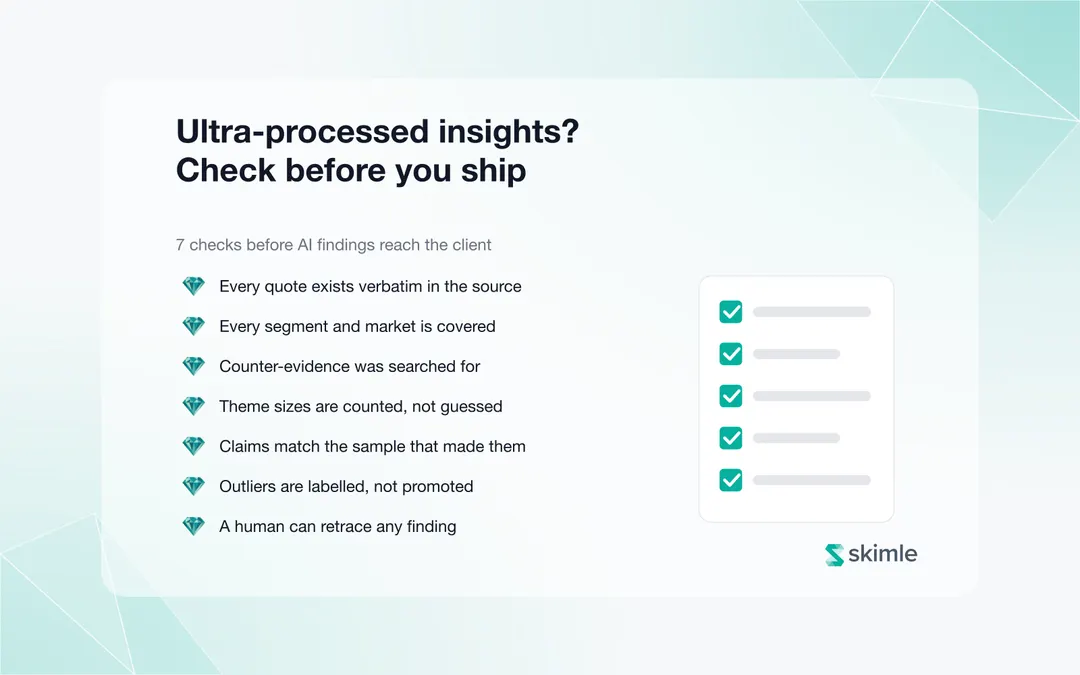
A synthesis is defensible when any claim in the deliverable can be traced to specific evidence, when that evidence can be shown to be representative rather than cherry-picked, and when the confidence level attached to the claim accurately reflects the quality and consistency of the underlying data.
In practice, this means:
Specific quotes, not paraphrases. "The expert felt that competitive pressure was manageable" is a paraphrase. "We're not losing deals on price. We're losing them on integration speed, and we've seen that for the past 18 months" (Source: Expert Call 14, former VP Sales at Competitor A) is a quote. The quote is verifiable and specific. The paraphrase is neither.
Representative sampling. When you cite a finding, it should reflect the balance of views in the dataset, not the most memorable or convenient quote. If 18 of 25 experts described competitive dynamics as moderate, but you cite the one expert who described them as severe (because the quote is more vivid), you are misrepresenting the evidence.
Explicit uncertainty. Not all findings are equally certain. A finding that appeared in 22 of 25 calls in consistent terms deserves a different confidence statement than one that appeared in 4 calls and was contested. Making confidence levels explicit is a sign of analytical rigour, not weakness.
Source independence. The most defensible findings are supported by multiple independent source types. A claim about market pricing that appears in expert calls, customer references, and publicly available pricing data is more defensible than one that appears only in expert calls. Triangulation is what converts interesting observations into defensible analysis.
These principles apply to any consulting research synthesis, but they matter most in high-stakes contexts: investment committee presentations, board strategy reviews, regulatory submissions. For those contexts, the audit trail matters as much as the finding itself.
If your team is running expert call programmes as part of primary research, the expert call synthesis guide covers that specific workflow. For PE and VC teams, qualitative primary research in private equity due diligence covers the deal-specific requirements. The primary research guide for consulting projects covers the full workflow from scoping to synthesis if you are starting from scratch.
Frequently asked questions
How do you synthesise across expert calls and documents at the same time?
Import all sources into a single project with metadata tags identifying source type, then run the analysis across the full corpus. The first-pass output will show which themes appear across multiple source types (the most credible findings) and which appear only in one type (requiring more scrutiny). Triangulation at the theme level (asking "what do calls say about this, what do documents show about this?") is most efficient when all sources are in a single analytical environment.
How many expert calls do you need before synthesis is worth doing?
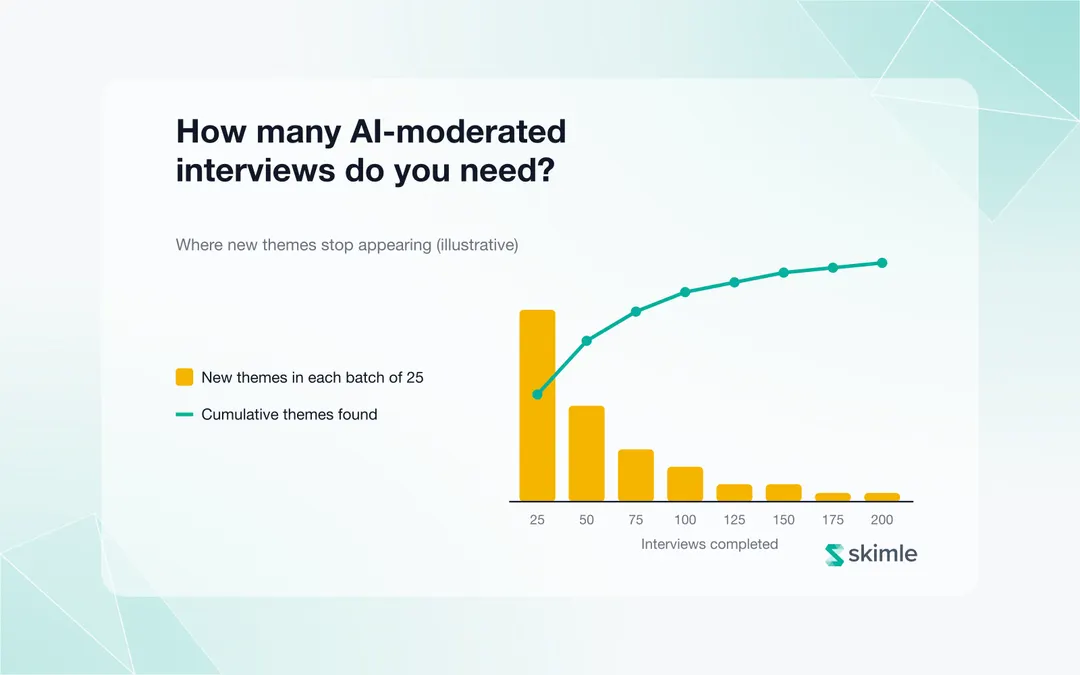
Meaningful cross-call synthesis is possible from around five to eight calls, which is enough to see whether themes are consistent or idiosyncratic. Most consulting projects that run 15–30 calls have enough data for a solid thematic structure. The diminishing returns in expert call programmes typically set in around 25–30 calls for a focused question. Beyond that, you are usually confirming themes rather than discovering new ones.
What is the right level of detail for a primary research section in a client deck?
At the deck level: one to two slides per major finding, with a headline claim, a two-sentence synthesis, and two to three supporting quotes. At the appendix or supporting memo level: full triangulation structure (what each source type shows, where they agree, where they conflict, and the assessment). The deck should contain the conclusions; the appendix should contain the evidence chain that supports them.
How do you handle source material that contradicts the client's preferred narrative?
Present it with appropriate confidence weighting and make the implications explicit. A primary research finding that contradicts the client's narrative is not a problem to be hidden. It is the most valuable thing the research can produce, because it is information the client does not already have. Frame it as "the primary research surfaced a dynamic that warrants attention" rather than as a challenge to the client's view. Partners and experienced clients will appreciate the rigour; the rare client who does not is a warning sign about the engagement.
Building a primary research synthesis for a client deliverable? Try Skimle for free and see how fast multi-source synthesis (from expert calls to documents to management interviews) can be structured into a defensible deliverable.
Related reading:
- Expert call synthesis: step-by-step guide
- How to get more from expert network calls
- Presenting qualitative findings to executives
About the authors
Henri Schildt is a Professor of Strategy at Aalto University School of Business and co-founder of Skimle. He has published over a dozen peer-reviewed articles using qualitative methods, including work in Academy of Management Journal, Organisation Science, and Strategic Management Journal. His research focuses on organisational strategy, innovation, and qualitative methodology. Google Scholar profile
Olli Salo is a former Partner at McKinsey & Company where he spent 18 years helping clients understand the markets and themselves, develop winning strategies and improve their operating models. He has done over 1000 client interviews and published over 10 articles on McKinsey.com and beyond. LinkedIn profile
Sources
- Evidence-Based Strategy: Using Qualitative Data for Decision Making — Harvard Business Review
- Primary Research in Management Consulting: Methods and Practice — McKinsey Quarterly
- Doing Qualitative Research: A Practical Handbook — Sage Publications
- Triangulation in Qualitative Research — Journal of Advanced Nursing (Wiley)
- Commercial Due Diligence: The Critical Success Factors — Journal of Private Equity (PM Research)