Qualitative market research uncovers the "why" behind customer behaviour, using methods like in-depth interviews, focus groups, ethnography and AI-assisted interviews to explore motivations, language and unmet needs in a market. It works with small, purposive samples and prioritises depth over statistical scale. AI tools like Skimle now let teams run and analyse it at a scale once reserved for surveys.
What is qualitative market research?
Qualitative market research is the practice of understanding markets, customers, and competitive dynamics through methods that explore meaning, context, and experience, rather than measuring frequency or testing statistical hypotheses. It answers questions that surveys cannot: why customers make the decisions they do, how they think about a product category, what language they use to describe their problems, and what unmet needs exist in markets where current offerings fall short.
The value of qualitative market research is not in the size of the sample but in the depth of the understanding it produces.
Why qualitative methods matter in market research
Quantitative market research is essential for measuring scale: how large is the segment, what percentage intend to buy, how does satisfaction compare to last year. But measurement requires knowing what to measure. Before you can design a survey that accurately captures customer preference, you need to understand how customers think about the category, what language they use, and what dimensions of the decision actually matter to them.
Qualitative research provides this foundation. The two approaches are most powerful in combination:
- Qualitative research to understand and frame the phenomenon
- Quantitative research to measure and generalise across the population
| Dimension | Qualitative market research | Quantitative market research |
|---|---|---|
| Core question | Why and how | How many and how much |
| Data | Words, behaviour, context | Numbers, ratings, counts |
| Sample | Small, purposive (often 10–40) | Large, representative |
| Methods | Interviews, focus groups, ethnography | Surveys, experiments, analytics |
| Output | Themes, motivations, language | Percentages, significance, trends |
| Best for | Exploring, framing, explaining | Measuring, sizing, generalising |
For a full treatment of when to use each, see quantitative vs qualitative research.
There is also a category of strategic market questions where qualitative research is not just foundational but the primary method. Understanding how a customer segment conceptualises an emerging category, or what is causing a pattern of attrition that does not show up cleanly in the data, requires interpretive depth that surveys cannot provide.
The main qualitative market research methods
Qualitative market research is not a single technique but a family of methods, each suited to a different kind of question. The most common are in-depth interviews and focus groups, but the toolkit is broader, and AI has recently added a genuinely new option.
In-depth interviews (IDIs)
One-to-one conversations between a trained researcher and a participant. In-depth interviews are the workhorse of qualitative market research, used when:
- Understanding individual decision processes and motivations is the goal
- The topic involves personal, sensitive, or professionally nuanced content that participants would not discuss in a group
- Participants are geographically dispersed or hard to bring together
- The research question requires extended exploration of a single respondent's experience
A standard IDI runs 45-90 minutes and is conducted by a skilled moderator who follows a discussion guide while remaining flexible enough to pursue productive tangents. Transcripts are then analysed (often using thematic analysis) to identify patterns across the participant set.
IDIs are the method most significantly affected by AI: AI transcription makes the recording-to-analysis transition much faster, and AI-assisted analysis can process corpora of 50-100 IDI transcripts that would previously have required months of manual coding. For the analysis workflow, see thematic analysis in qualitative research.
Focus groups
Moderated group discussions of 6-10 participants, typically lasting 90-120 minutes. Focus groups are useful when:
- The researcher wants to observe how customers talk about a topic with each other, not just with a researcher
- Social norms and group dynamics are part of what is being researched
- Rapid exploration of a topic across multiple participants is needed
- Concept stimuli (product designs, communications, packaging) are being evaluated
The weakness of focus groups is that group dynamics can suppress minority views and produce socially normalised responses rather than authentic individual perspectives. Participants may agree with dominant voices rather than expressing their own view. For sensitive topics or individual decision-making research, IDIs are typically more reliable.
Focus groups have declined somewhat in professional market research practice, in part because online qualitative methods and AI-assisted analysis have changed the cost-benefit equation: IDIs at scale are now more practical than they were, reducing the need to use focus groups as a substitute for individual depth.
Online qualitative communities and bulletin board studies
Asynchronous online communities in which participants respond to research tasks, stimuli, and prompts over a period of days or weeks. Advantages include:
- Participants engage on their own schedule, reducing respondent convenience barriers
- The extended period allows for diary-style research and observation of behaviour in context
- Responses are naturally text-based and ready for analysis without transcription
These methods produce large volumes of text data that are well suited to AI-assisted thematic analysis.
Ethnographic research and shop-alongs
Observing customers in their natural context: their homes, their workplace, their retail environment. Ethnographic market research captures behaviour as it actually occurs, not as customers recall or predict it.
Example: A consumer electronics company sends researchers to observe families using smart home devices over three evenings in their homes. The observations reveal that the primary users of voice-controlled devices are often not the people who purchased them, and that ease of use for secondary users is a significant adoption driver that survey research had not identified.
Shop-alongs (observing customers making purchase decisions in-store) are a common commercial application: the researcher accompanies the customer through a shopping trip, asking questions in real time about decision-making as it unfolds.
Projective techniques
Indirect exercises that surface associations respondents cannot easily articulate directly: word association, sentence completion, brand personification ("if this brand were a person…"), and collage or image-sorting tasks. Projective techniques are used inside interviews and focus groups to get past rational, rehearsed answers to the emotional and symbolic meanings behind a brand or category.
Social listening and open-text analysis
Not all qualitative data is collected in a room. Product reviews, support tickets, open-ended survey responses, app-store reviews and social media conversations are qualitative data a market already generates at scale. Analysing this text thematically turns "found" data into structured insight. See analysing NPS verbatim comments and analysing app store reviews at scale for worked examples.
AI-assisted qualitative interviews
AI-powered conversational interview tools conduct structured qualitative research conversations at scale. Skimle Ask conducts qualitative interviews that adapt follow-up questions to each participant's responses and generate transcripts ready for systematic analysis.
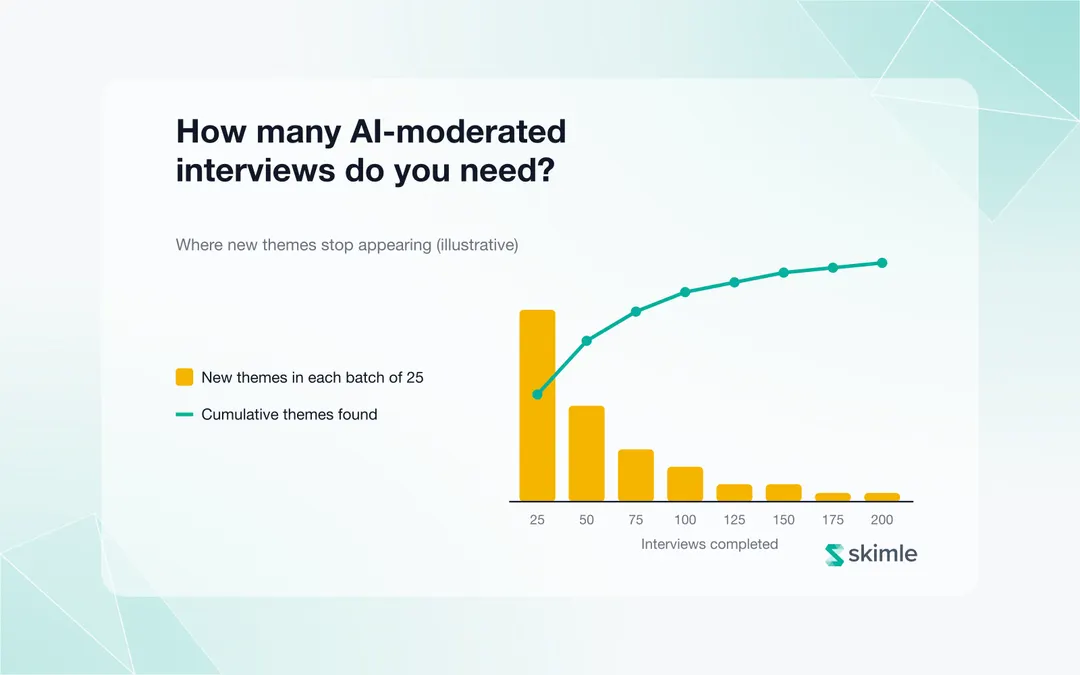
The case for AI-assisted interviewing in market research is practical: a study that previously required 30 human-moderated IDIs (scheduled, conducted, and transcribed over four to six weeks) can now be run as 200 AI interviews in a week, with integrated analysis. The trade-off is depth per conversation: AI interviews are less flexible and less capable of pursuing truly unexpected tangents than a skilled human moderator. For straightforward market research questions about experience and preference, this trade-off is often acceptable.
Choosing a method at a glance
| Method | Best for | Typical sample | Format |
|---|---|---|---|
| In-depth interviews | Individual decisions, sensitive topics | 12–40 | 1-to-1, 45–90 min |
| Focus groups | Group reactions, concept stimuli | 3–6 groups of 6–10 | Moderated group |
| Online communities | Diary-style, over-time behaviour | 30–100+ | Asynchronous, days–weeks |
| Ethnography / shop-alongs | Actual (not reported) behaviour | 6–20 | In-context observation |
| Projective techniques | Emotional, symbolic meaning | Within other methods | Exercises |
| Social listening / open-text | Existing reviews, tickets, verbatims | Hundreds–thousands | Found text |
| AI-assisted interviews | Depth at survey-like scale | 50–500+ | Adaptive AI chat |
Advantages and disadvantages of qualitative market research
Advantages
- Explains the "why". It reveals the motivations, context and language that numbers alone cannot.
- Flexible and exploratory. The discussion guide can follow unexpected but important tangents.
- Rich, actionable detail. Findings connect directly to real customer words and behaviour.
- Strong for early-stage questions. Ideal for new markets, concept development and framing surveys.
- Builds empathy. Stakeholders engage more with a customer's own words than with a chart.
Disadvantages
- Not generalisable. Small samples cannot tell you what share of the market holds a view.
- Traditionally slow and costly. Manual coding of 40 transcripts can take four to eight weeks.
- Interpretation-dependent. Quality hinges on the skill and rigour of the analyst.
- Prone to bias. Moderator influence and group dynamics can distort what participants say.
AI-assisted analysis addresses the two practical disadvantages most directly, cutting the time and cost of coding while keeping every finding traceable to its source. See why manual coding is too slow.
When is qualitative market research the right choice?
Exploration and hypothesis generation
When you are new to a market, a customer segment, or a product category, qualitative research is the starting point. Before designing a survey, you need to understand how customers frame the problem space, what vocabulary they use, and what dimensions they consider relevant. Qualitative research provides this map.
Example: A financial services firm considering a new retail product in a country where they do not currently operate runs 15 in-depth interviews with potential customers to understand how they think about savings, what concerns they have about financial products, and what trust signals they look for in a provider. The findings directly inform the quantitative survey and the product positioning.
Understanding the "why" behind quantitative patterns
When tracking data shows an unexpected change (a drop in NPS, an increase in churn, an uptick in a specific support category) qualitative research explains what is behind the number.
Example: A subscription platform's renewal rate falls three percentage points in Q3. Customer satisfaction surveys show no obvious change. In-depth interviews with a sample of churned customers reveal that a product update three months earlier changed a workflow that a specific user type relied on, and that this group is churning at twice the average rate. The finding leads to a targeted intervention for that user type.
This kind of work, explaining your own customer base rather than measuring a market broadly, is what customer insights research covers in detail: the two disciplines share methods but differ in scope.
Concept development and testing
Before a quantitative concept test, qualitative research identifies which concepts are worth testing and refines the language used to describe them. This prevents the quantitative study from spending resources testing concepts that qualitative research would have revealed as unviable or poorly framed.
Developing survey instruments
The items in a quantitative survey should reflect how customers actually think and talk about the topic, not how researchers assume they do. Qualitative research with the target population is the most reliable way to ensure survey items are framed in language that respondents understand and that captures the dimensions they find salient.
How to conduct qualitative market research in 6 steps
- Define the decision. Be explicit about the business question and what a useful answer looks like. Qualitative research is most valuable when it informs a specific decision.
- Choose the method and sample. Match the method to the question (see the table above) and recruit a purposive sample that covers the segments that matter.
- Write a discussion guide. Draft open, non-leading questions. See how to write the perfect interview guide and good interview questions to ask.
- Collect the data. Run the interviews, groups, or AI-led sessions, and capture verbatim transcripts rather than summary notes.
- Code and analyse systematically. Apply thematic analysis or another explicit coding approach so findings are grounded in evidence, not impressions. See how to code qualitative data. This bottom-up step is the one most commercial market research skips under deadline pressure; see the bottom-up rigour problem in commercial research for why, and what changes it.
- Report with traceability. Present themes backed by direct quotes, and connect each finding to the decision it informs. See presenting qualitative research findings to executives.
Examples of qualitative market research in practice
New market entry
A healthcare technology company is considering entering the UK primary care market with a digital triage tool. Before commissioning quantitative market sizing research, they run:
- Eight in-depth interviews with GP practice managers to understand current triage workflows, pain points, and decision-making authority
- Six interviews with clinical leads to understand safety concerns and regulatory requirements
- Six interviews with patients who have used digital health tools to understand adoption barriers
The qualitative phase reveals that the primary obstacle is not technology adoption but NHS procurement processes: GPs do not have individual purchasing authority, and the buying decision requires CCG-level approval. This finding fundamentally changes the go-to-market approach before any significant investment is made.
Customer voice programme
A B2B software company runs a continuous voice of customer programme using a combination of methods:
- Monthly in-depth interviews with a rotating sample of active customers
- Quarterly exit interviews with churned accounts
- Ongoing AI-assisted analysis of support tickets and NPS verbatims
- Annual deep-dive qualitative study of a specific customer segment or use case
The programme surfaces product improvement priorities, customer success team coaching opportunities, and competitive intelligence about what customers consider when evaluating alternatives. See always-on customer research for the operational design.
Brand perception study
A consumer goods brand wants to understand how their brand is perceived relative to three key competitors in two European markets. The qualitative research programme includes:
- 12 focus groups across the two markets (6 per market), split by current brand preference
- Mobile ethnography in which participants photograph instances of brand interaction over two weeks
- Online community with 50 participants per market engaging with brand stimuli
The qualitative findings reveal significant differences in brand associations between the two markets that the company's standardised brand tracking survey had been aggregating away. The findings inform distinct local marketing strategies for each market.
Product development research
A financial planning application wants to understand why users in the 35-50 age bracket are significantly less engaged with the product than younger users. Qualitative research includes:
- 20 in-depth interviews with users in the target segment
- Six shop-alongs observing how participants use personal finance tools in their daily lives
- Analysis of customer support transcripts for this age group
The research reveals that the 35-50 segment has significantly more complex financial situations (mortgages, pension planning, dependent children, business ownership) than the product was designed for, and that the navigation architecture implicitly assumes a simpler financial life. The finding leads to a product redesign initiative specifically for this segment.
How AI is expanding the scope of qualitative market research
The traditional constraint on qualitative market research has been analyst time. Coding and analysing 40 interview transcripts manually takes 4-8 weeks. This makes qualitative research expensive and slow, and limits how frequently organisations can run qualitative studies.
AI-assisted analysis changes this constraint directly. For research teams using Skimle:
- A corpus of 40 interview transcripts is processed for themes in hours, not weeks
- Cross-tabulation by customer segment, geography, or time period is built into the analysis
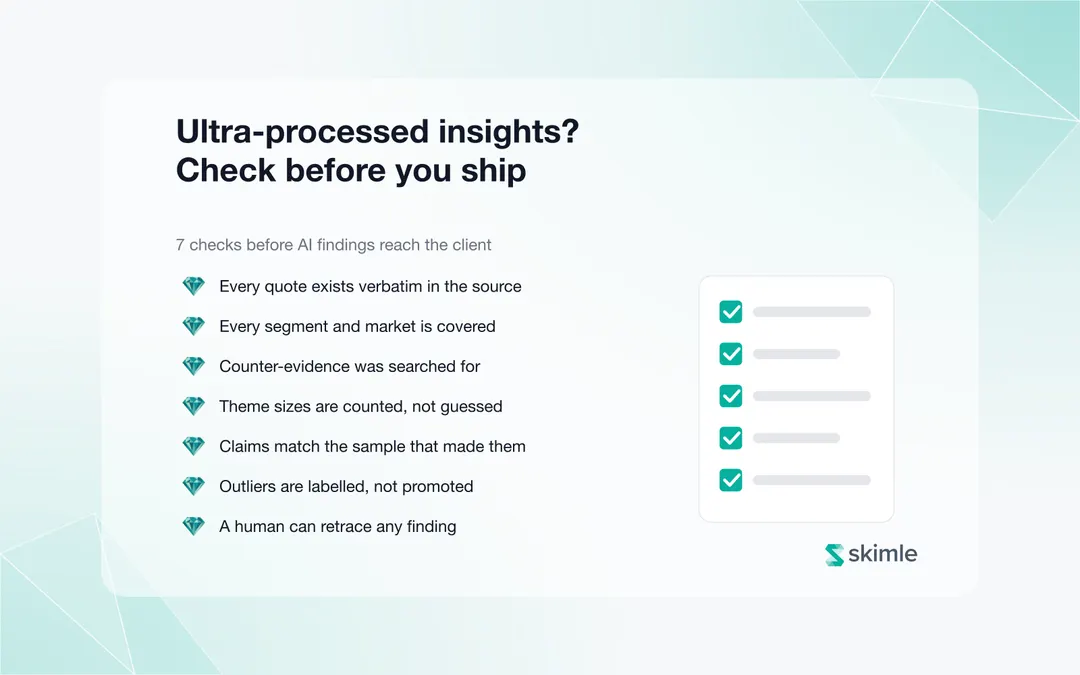
- Every theme is traceable to the specific quotes that support it, making findings auditable
Combined with AI-assisted interviewing (Skimle Ask), qualitative market research can now be run at a scale previously associated only with quantitative methods, while preserving the depth and contextual richness that makes qualitative data valuable. For a full breakdown of the analysis-layer tools available in 2026, organised by category, see customer research analysis tools: the 2026 landscape by category.
For teams working in product management, consulting, or academic research, this represents a meaningful expansion in what qualitative research can contribute to decisions.
Frequently asked questions
How many participants do you need for qualitative market research?
The right sample size for qualitative market research depends on the diversity of the population and the scope of the research question. For a homogeneous customer segment with a narrow research question, 12-15 IDIs often reaches saturation. In a widely cited study in Field Methods, Guest, Bunce and Johnson (2006) found that saturation was largely reached within the first twelve interviews for a homogeneous sample. For a diverse market or multiple distinct segments, 25-40 or more may be needed. Focus groups are typically run in sets of 3-4 per segment or condition. The principle is the same as in academic qualitative research: continue until additional participants are not producing new themes.
Can qualitative market research replace quantitative research?
No, and it should not try to. Qualitative research cannot tell you the percentage of customers who hold a particular view, or whether a difference between two groups is statistically significant. These require quantitative methods with representative samples. Qualitative research tells you what is happening and why; quantitative research tells you how widely it applies and with what magnitude. Both are needed for good market decisions.
What is the difference between qualitative market research and ethnographic research?
Ethnographic research is one type of qualitative market research: specifically, research conducted through observation in naturalistic settings over an extended period. Most qualitative market research is interview-based rather than ethnographic. Ethnographic approaches are most appropriate when actual behaviour (as opposed to reported behaviour) is the focus, and when the context in which the behaviour occurs matters analytically.
How do you ensure quality in qualitative market research?
Key quality indicators include: a clearly defined and appropriate sample, a skilled moderator or interviewer who does not lead participants, verbatim transcription rather than summary notes, systematic analysis with explicit coding rather than impressionistic reading, and transparent reporting that connects findings to specific evidence in the data. Third-party review of the analysis, or structured inter-rater reliability checks on coding, further strengthen credibility.
What are the main qualitative market research methods?
The main qualitative market research methods are in-depth interviews, focus groups, online research communities, ethnography and shop-alongs, projective techniques, social listening and open-text analysis, and, increasingly, AI-assisted interviews. Interviews and focus groups remain the most widely used.
Is a focus group qualitative or quantitative?
A focus group is a qualitative method. It gathers non-numerical data, such as opinions, language, and group interaction, from a small moderated group, rather than measuring how many people hold a view. Counting responses across many focus groups does not make it quantitative.
What are the advantages of qualitative market research?
Its main advantages are explaining the "why" behind behaviour, flexibility to explore unexpected findings, rich and actionable detail grounded in real customer language, and suitability for early-stage questions like new-market entry and concept development. Its main limitation is that small samples cannot be generalised statistically.
Ready to run qualitative market research that delivers depth at scale? Try Skimle for free and see how AI-assisted analysis turns customer interview transcripts into systematic, comparable, and defensible findings, without the weeks of manual coding.
Related reading: What is market research? Definition, types and examples | Voice-of-market research: building a complete picture | Customer discovery interviews: a practical guide
Further reading for market research teams: how to analyse concept test interviews and qualitative research for CPG brands.
About the authors
Henri Schildt is a Professor of Strategy at Aalto University School of Business and co-founder of Skimle. He has published over a dozen peer-reviewed articles using qualitative methods, including work in Academy of Management Journal, Organisation Science, and Strategic Management Journal. His research focuses on organisational strategy, innovation, and qualitative methodology. Google Scholar profile
Olli Salo is a former Partner at McKinsey & Company where he spent 18 years helping clients understand the markets and themselves, develop winning strategies and improve their operating models. He has done over 1000 client interviews and published over 10 articles on McKinsey.com and beyond. LinkedIn profile
Sources
- Qualitative Marketing Research, Mariampolski (2001), SAGE
- Qualitative Consumer Research: Taking a Step Back, Belk, Fischer & Kozinets (2012), SAGE
- The Market Research Toolbox, McQuarrie (2015), SAGE
- ESOMAR Global Market Research Report 2023
- How Many Interviews Are Enough? An Experiment with Data Saturation and Variability, Guest, Bunce & Johnson (2006), Field Methods