Market research is the systematic process of collecting, analysing, and interpreting information about a market: the customers within it, the competitors operating in it, and the conditions that shape it. Businesses use market research to inform decisions: whether to enter a market, how to price a product, what customers actually want, and where unmet needs exist. Academic researchers use it to understand market structures, consumer behaviour, and economic dynamics.
The field spans a wide range of methods, from large-scale quantitative surveys to in-depth qualitative interviews, and increasingly, AI-assisted analysis that combines the scale of quantitative approaches with the depth of qualitative ones.
A short definition of market research
Market research answers one of three broad questions:
- What is happening in the market? (descriptive research: size, share, behaviour, trends)
- Why is it happening? (explanatory research: motivations, causal relationships, drivers)
- What is likely to happen? (predictive research: forecasts, scenario analysis, leading indicators)
Most market research projects combine more than one of these. A product launch study might describe the target segment, explain why customers in that segment choose as they do, and predict whether a new offering would be adopted.
Primary vs secondary market research
The first distinction in market research is where the data comes from.
Primary research involves collecting new data directly from the market: surveying customers, interviewing experts, observing shoppers, testing products with users. The researcher designs the study and controls what is collected.
Secondary research involves analysing data that already exists: published market reports, government statistics, academic studies, competitive intelligence from public sources. It is faster and cheaper than primary research but limited by what others have already collected and published.
Most market research programmes combine both: secondary research establishes the context and frames the questions; primary research answers the specific questions the secondary sources cannot.
Quantitative vs qualitative market research
The second major distinction is between quantitative and qualitative approaches.
Quantitative market research
Quantitative research measures market phenomena numerically. It answers questions like: How many customers are in this segment? What percentage would switch to a lower-price alternative? How does purchase intent vary by demographic group?
Methods include:
- Surveys (online, telephone, face-to-face) with large, representative samples
- Market experiments (A/B tests, controlled trials) testing specific variables
- Transactional data analysis of purchase behaviour, pricing sensitivity, or engagement
- Tracking studies that measure the same metrics over time to identify trends
Quantitative market research is most valuable when you need to estimate scale, test a hypothesis, or establish a pattern across a large population.
Qualitative market research
Qualitative research explores what customers think, feel, and do, and why. It answers questions that numbers cannot: What language do customers use to describe this problem? How do they actually make purchasing decisions? What workarounds have they developed because the current solutions do not fully meet their needs?
Methods include:
- In-depth interviews (IDIs) — one-to-one conversations exploring experience in depth
- Focus groups — moderated group discussions of 6-10 participants
- Ethnographic research — observing customers in their natural context
- Diary studies — participants record their experience in real time over a period
- AI-assisted interviews — structured conversational AI that conducts and transcribes research conversations at scale
Qualitative market research is most valuable when you need to understand the reasoning behind behaviour, discover unexpected needs, or develop insights that inform the design of quantitative instruments.
For a full exploration of the comparison, see quantitative vs qualitative research.
Types of market research by purpose
Customer segmentation research
Divides the market into distinct groups of customers with shared characteristics, needs, or behaviours. Quantitative segmentation typically uses statistical clustering; qualitative segmentation adds depth by understanding the motivations and decision processes within each segment.
Example: A software company surveys 2,000 current and potential customers to identify distinct user segments by workflow type and technical sophistication. Follow-up qualitative interviews with members of each segment reveal what features each group finds most valuable and what would drive switching decisions.
Pricing research
Explores what customers are willing to pay and how price changes affect demand. Methods range from direct price sensitivity surveys (Van Westendorp, Gabor-Granger) to qualitative exploration of how customers think about value.
Example: A subscription service uses a survey to measure willingness to pay across three proposed pricing tiers, then follows up with in-depth interviews with respondents from each tier to understand how they frame value and what the price communicates to them about the brand.
Concept and product testing
Tests new products, concepts, or features with target customers before launch. Qualitative concept testing explores initial reactions, questions, and associations; quantitative validation measures adoption likelihood across a representative sample.
Example: A healthcare company tests three alternative concepts for a patient communication app with 30 qualitative interviews exploring how patients respond to each concept's design and language, then tests the strongest concept quantitatively with 500 respondents to estimate adoption potential.
Customer experience research
Explores how customers experience a product, service, or organisation at each touchpoint. Methods include customer journey mapping, service safaris, and systematic analysis of feedback data.
Example: A bank analyses customer service call transcripts, NPS verbatims, and branch observation notes to map the points in the customer journey where friction is highest and the language customers use when they experience that friction. This kind of work, focused on explaining your own customers rather than measuring a market broadly, sits closer to customer insights research than to market research proper; see that guide for where the two disciplines diverge.
Competitive intelligence
Systematically tracks what competitors are doing and how the market is responding to them. Sources include competitor review analysis, expert interviews, earnings call monitoring, and customer switching study interviews.
Example: A logistics company runs quarterly expert interviews with industry observers and former competitor employees, combined with systematic analysis of competitor review platforms, to track shifts in competitor positioning and customer perception. See voice-of-market research for the full methodology.
Brand and perception research
Measures and explores how a brand is perceived in the market: awareness, associations, trust, and differentiation relative to competitors. Brand tracking surveys provide quantitative tracking; qualitative research explores the associations and meanings behind the numbers.
Examples of market research in practice
Consumer goods: A food and beverage brand wanting to enter a new country conducts secondary research on market size and competitive structure, in-depth qualitative interviews with local shoppers to understand purchase drivers and cultural associations with the category, and a quantitative survey to test purchase intent for three concept designs.
B2B software: A project management tool company conducts regular customer discovery interviews with their target customer segment (operations managers at mid-sized firms) to understand workflow problems, using the findings to prioritise product development. See customer discovery interviews for the interview methodology.
Public sector: A government department consults stakeholders on a proposed policy change using a structured online consultation platform, gathering thousands of open-text responses that are systematically coded to identify patterns of support, opposition, and suggested modifications across different stakeholder groups. See stakeholder consultation analysis.
Academic research: A management researcher studies how startups enter established markets using a qualitative case study approach: in-depth interviews with founders and executives, document analysis of investor presentations and media coverage, and observation of industry events. The findings generate theory about market entry strategies that is then tested quantitatively across a larger sample.
How AI is opening new fields in market research
The traditional market research trade-off was straightforward: qualitative research gives you depth, quantitative research gives you scale. You could have one or the other, depending on your budget and question.
AI is reshaping this trade-off in three specific ways.
Qualitative research at scale
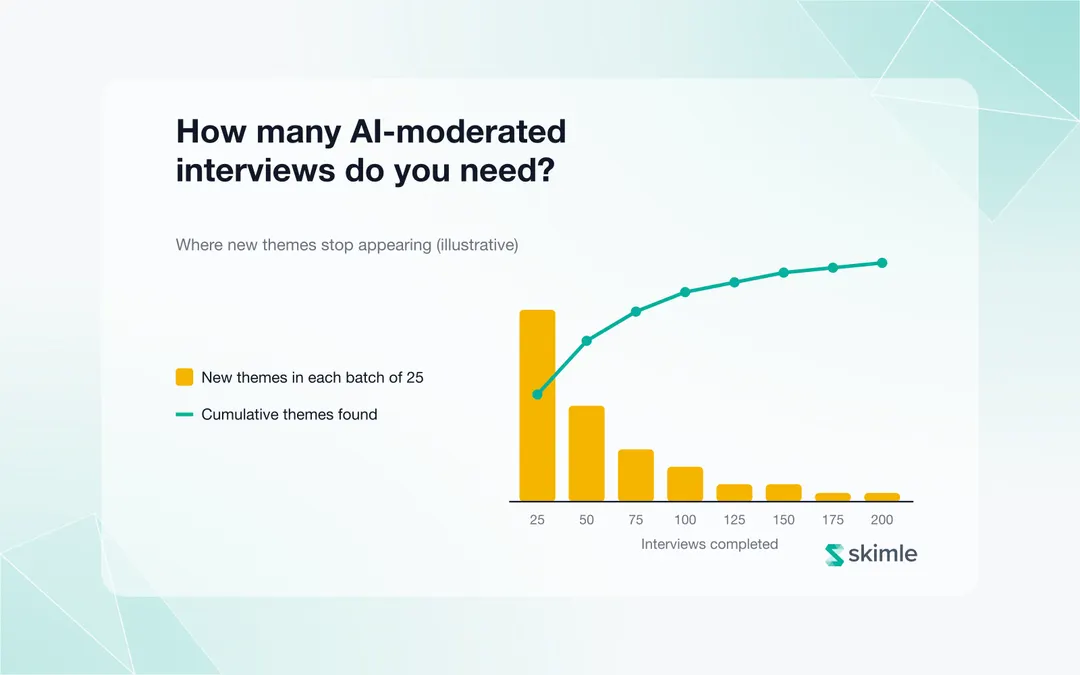
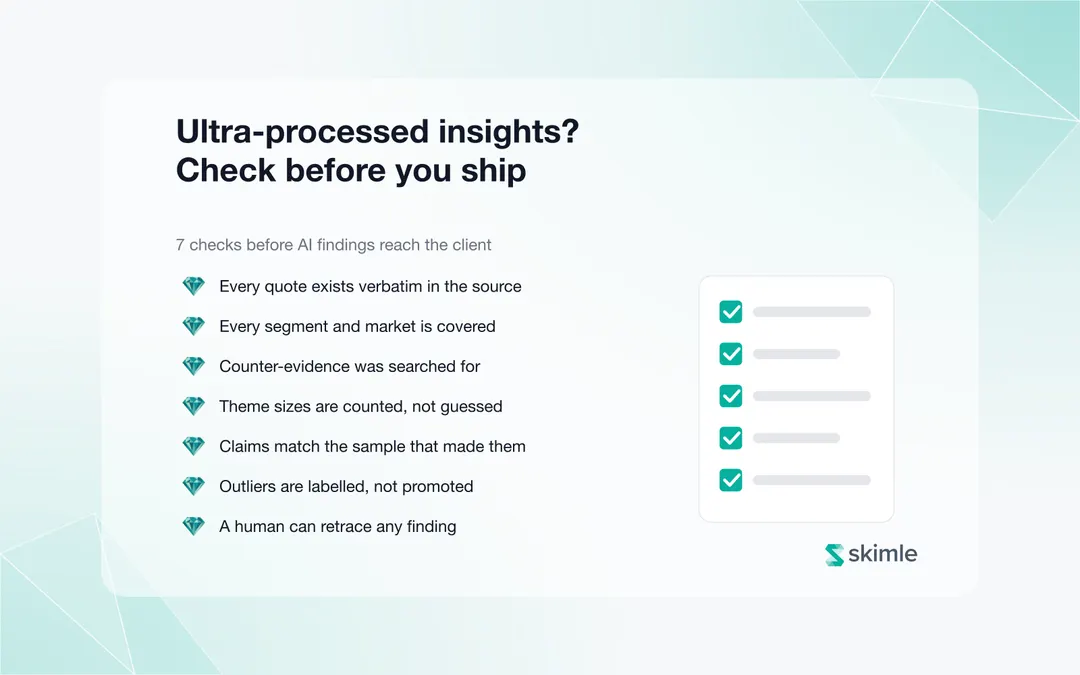
Manual qualitative analysis has always been constrained by how much time a researcher can spend. Analysing 200 in-depth interview transcripts systematically would require a team of researchers working for months. With AI-assisted analysis, the same corpus can be processed in hours, producing thematic output with full traceability to source quotes.
This opens up qualitative research at sample sizes previously only associated with surveys. A brand that once ran eight focus groups (say, 80 participants) to understand customer perception can now conduct 80 structured interviews, analyse all of them systematically, and produce findings with significantly more depth, comparability, and credibility than focus group data alone.
AI-powered interviewing
AI-powered qualitative interview platforms (such as Skimle Ask) can conduct structured conversational interviews at scale. A single research project can gather qualitative responses from hundreds of participants simultaneously, with the AI adapting follow-up questions based on each participant's responses. The resulting transcripts are immediately available for analysis.
This is not a replacement for human interviewing in all contexts. Sensitive topics, expert calls, and research requiring deep rapport still benefit from a skilled human interviewer. But for research questions where scale and consistency matter (understanding how a large customer base experiences a product, or gathering stakeholder views across a broad population), AI interviewing produces richer data than a survey while remaining feasible within standard research timelines.
Better analysis of qualitative interviews
The most immediate impact of AI on market research is not in data collection but in analysis. Most organisations have more qualitative data than they have ever analysed: NPS verbatims, support tickets, customer interview transcripts, focus group recordings, social media content. AI-assisted analysis makes it practical to process all of this systematically, rather than sampling opportunistically.
The analytical output (themes with supporting quotes, cross-tabulation by customer segment, patterns over time) gives market researchers a level of evidence that was previously impractical to generate from qualitative sources. See qualitative market research for a full guide to this application, and see customer research analysis tools: the 2026 landscape by category for how the software doing this work in 2026 breaks down by category.
Frequently asked questions
What is the difference between market research and consumer research?
Consumer research focuses specifically on the behaviour, motivations, and decision-making of individual consumers. Market research is broader: it encompasses consumer research, but also competitive analysis, market sizing, pricing research, and industry dynamics that do not focus on individual consumers. In practice, the terms are often used interchangeably.
How much does market research cost?
Costs vary enormously by method and scale. Secondary research (desk research using published sources) can be done for little cost beyond researcher time. A small qualitative study (10-15 in-depth interviews, professional analysis) typically costs €8,000-25,000 (€7,300-22,900) including recruitment, incentive payments, and analysis. Large-scale quantitative surveys with professional fieldwork can cost anywhere from €15,000 (€13,700) for a simple online survey to several hundred thousand euros for complex multi-country studies with specialist populations.
How long does market research take?
A desk research summary can be produced in days. A qualitative study with 20 interviews (including recruitment, data collection, transcription, and analysis) typically takes 6-12 weeks from commission to report. A large quantitative tracking study with multiple waves can run for months or years. AI-assisted approaches to analysis can significantly compress the analysis phase: what might take 3-4 weeks of manual coding can be done in days, though the interpretation and reporting phase still requires researcher time.
What makes market research reliable?
Reliability in market research depends on: a well-defined research question, a representative or purposively appropriate sample, a data collection instrument that measures what it intends to measure, systematic analysis that is transparent and reproducible, and conclusions that are proportionate to the strength of the evidence. Both qualitative and quantitative research can be rigorous or sloppy; the method does not determine reliability, the design and execution do.
Ready to run market research that gives you both depth and scale? Try Skimle for free and see how AI-assisted qualitative analysis turns customer conversations into systematic, comparable findings, without the weeks of manual coding.
Related reading: Qualitative market research: overview and examples | Voice-of-market research: building a complete picture | Customer discovery interviews: a practical guide
About the authors
Henri Schildt is a Professor of Strategy at Aalto University School of Business and co-founder of Skimle. He has published over a dozen peer-reviewed articles using qualitative methods, including work in Academy of Management Journal, Organisation Science, and Strategic Management Journal. His research focuses on organisational strategy, innovation, and qualitative methodology. Google Scholar profile
Olli Salo is a former Partner at McKinsey & Company where he spent 18 years helping clients understand the markets and themselves, develop winning strategies and improve their operating models. He has done over 1000 client interviews and published over 10 articles on McKinsey.com and beyond. LinkedIn profile