Qualitative pricing research uses interviews to understand why customers value a product the way they do: what they compare it to, which features carry the value, where their price limits come from and which objections would stop a purchase. Use it before a quantitative pricing study to design the right questions, or after one to explain the numbers.
Pricing is one of the highest-stakes decisions a company makes and one of the least researched. When it is researched, it is usually with surveys: Van Westendorp's price sensitivity questions, Gabor-Granger purchase-likelihood ladders or conjoint analysis. These produce numbers, and the numbers are useful to pricing, commercial and product teams alike. They rarely say why a customer thinks something is too expensive, and without the why, it is hard to know whether to lower the price, change the package or change the story.
What can qualitative pricing research tell you that surveys cannot?
Four things, mainly.
- The reference point. People judge price against something: a competitor, the tool they use today, the cost of a consultant, the price of a coffee. Knowing the reference changes the pricing conversation completely. At $50 (€45) a month, a tool feels expensive next to a $10 (€9) app and cheap next to a day of an analyst's time.
- The value drivers. Which features or outcomes carry the value in the customer's mind. Often it is one or two, and they are not the ones the product team is proudest of.
- The objections. What would stop the purchase at a given price: budget cycles, approval thresholds, a lack of proof, fear of lock-in. Many "too expensive" answers are really "I can't justify it to my boss yet".
- The packaging. How customers want to buy: per user, per project, per month, annually, with a free trial. Packaging problems often look like price problems in survey data.
How does Van Westendorp pricing work, and where does qual fit?
Peter van Westendorp introduced the Price Sensitivity Meter at the ESOMAR Congress in 1976. It asks respondents four questions about a product:
- At what price would it be so expensive that you would not consider buying it?
- At what price would it be so cheap that you would doubt its quality?
- At what price would it start to seem expensive, but still worth considering?
- At what price would it be a bargain?
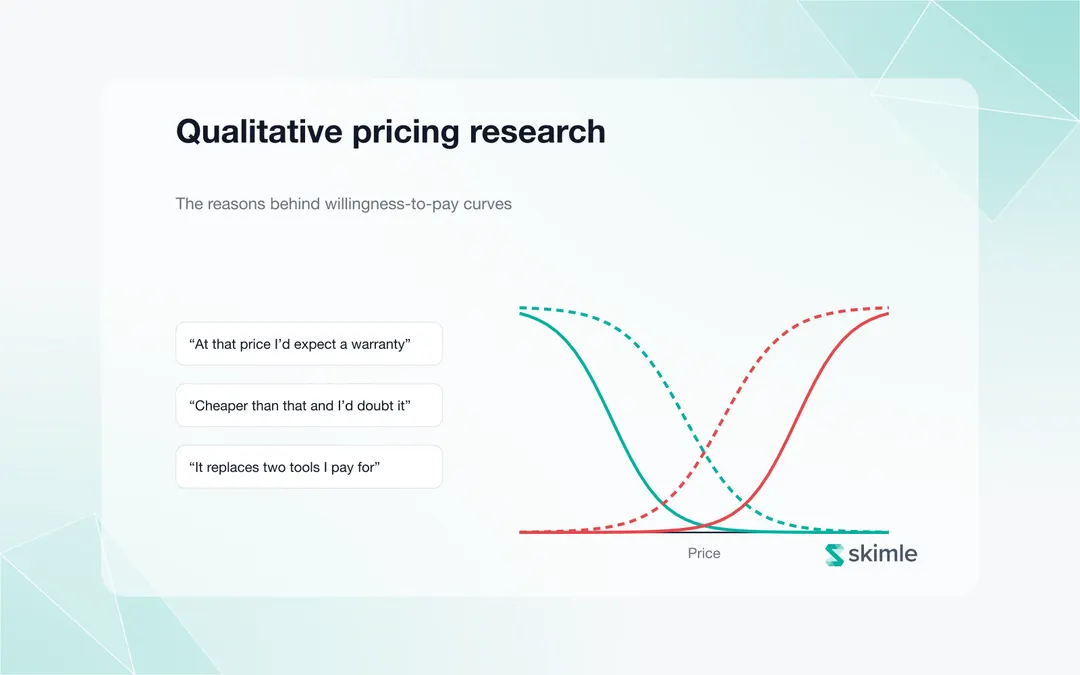
Plotting the cumulative answers produces four curves, sketched on the cover of this post, whose intersections suggest an acceptable price range. It is quick and widely used. What it does not provide is the reason behind each threshold. Adding a single open follow-up ("What makes that price feel too expensive?") or running a set of interviews alongside the survey fills that gap. The quotes on the cover are the kind of answers that explain a curve.
The same applies to conjoint analysis: it estimates how much each feature is worth, but only for the features you included. Interviews beforehand tell you which features belong in the design.
How do you run a willingness-to-pay interview?
A willingness-to-pay interview is a semi-structured conversation, typically 30 to 45 minutes. A structure that works for both B2B and consumer products:
1. Current situation (10 minutes). How do they solve the problem today? What does it cost them in money, time and frustration? This establishes the reference point without mentioning your price.
2. Value exploration (10 minutes). Show or describe the product. Which parts matter most to them and why? What would it change for them? Use the laddering technique to move from features to outcomes.
3. Price reaction (10 minutes). Introduce price late. Ask open questions first ("What would you expect to pay for this?"), then react to a specific price or range. Probe every reaction: "What makes that feel high?", "What would make it feel worth it?"
4. Buying process (5 to 10 minutes). Who approves the spend, what thresholds apply, how they would want to buy, what would make them try it.
Common mistakes to avoid:
- Asking "would you pay X?" and taking yes for an answer. Stated willingness to pay is optimistic. Probe for the reasons and the conditions, not the yes.
- Anchoring too early. Mention a price in the first five minutes and every later answer is relative to it.
- Interviewing only fans. Include lapsed customers, lost deals and people who chose a competitor. Their reasons are the most valuable.
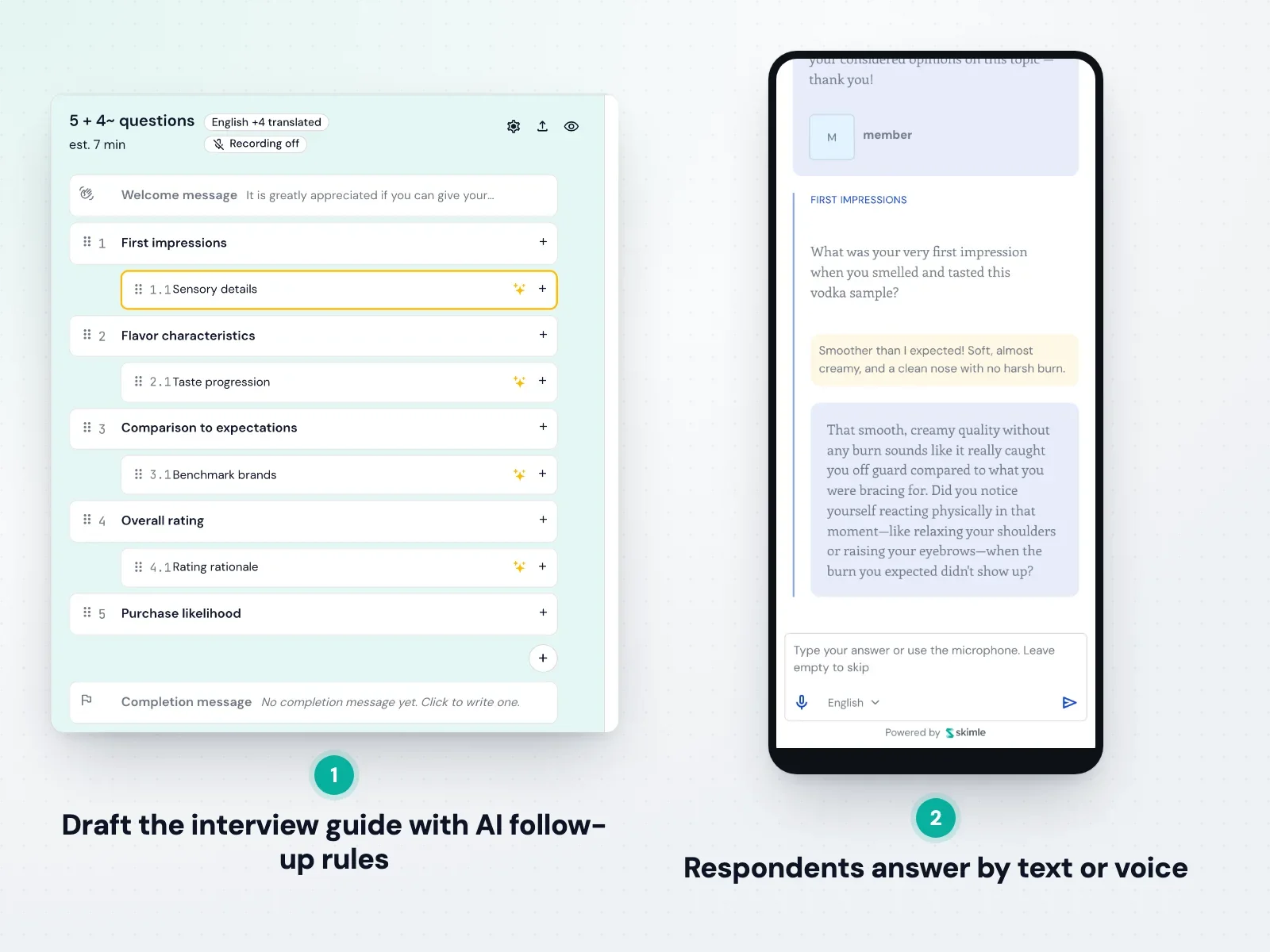
With AI-moderated interviews you can run this guide with dozens of customers in parallel and ask the same follow-ups every time. In Skimle Ask you write the guide and the follow-up rules once, as shown below, and respondents answer by text or voice.
If your team runs pricing or proposition studies, see how this fits the market research and customer insights workflow or, for strategy work, the consultants and investors workflow.
How do you analyse pricing interviews?
Code the transcripts into five categories, then compare across segments.
| Category | What to capture | Example codes |
|---|---|---|
| Reference points | What they compare the price to | Current tool, consultant day rate, in-house time |
| Value drivers | What carries the value | Time saved, risk reduced, better client output |
| Price reactions | Their response to price levels, and why | "Fair for teams", "Too high for one user" |
| Objections | What would stop them | Budget timing, approval limit, proof needed |
| Packaging preferences | How they want to buy | Annual, per project, trial first |
Then compare segments. Small and large customers, new and existing, different countries: pricing perceptions differ more by segment than almost any other topic. A price that is "too low to trust" for enterprise buyers can be "too high to try" for freelancers. Skimle's metadata analysis ranks those differences by size and shows the quotes behind each, so the segment story is grounded in what each group actually said.
How do you turn pricing interviews into a pricing decision?
Interviews will not hand you a number. They give you the reasoning to choose between options. Translate the analysis into four outputs:
- The price frame. What should the price be compared to in your communication? If customers compare you with an analyst's time, say so on the pricing page.
- The packaging. Which features belong in which tier, based on value drivers by segment.
- The objection handlers. For each frequent objection, what proof or offer removes it: a trial, a case study, a monthly option.
- The test plan. Which price points or packages to test quantitatively or in-market, now that you know which ones are plausible.
A common pattern, especially for new products, is that many early "too expensive" answers turn out to mean "I don't yet know what I'd use it for". When the interviews show that, the fix is usually a trial and clearer examples rather than a lower price.
Frequently asked questions
How many interviews do you need for qualitative pricing research?
Usually 15 to 30 per main segment. Pricing perceptions vary a lot between segments, so it is better to cover each important segment properly than to spread the sample thin.
Should I ask customers directly what they would pay?
You can ask, but treat the number as a weak signal. The reasons behind it, and the reference points they use, are more reliable and more useful than the figure itself.
When should I use Van Westendorp versus interviews?
Use interviews first when you do not yet know what customers compare you with or which features carry the value. Use Van Westendorp or conjoint when you need a quantified price range across a large sample. The strongest studies combine both, with open follow-up questions in the survey.
Can AI interviews be used for pricing research?
Yes, especially for reaching many customers quickly and asking consistent follow-ups. For high-value B2B deals or very sensitive pricing, combine them with a few human-moderated interviews, where an experienced interviewer can probe negotiation dynamics.
Planning a pricing study? Try Skimle for free: run willingness-to-pay interviews with Skimle Ask and analyse value drivers and objections across segments, with every finding linked to the customer's own words.
Related reading:
- Win-loss interview questions guide
- Customer discovery interviews: a practical guide
- How to analyse customer interviews for market research
About the author
Olli Salo is a former Partner at McKinsey & Company where he spent 18 years helping clients understand the markets and themselves, develop winning strategies and improve their operating models. He has done over 1000 client interviews and published over 10 articles on McKinsey.com and beyond. LinkedIn profile