The best qualitative research tools for market research agencies in 2026 combine fast transcription, structured AI-assisted analysis, and clean client reporting. For transcription, Otter.ai and Skimle work well. For analysis, Skimle, Dovetail, NVivo, and MAXQDA each suit different team sizes and budget levels. For agency work specifically, cloud-based tools with multi-project management and Word or PowerPoint export matter most.
Market research agencies live by turnaround time. A client brief arrives on a Tuesday; a debrief deck is due by Friday. The right tools speed that up without turning your agency into a race-to-the-bottom commodity vendor; see the commoditisation trap for why that distinction matters commercially. Between those two points sits the hard work of qualitative analysis: reviewing 15 in-depth interviews, pulling out themes, building a narrative, and packaging findings in a format the client can act on.
The tools that agencies reach for in 2026 look quite different from what worked five years ago. AI has accelerated transcription to near-instantaneous, AI-assisted theme extraction can process a 20-interview corpus in minutes rather than days, and cloud collaboration means a team spread across London, Helsinki, and Berlin can work on the same project simultaneously.
According to ESOMAR, the global insights industry surpassed $150 billion in 2024, with research software as one of the fastest-growing segments, up 11.5% year on year. That growth reflects both new entrants and migration from legacy desktop software to cloud platforms that fit the pace of agency work.
The tools market is, in a word, crowded. This guide cuts through it for research directors and senior analysts at mid-size market research agencies: qualitative boutiques, full-service MR firms, and insight consultancies. It covers what to look for, which tools are worth trialling, and how to get your team on the same platform.
What do market research agencies need that other tools don't deliver?
Most qualitative software is designed for one of two audiences: consumer researchers who need a single product study completed, or academics who have months to build a detailed codebook and check inter-rater reliability across a thesis.
Market research agencies are neither. The demands are distinct.
Client deliverability. Agencies do not just produce findings; they produce deliverables. A themes memo, an executive debrief deck, or a Word report that a client brand manager can share with their leadership team. Tools that produce rich internal outputs but no clean export path create friction at the most visible point of the project.
Multi-project management. At any given week, an agency team might be running three active projects: a brand tracker with 30 interviews, a concept test with eight focus groups, and a category exploration with 12 IDIs. The ability to keep these separate, keep findings attributed correctly, and switch between them without confusion is table stakes.
Team collaboration. Analysis on agency projects is rarely solo work. A senior analyst codes; a junior analyst checks; a research director reviews. The tool needs to support this without version conflicts, and without requiring everyone to pass files around over email.
Speed of turnaround. A tool that takes three days to learn produces nothing on a Monday-to-Friday project. Onboarding friction matters enormously in agency settings where staff rotate across projects and clients.
For a fuller picture of the consumer insights workflow, see our guide to qualitative consumer insights research.
Transcription tools: what are the real options?
Transcription used to be the long pole in the tent. Sending audio to a transcription service meant a 24-to-48 hour wait, plus a proofreading round for names, brand terms, and technical vocabulary. AI transcription has mostly solved the wait; it has not fully solved the accuracy.
Otter.ai
Otter.ai is the most widely used AI transcription tool in the market. It connects directly to Zoom and Teams, produces a timestamped transcript within minutes, and identifies speakers reasonably well when speakers are introduced at the start of a call. Accuracy on standard British or American English is good. It struggles with heavy accents, overlapping speech, and technical terminology.
Pricing sits around $16.99/month per user (€16/month) for the Business tier. The free tier has generous limits for one-off use.
For GDPR-conscious agencies working with sensitive consumer data, it is worth checking Otter's data residency terms before sending client audio through it.
Fireflies.ai
Fireflies is similar to Otter in functionality, with a stronger emphasis on meeting notes and action items rather than pure research transcription. It integrates with CRM tools, which makes it more useful for commercial teams than for qual research specifically. Pricing starts around $10/month per user (€9/month).
OpenAI Whisper
Whisper is an open-source speech recognition model from OpenAI that agencies can run locally or via API. It has excellent accuracy, particularly across accents, and is free to use (though API costs apply). The tradeoff is that it requires some technical setup and does not come packaged as a research workflow tool. Several agencies use it as the transcription engine behind an internally built pipeline.
Skimle transcription
Skimle includes built-in audio transcription as part of the platform. Upload an audio or video file and the transcript appears within minutes, already imported into the analysis environment. The practical benefit for agencies is that transcription and analysis happen in the same system, so there is no import step, no reformatting, and no file management across tools.
You can read more about how Skimle's transcription works and which audio formats are supported.
For a full comparison of transcription tools including accuracy benchmarks and GDPR considerations, see our post on the best AI transcription tools for research in 2026.
Analysis tools: the main options for agencies
This is where the real decisions sit. Transcription is mostly commoditised; analysis is where different tools make meaningfully different trade-offs.
Skimle
Skimle is a cloud-based qualitative analysis platform built specifically for professional researchers. It runs automatic thematic analysis across a corpus of documents, identifying categories and surfacing supporting evidence with source traceability back to the original quote.
For agencies, the key features are multi-project management, team collaboration with shared workspaces, metadata support for slicing findings by respondent type or segment, and export to Word or PowerPoint for client deliverables. See how Skimle fits the customer and market research workflow.
Pricing starts at $50/month per seat (€46/month). See the pricing page for current tiers.
NVivo
NVivo is the established standard in academic qualitative analysis and is widely used in agencies that emerged from or work closely with academic institutions. It is powerful, deeply featured, and supports complex coding frameworks including node hierarchies, matrix coding, and inter-rater reliability checks.
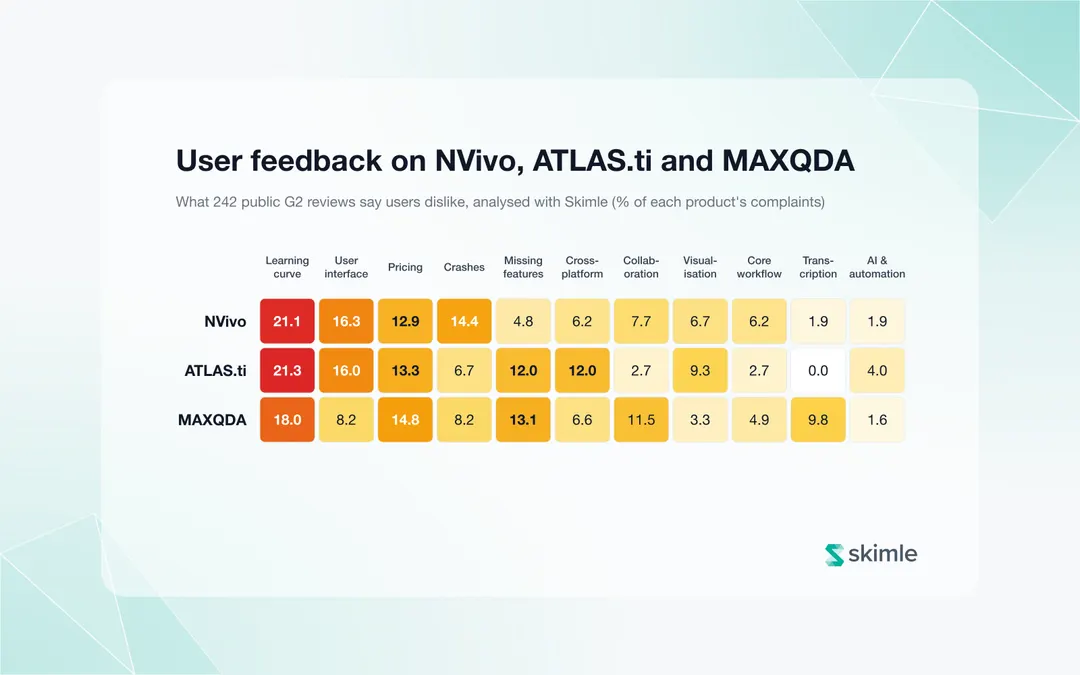
The limitations for agency use are practical: NVivo is desktop software (though a cloud version exists), the learning curve is steep for analysts without academic training, and collaboration requires file sharing rather than real-time co-editing. The interface has changed little in a decade.
Pricing: approximately $790/year per user (€730/year) for the academic licence; commercial licences are higher.
MAXQDA
MAXQDA is a German-developed QDA tool that competes directly with NVivo. It has a cleaner interface, better mixed-methods support, and slightly better data visualisation. It is particularly strong on focus group analysis, where its ability to handle multiple speakers is more mature than NVivo's.
Like NVivo, it is desktop-first, and real-time collaboration requires add-on features. Pricing runs approximately $990/year per user (€900/year).
For a direct comparison of these two tools, see our post on NVivo vs MAXQDA in 2026.
Dovetail
Dovetail is a research repository and insight management platform widely used by UX research teams inside product companies. It has grown in adoption among agencies as well, particularly those with a product research focus.
Its strengths are onboarding speed, a polished interface, and repository features that make historical findings searchable. It is less strong on structured thematic analysis; its approach is more flexible and less systematic than NVivo, MAXQDA, or Skimle. Pricing ranges from approximately $33–58/month per user (€30–54/month) depending on tier.
For a closer look at how Dovetail compares, see our Dovetail alternative comparison. If you're evaluating specifically as a market research or customer insights team rather than a UX research team, see our Dovetail and Condens alternatives built for that workflow.
Discuss.io, Remesh, and Forsta
Some agencies running live moderated or large-scale AI-moderated video sessions reach for Discuss.io, Remesh, or Forsta earlier in the workflow, before analysis even starts. These platforms specialise in recruitment and live session capture rather than transcript coding, so most agencies pair them with a dedicated analysis tool once the sessions are recorded. Forsta's ownership also changed materially in 2026 after a $6.75 billion (€6.2 billion) Qualtrics acquisition. See our full comparison of Discuss.io vs Remesh vs Forsta for what that means if your agency runs on one of these platforms.
For a broader view of the analysis layer specifically, organised by category rather than by agency workflow, see customer research analysis tools: the 2026 landscape by category.
Tool comparison table
| Tool | Best for | Key strength | Key limitation | Pricing (approx.) |
|---|---|---|---|---|
| Skimle | Agency multi-project work, AI-assisted analysis | Built-in transcription + analysis + export in one platform; source traceability | Newer to market than NVivo/MAXQDA | From $50/month per seat (€46/month) |
| NVivo | Complex academic-style coding, node hierarchies | Deeply featured; academic credibility | Desktop-first; steep learning curve; poor real-time collaboration | ~$790/year per user (€730/year) |
| MAXQDA | Mixed methods, focus group analysis | Clean UI; strong visualisation; better than NVivo on mixed methods | Desktop-first; collaboration requires add-ons | ~$990/year per user (€900/year) |
| Dovetail | UX research, insight repositories | Fast onboarding; polished interface; great for storing past research | Less systematic on thematic analysis; not built for client deliverables | $33–58/month per user (€30–54/month) |
For a full feature-by-feature breakdown across these and other tools, see our complete comparison of qualitative data analysis tools.
Reporting: getting findings out of your analysis tool and into a client deck
Analysis tools are where insights are found. Deliverables are where those insights reach the client. The gap between them is where agencies lose time.
The gold standard for agency reporting is a Word document or PowerPoint deck that the client can open, edit, and share without requiring any specialist software. Most analysis tools handle this badly.
NVivo and MAXQDA both have export functions, but the outputs tend to require significant reformatting before they are client-ready. Dovetail's sharing features are designed for internal repository access, not external client delivery.
Skimle's export to Word and PowerPoint is designed specifically for the agency reporting use case: structured findings, supporting quotes, and attribution in a format that can go straight into a client deck. For agencies billing on time, this matters.
4 common mistakes agencies make with AI analysis tools
AI-assisted thematic analysis is fast. That speed creates specific traps that experienced qualitative researchers fall into as readily as junior analysts.
1. Treating AI themes as final without verification
AI theme extraction identifies patterns in text. It does not interpret them. The category label "price sensitivity" might contain responses from highly price-sensitive buyers and from buyers explaining why price is not their primary concern. Both contribute evidence; only one represents what the client actually wants to know about.
Every AI-generated theme deserves a pass by a senior analyst who reads the underlying quotes and checks that the label matches the content. The AI does the clustering; the analyst provides the judgement.
2. Not checking themes within specific subgroups
Aggregate findings can mask the most important story. If a project is exploring why some customers churn while others become advocates, analysing the full corpus together may produce clean themes that tell neither story accurately.
Skimle's metadata analysis lets you slice findings by respondent attribute: segment, region, tenure, NPS score, or any other variable in your data. Running the same analysis separately on detractors and promoters often produces a more useful and more nuanced debrief than the aggregate view.
This is particularly relevant for NPS verbatim analysis. See our guide to analysing NPS verbatim comments for a worked example of why subgroup analysis changes the story.
3. Not building a consistent coding framework across projects
One of the advantages agencies have over one-off client research teams is accumulated knowledge. After five brand equity studies, you know which themes tend to appear, which are client-specific, and which cut across categories.
That institutional knowledge is wasted if each project starts from scratch with a new AI-generated category set. Building a predefined framework that carries across similar projects, then running new data against it, lets you spot genuine differences rather than differences in how the AI labelled the same underlying phenomena.
Skimle supports predefined category analysis for exactly this reason. You can bring in a category framework from a previous project and apply it to new data, which is far more useful for tracking change over time than auto-generated themes that shift with every corpus.
4. Over-relying on AI for focus group data
Focus group dynamics are complex in ways that text alone does not capture. Dominant voices, group polarisation, and the social performance of opinion all shape what gets said. AI theme extraction treats a focus group transcript like any other text corpus and has no model of group dynamics.
For focus groups, AI analysis works best as a first pass to identify what topics came up, with a human analyst reviewing the dynamics: who said what, who changed position, what the moderator prompted. See our post on focus group analysis methodology for a more detailed treatment.
Open-text analysis at scale has its own set of pitfalls too. Our guide on how to analyse open text responses at scale covers the most common ones.
How should agencies evaluate a new analysis tool?
The decision is significant. Switching tools mid-project is painful; switching platforms for a whole team is a months-long process. The questions below are designed to surface the things that matter in an agency context before you sign a contract.
Questions to ask the vendor:
- Where is our data stored, and what are the data residency options? (Critical for GDPR compliance and for clients with data sovereignty requirements)
- What is the export format for client deliverables? Can we export to Word and PowerPoint? What does the output look like?
- How does collaboration work when two analysts are working on the same project? Is there real-time co-editing, or are changes batched?
- Can we set up a project template or coding framework that carries across multiple client engagements?
- What is the per-seat pricing at our team size? Are there volume discounts?
- What does onboarding look like for a team of our size? Is there hands-on training included, or only documentation?
What to test in a trial:
Run a real project through the trial rather than a toy dataset. Use 10–15 transcripts from an actual engagement (anonymised if necessary) and measure:
- Time from upload to first-pass themes (the speed question)
- Quality of theme labels and supporting evidence (the accuracy question)
- How much analyst time the output still requires (the efficiency question)
- Whether the export looks like something you would send a client (the deliverability question)
For more on evaluating the analysis workflow specifically, see our guide to how to analyse customer interviews in a market research context.
Team adoption: getting all analysts on the same platform
Buying a tool and adopting a tool are different things. Research directors frequently report buying software that sits on one analyst's laptop while the rest of the team continues to work in Word documents and colour-coded Excel sheets.
The adoption problem has a few root causes, and they are worth naming.
Seniority bias in tool selection. The research director who selects the tool may have very different working patterns from the junior analysts who will use it most. If the tool is chosen for its output features and not its usability at the analysis stage, adoption stalls at the analyst level.
Project deadlines override training. If the tool is introduced mid-project, analysts default to what they know. New tools need to be introduced at the start of a project cycle with enough runway for analysts to go through the learning curve before the pressure of a client deadline.
No shared conventions. A tool used differently by five analysts produces five different output styles, which makes peer review and director review more difficult, not less. Before rolling out a new platform, agree on conventions: how categories are named, what counts as sufficient evidence for a theme, how many supporting quotes appear in a deliverable.
Skimle's team collaboration features include shared workspaces and visibility into how each team member has coded, which makes the convention-setting process visible rather than a document no one reads.
Piloting the right way. The most successful agency rollouts pick one team of three or four analysts, run two full projects through the new tool, and document what worked and what did not before expanding. This produces an internal training resource based on real agency work rather than vendor demos.
Research cited by win-loss intelligence firm Clozd found that 68% of companies who share research insights systematically across departments report an increase in performance on the metrics those insights address. The corollary for agencies is that a tool that sits with one analyst adds less value than one used consistently enough that findings can be compared across projects and clients.
For more on making shared analysis work across a team, see our post on sharing and collaborating on interview insights at scale.
Frequently asked questions
What is the best qualitative research software for market research agencies?
The best tool depends on team size, budget, and workflow. For agencies prioritising speed and client deliverability, Skimle offers AI-assisted analysis, built-in transcription, and Word/PowerPoint export in a single platform. NVivo and MAXQDA offer more depth for complex coding frameworks but require more training. Dovetail suits agencies with a UX research focus. Cloud-based tools generally fit agency timelines better than desktop software.
How do market research agencies manage multiple client projects in qualitative software?
Cloud platforms like Skimle and Dovetail handle multi-project management through separate project workspaces. Each project keeps its documents, categories, and insights separate, and team members can be assigned across projects with appropriate access controls. Legacy desktop tools like NVivo require separate project files, which creates file management overhead when analysts are running several engagements simultaneously.
Should agencies use NVivo or a cloud-based tool like Skimle or Dovetail?
NVivo is the right choice for agencies doing academic-style research with complex coding frameworks, inter-rater reliability requirements, or clients who specifically request CAQDAS-standard outputs. Cloud-based tools like Skimle are better suited to faster-turnaround commercial research where team collaboration, quick onboarding, and clean client export are the priorities. Many agencies run both: NVivo for long-form projects, a cloud platform for faster commercial work.
How long does it take to analyse 20 in-depth interviews with AI tools?
With a platform like Skimle, a 20-interview corpus can produce a first-pass thematic analysis in under 30 minutes once transcripts are uploaded. The analyst's job then is to review and refine the AI-generated themes, add interpretation, and build the client narrative. Realistically, a senior analyst can produce a polished debrief-ready analysis of 20 IDIs in one to two working days with AI assistance, versus three to five days using manual coding.
Try Skimle with your next project
If your team is spending more time organising transcripts than thinking about what they mean, it is worth seeing what a purpose-built platform looks like in practice.
Try Skimle for free and run your next project through it. The free plan lets you upload a real corpus and see what AI-assisted analysis produces before committing to a paid seat.
Related reading:
- Complete comparison of qualitative data analysis tools
- How to analyse customer interviews in a market research context
- The best AI transcription tools for research in 2026
- Market research tools in 2026: 20 platforms compared
- Discuss.io vs Remesh vs Forsta: qualitative research platforms for agencies
About the authors
Henri Schildt is a Professor of Strategy at Aalto University School of Business and co-founder of Skimle. He has published over a dozen peer-reviewed articles using qualitative methods, including work in Academy of Management Journal, Organisation Science, and Strategic Management Journal. His research focuses on organisational strategy, innovation, and qualitative methodology. Google Scholar profile
Olli Salo is a former Partner at McKinsey & Company where he spent 18 years helping clients understand the markets and themselves, develop winning strategies and improve their operating models. He has done over 1000 client interviews and published over 10 articles on McKinsey.com and beyond. LinkedIn profile