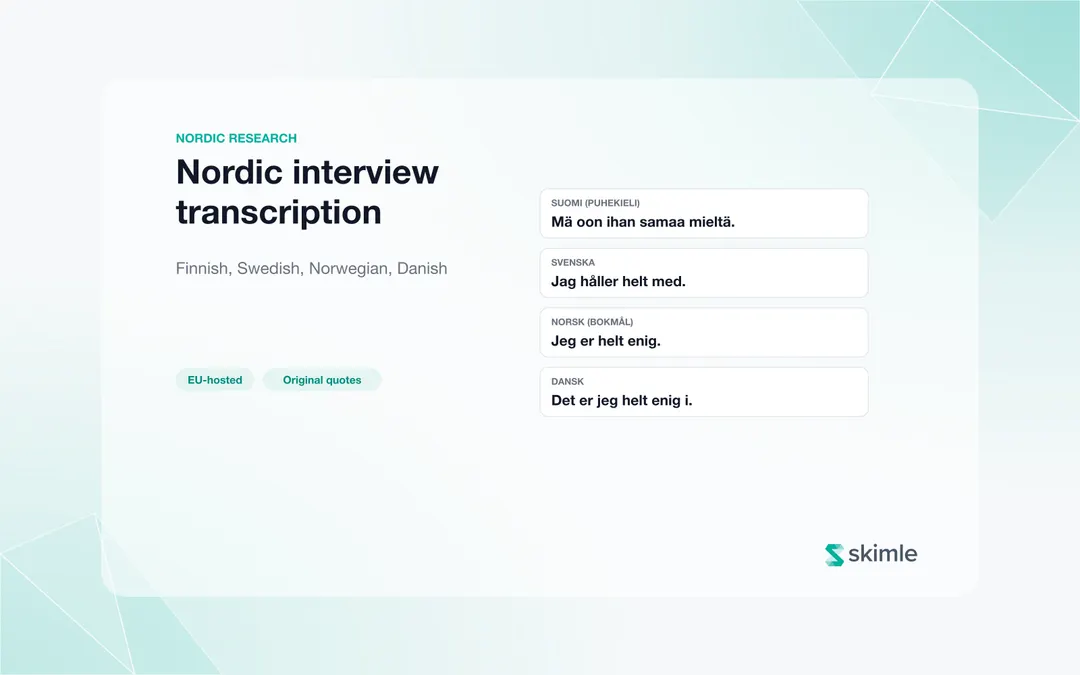
You can transcribe Finnish, Swedish, Norwegian and Danish interviews with AI at research quality in 2026, but accuracy varies more between these languages than English benchmarks suggest. Spoken Finnish, Norwegian dialects and Danish pronunciation are the usual weak points. The workable routine is to transcribe with a tool tested on your own recordings, check names and key terms against the audio, keep quotes in the original language, and report in whichever language your readers need. Skimle does all of this in one EU-hosted project, and was built in Helsinki with these languages in mind.
This short guide covers what makes each Nordic language harder to transcribe, how to handle projects that mix them, and what to check before you analyse. For the full comparison of tools, see interview transcription software for researchers.
Why are Nordic languages harder to transcribe?
Speech recognition models learn from data, and the Nordic languages have far less of it than English, German or Spanish. When we tested transcription engines before building Skimle's, several that were excellent in English were noticeably weaker in Finnish and Swedish. Each language also has its own difficulty:
| Language | What makes it hard | What to check in the transcript |
|---|---|---|
| Finnish | Long compound words and case endings; spoken Finnish (puhekieli) differs a lot from written (mä oon for minä olen) | Compound words split or merged wrongly; how spoken forms are written |
| Swedish | Finland Swedish and regional accents in Sweden; English loanwords in business speech | Names, place names and borrowed terms |
| Norwegian | Strong dialect variation, and two written standards; AI transcription writes Bokmål | Dialect words; Nynorsk speakers' words appearing in Bokmål spelling |
| Danish | Reduced, soft pronunciation and the glottal stop (stød) make word boundaries hard to hear | Short function words and numbers |
None of this rules AI transcription out. It means the check after transcription matters more than in English, and that you should test an engine on one of your own recordings before transcribing a whole study.
How do you handle spoken Finnish in a transcript?
Finnish interviews are mostly spoken in puhekieli, and you have to decide whether the transcript keeps the spoken forms or normalises them to standard written Finnish. For thematic, content or framework analysis, either works if you are consistent; for discourse or conversation analysis, keep the spoken forms. Write the rule down in your transcription notes, and make sure quotes you publish keep the participant's own forms. AI transcription usually stays close to what was said, so check its output against your rule rather than assuming it normalises.
What about interviews that mix languages?
Mixed-language interviews are normal in the Nordics. A Finnish engineer drops English terms mid-sentence (se deadline on tosi tiukka), a study in Finland includes both Finnish and Swedish speakers, and a cross-Nordic project has interviews in all four languages plus English.
Two practical points:
- Code-switching within an interview is transcribed less reliably than single-language speech, because the engine has to decide which language each stretch belongs to. Check English terms and product names in particular.
- Several languages in one project need no translation before analysis. In Skimle, each recording's language is detected automatically, every transcript is analysed for meaning whatever its language, and categories and summaries are written in the project language you choose, such as English, Finnish, Swedish, Norwegian or Danish. Quotes always stay in the original language, so nothing is lost or misattributed in translation. See analysing interviews in multiple languages.
Where should Nordic research data be processed?
Nordic universities' data management plans and ethics reviews generally expect personal data, including voice recordings, to be processed in the EU or EEA with a data processing agreement in place. Many US-based transcription tools can be used lawfully, but each one adds paperwork and questions from a data protection officer. Skimle processes and stores recordings and transcripts in the EU, can delete each recording as soon as its transcript is ready, and can pseudonymise transcripts before analysis. The Finnish Academy of Science and Letters uses it to transcribe and analyse more than 400 hours of interviews with about 200 professors.
A checklist for Nordic interview transcription
- Test the transcription engine on one of your own recordings, in each language you will use
- Decide on spoken versus written forms (Finnish, Norwegian dialects) and record the rule
- Check names, places, organisations and English loanwords against the recording
- Keep quotes in the original language; translate only those you publish, and say who translated them
- Use EU processing and delete recordings when your ethics approval requires it
- Analyse across languages without translating first, and report in the language your readers need
Once the transcripts are ready, the next steps are the same in any language: see how to analyse interview transcripts, or our step-by-step guide to transcribing an interview if you are planning the whole workflow.
Frequently asked questions
Can AI transcribe Finnish accurately?
Yes, on clear recordings, though accuracy is lower than in English and varies a lot between engines. Spoken Finnish, compound words and English loanwords are where errors cluster. Test on your own audio and check key terms against the recording.
Can I transcribe Norwegian Nynorsk or dialect interviews?
AI transcription writes Norwegian in Bokmål. Dialect speakers are transcribed, but their words appear in Bokmål spelling, and strong dialects lower accuracy. If your analysis depends on dialect forms, plan for careful manual correction.
Can one project contain Finnish, Swedish and English interviews?
Yes. Skimle detects each recording's language, analyses all transcripts together without translating them, and writes the results in the project language you choose, while quotes stay in their original language.
Is Skimle a Nordic company?
Yes. Skimle is built in Helsinki, Finland, and processes data in the EU.
Have Nordic interviews to transcribe? Create a free Skimle account: the free plan transcribes more than three hours of recordings in Finnish, Swedish, Norwegian, Danish and 100+ other languages, and analyses them together.
Related reading:
- Interview transcription software for researchers in 2026: 8 tools compared
- How to transcribe an interview: 5 methods
- Transcribing audio and video interviews with Skimle
- Transcribing German, French, Spanish and Italian interviews
About the authors
Henri Schildt is a Professor of Strategy at Aalto University School of Business and co-founder of Skimle. He has published over a dozen peer-reviewed articles using qualitative methods, including work in Academy of Management Journal, Organisation Science, and Strategic Management Journal. His research focuses on organisational strategy, innovation, and qualitative methodology. Google Scholar profile
Olli Salo is a former Partner at McKinsey & Company where he spent 18 years helping clients understand the markets and themselves, develop winning strategies and improve their operating models. He has done over 1000 client interviews in numerous languages and published over 10 articles on McKinsey.com and beyond. LinkedIn profile