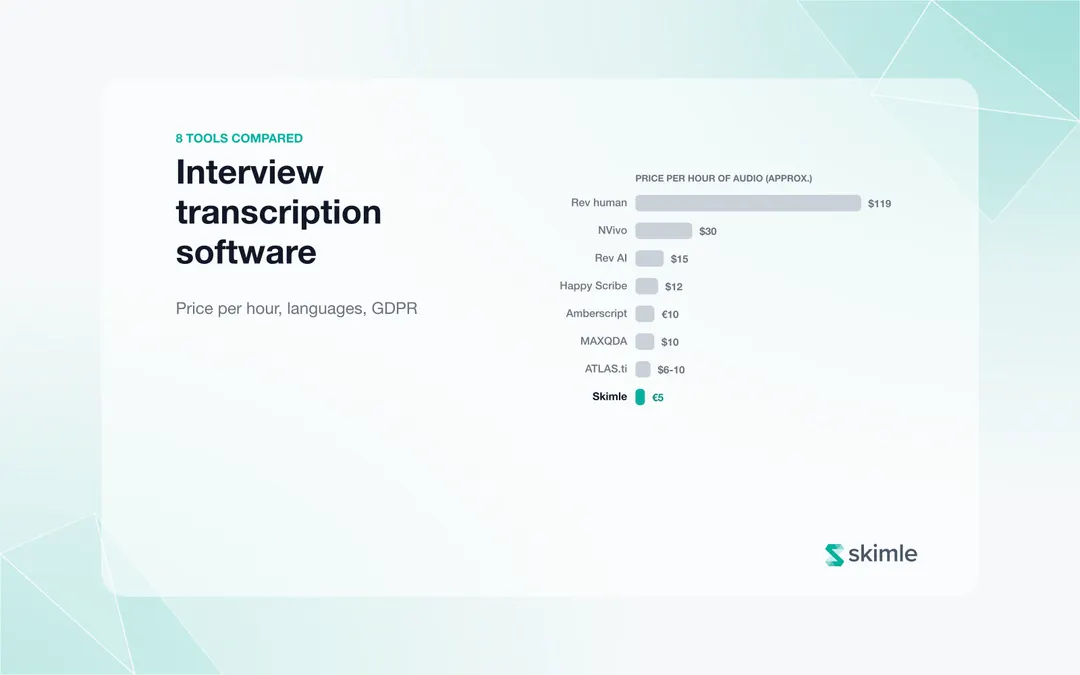
The best interview transcription software for researchers in 2026 depends on what happens after the transcript. If you will code and analyse the interviews, choose a tool that transcribes inside your analysis software: Skimle (about €5 per hour of audio), ATLAS.ti or MAXQDA (around $6 to $10 per hour), or NVivo Transcription ($30 per hour pay-as-you-go). If you only need the text, EU-based Amberscript or Happy Scribe (about €10 to $12 per hour) are strong standalone options. For difficult audio that must be exact, Rev's human service ($1.99 per minute) is still the quality ceiling.
This guide compares eight tools on the things researchers ask about: price per hour of audio, languages, speaker labels, where the data is processed, and whether the transcript lands somewhere you can analyse it. One disclosure: Skimle is our product. We have described every tool on its own terms and said where another one is the better fit.
The short video below compares the eight tools on price and shows what transcription inside an analysis tool looks like in practice.
How do the 8 interview transcription tools compare?
| Tool | Type | Price per hour of audio (approx.) | Languages | Speaker labels | Data and hosting | Straight into analysis? |
|---|---|---|---|---|---|---|
| Skimle | Transcription inside an AI analysis platform | ~€5 on paid plans; 3+ hours free | 100+ spoken | Yes | EU-hosted; recordings optional | Yes: coding, themes, quotes that play back |
| NVivo Transcription | Add-on to NVivo | $30 pay-as-you-go; ~$10 in a 50-hour package | 40+ | Yes | Separate service, sold apart from the licence | Imports into NVivo |
| MAXQDA Transcription | Add-on to MAXQDA | ~$10, sold in 2 to 20-hour packs | 50+ | Yes | German vendor | Yes, inside MAXQDA |
| ATLAS.ti Auto Transcription | Built into ATLAS.ti Desktop | ~$6 to $10, sold in packs | 40+ | Yes | German vendor | Yes, inside ATLAS.ti |
| Dovetail | Research repository | Included in plans (seat-based) | 95 | Yes | Check plan for data region | Yes, tagging and highlights |
| Amberscript | Standalone (Netherlands) | €10 machine; human from ~€1.85 per minute | 90+ | Yes | EU-based | Export only |
| Happy Scribe | Standalone (EU) | ~$12 as credits; lower on plans | 100+ | Yes | EU-based | Export only |
| Rev | Standalone (US) | $15 AI; $1.99 per minute human (~$119 per hour) | 30+ AI | Yes | US-based | Export only |
Prices are list prices found in October 2026 and change often; check the vendor's page before you budget. For meeting recorders such as Otter.ai and Fireflies, and for running Whisper yourself, see our comparison of AI transcription tools.
What are the two kinds of interview transcription software?
Interview transcription software falls into two groups, and the difference matters more than any accuracy benchmark.
Standalone transcription services (Amberscript, Happy Scribe, Rev) take a recording and return a document. They are often excellent at the transcript itself, offer human review and many export formats, and suit teams who only need text or who analyse in a tool without transcription. The cost they leave out is the step after: download, rename, clean up, import into your analysis tool, re-add participant details, and keep the recording somewhere else.
Transcription inside an analysis tool (Skimle, NVivo, MAXQDA, ATLAS.ti, Dovetail) puts the transcript straight into the project where you will code it. The recording, transcript and analysis share one security perimeter, and in the better implementations every quote stays linked to the moment in the recording it came from.
For a project of 30 interviews, the export-import loop alone is a working day. More importantly, it breaks the chain between a finding and the voice behind it, which reviewers and clients increasingly ask about.
What does it cost to transcribe a 30-interview study?
Per-hour prices are easier to compare as a project. Here is the list-price cost of transcribing 30 one-hour interviews:
| Tool | 30 hours of audio |
|---|---|
| Rev human transcription | ~$3,580 |
| NVivo Transcription, pay-as-you-go | ~$900 |
| Rev AI | ~$450 |
| Happy Scribe (extra credits) | ~$360 |
| MAXQDA Transcription | ~$300 |
| Amberscript machine | ~€300 |
| ATLAS.ti Auto Transcription | ~$180 to $300 |
| Skimle (paid plan) | ~€150 |
| Whisper run on your own computer | Free, plus your time and setup |
Two things change these numbers in practice. Human transcription is rarely needed for every file: transcribing with AI and sending only the two or three hardest recordings to a human service keeps quality high at a fraction of the cost. And the time spent checking transcripts (10 to 15 minutes per interview hour with good audio) is the same whichever AI service you pick, so it should not drive the choice. Our guide on how to transcribe an interview compares the time each method takes, including doing it by hand.
What should researchers look for in transcription software?
| Question | Why it matters for research |
|---|---|
| How accurate is it in your languages and accents? | English benchmarks do not carry over. Test one of your own recordings before committing |
| Does it separate speakers reliably? | Misattributed turns make quotes unusable, especially in focus groups |
| Where is the audio processed, and is it used to train models? | Ethics approvals and GDPR data protection agreements usually specify both |
| Can you delete the recording and keep the transcript? | Many ethics approvals promise the audio is destroyed after transcription |
| Does it keep timestamps? | You need them to check a quote against the recording |
| Can you anonymise the transcript before others see it? | Required for most sharing, archiving and client delivery; see anonymisation tools compared |
| What happens next? | A transcript is the input to analysis, not the output of the study |
Which transcription tools are best for researchers? The 8 tools in detail
Skimle
Skimle transcribes audio and video as one step of a qualitative analysis project. You add an Audio or video data source, drop in recordings (MP3, WAV, M4A, MP4, MOV and others, up to 1 GB each), and each one becomes a speaker-labelled, timestamped transcript within minutes. The recording can be kept beside the transcript, so every quote in your analysis has a play button that starts the recording a second before the quote; or it can be deleted once the transcript exists, for studies whose ethics approval requires it.
The transcript then goes straight into coding: Skimle reads every document, builds categories across the whole set, links each insight to its quotes and lets you compare groups by metadata. Data is processed and stored in the EU. Transcription uses one credit per minute; the free plan covers more than three hours, and paid plans work out at about €5 per hour.
Best for: researchers who will analyse what they transcribe and want quotes they can verify against the recording. Less suited to: anyone who only needs a Word file for use elsewhere. See how transcription works in Skimle.
NVivo Transcription
NVivo Transcription is Lumivero's add-on service for NVivo. It supports more than 40 languages, includes speaker identification and a built-in editor, and imports the finished transcript into an NVivo project with the media linked. Credits are bought separately from the NVivo licence: about $30 for a single hour, or $499 for a 50-hour annual package (about $10 per hour).
Best for: teams already committed to NVivo who want the transcript in the same project. Watch out for: the pay-as-you-go rate is high, and the total cost of NVivo plus add-ons adds up; see NVivo pricing in 2026.
MAXQDA Transcription
MAXQDA's built-in automatic transcription handles more than 50 languages and delivers the transcript inside the MAXQDA project, with timestamps linked to the media. Each licence includes 60 minutes to try it; further hours come in packs of 2 to 20 hours, at roughly $10 per hour. MAXQDA also keeps its manual transcription mode, with playback controls and a foot pedal option, for researchers who transcribe by hand.
Best for: MAXQDA users, and anyone who wants manual and automatic transcription in one place. See MAXQDA pricing in 2026.
ATLAS.ti Auto Transcription
ATLAS.ti Desktop includes AI auto-transcription in more than 40 languages, with one free hour per seat on eligible licences and further time sold in packs (reported at around 10 cents a minute). The transcript arrives as an ATLAS.ti document, ready for coding and for the AI coding tools ATLAS.ti has added since 2024. Auto-transcription is a Desktop feature and does not run in the web version.
Best for: ATLAS.ti Desktop users who want the cheapest add-on transcription among the traditional tools.
Dovetail
Dovetail transcribes uploaded recordings and connected calls in 95 languages, and the transcript becomes the base for highlights, tags and insights in a research repository. Transcription is part of the plans rather than sold per hour, which suits teams with a steady stream of customer calls. It is built for product and UX teams; academic projects and one-off studies usually fit less well. See Dovetail alternatives.
Best for: product teams building a repository of customer conversations.
Amberscript
Amberscript, based in Amsterdam, offers machine transcription at about €10 per audio hour and human-reviewed transcription from around €1.85 per minute, in 90+ languages for machine output. EU hosting and university agreements make it common in European academia. Output exports to Word, text and subtitle formats.
Best for: European researchers who need a standalone transcript with an EU vendor, or human review on a few files.
Happy Scribe
Happy Scribe, also EU-based, transcribes in more than 100 languages and dialects, with subscription plans from about $17 per month and extra AI credits at roughly $12 per hour. Human transcription starts at about $2 per minute. Its editor and subtitle tools make it popular with journalists as well as researchers.
Best for: multilingual standalone transcription with a good editor.
Rev
Rev, based in the US, offers AI transcription at $0.25 per minute ($15 per hour) and human transcription at $1.99 per minute. Its human service remains the benchmark for difficult audio: heavy accents, poor recordings and overlapping speakers. Data is processed in the US, which matters for EU personal data.
Best for: a handful of critical recordings where exactness justifies the cost.
Which tool should you choose?
| If you are... | Choose |
|---|---|
| Running an interview study you will code and analyse | Skimle, or the add-on of the CAQDAS tool you already use |
| Already licensed for NVivo, MAXQDA or ATLAS.ti | Their built-in transcription, to keep media linked (compare the per-hour cost first) |
| A product or UX team with ongoing customer calls | Dovetail or Skimle |
| A European researcher who only needs the transcript | Amberscript or Happy Scribe |
| Facing a few very difficult recordings | Rev or Amberscript human transcription for those files only |
| Working in Finnish, Swedish, Norwegian or Danish | Test your own audio; see transcribing Nordic interviews |
| Running cross-market studies in Europe | See German, French, Spanish and Italian interviews |
| Working in South or Southeast Asia | See Hindi, Vietnamese, Filipino, Indonesian and Thai interviews |
If transcription is the first step of an analysis you will defend to a supervisor, reviewer or client, the deciding feature is not the transcript but what is attached to it: the recording, the participant's details and the quotes you will use. Skimle keeps all three together, codes every transcript, and lets you play any quote from its moment. See how it fits academic researchers and market and customer research teams.
Is AI transcription accurate enough for research?
For clear recordings of one or two speakers, current AI transcription reaches word error rates of a few per cent, which is enough for thematic analysis once you have checked names, technical terms and the passages you plan to quote. Accuracy falls with background noise, phone-quality audio, overlapping speech and strong accents, and it varies by language far more than vendors' headline figures suggest.
The practical routine: transcribe everything with AI, check each transcript against the recording at the points that matter (search for the key terms and names first), and send only the hardest files to a human. A tool that lets you click any word to hear the recording makes the checking much faster. Our practical interview setup guide covers recording quality, which affects accuracy more than the choice of engine.
Is interview transcription software GDPR compliant?
A voice recording of a research participant is personal data, and often sensitive personal data. Under GDPR you need a lawful basis, a data processing agreement with the transcription vendor, and clarity on where the data is processed and for how long it is kept. US-based services can be used lawfully, but many universities' data protection officers and ethics committees prefer, or require, EU processing. Before choosing, check:
- where audio and transcripts are processed and stored
- whether the vendor uses your data to train models
- whether you can delete recordings once transcribed
- whether the vendor signs a data processing agreement
Then anonymise the transcript before it is shared. See how to anonymise qualitative research data and Skimle Anonymise.
Frequently asked questions
What is the best transcription software for qualitative research?
For studies you will analyse, the best choice is transcription built into your analysis tool, because the transcript, recording and coding stay together: Skimle, ATLAS.ti, MAXQDA or NVivo. For standalone transcripts in Europe, Amberscript and Happy Scribe are strong. For a few very difficult recordings, Rev's human service.
Is there free interview transcription software?
Yes. Whisper, OpenAI's open-source model, is free to run on your own computer and supports about 100 languages, though it needs some technical setup and has no speaker labels out of the box. Free tiers are small elsewhere: Skimle's free plan covers more than three hours, MAXQDA and ATLAS.ti include an hour with a licence, and Rev offers 45 AI minutes a month.
Can NVivo transcribe interviews?
Yes, through NVivo Transcription, a separate paid service. It costs about $30 per hour pay-as-you-go or $499 for a 50-hour annual package, supports more than 40 languages, and imports the transcript into your NVivo project.
Which tools transcribe interviews and analyse them in one place?
Skimle, NVivo, MAXQDA, ATLAS.ti and Dovetail all transcribe inside the tool you analyse in. They differ in what happens next: the traditional tools give you a transcript to code by hand with AI help, Dovetail feeds a research repository, and Skimle codes every transcript and links each finding to quotes you can play back.
How much does interview transcription cost per hour?
AI transcription costs between about €5 and $30 per hour of audio in 2026, depending on the tool. Human transcription costs about $90 to $150 per hour, more for difficult audio or fast turnaround.
Can transcription software handle focus groups?
Yes, but accuracy and speaker labelling fall as the number of speakers grows and people talk over each other. Record with a good central microphone, have participants introduce themselves, and check speaker labels carefully. See focus group transcription: 5 challenges.
Want to transcribe and analyse your interviews in one place? Create a free Skimle account: the free plan transcribes more than three hours of recordings, and every quote in your analysis plays back from the moment it was said.
Related reading:
- How to transcribe an interview: 5 methods, time and cost
- Best AI transcription tools for researchers in 2026
- Transcribing audio and video interviews with Skimle
- How to analyse interview transcripts
About the authors
Henri Schildt is a Professor of Strategy at Aalto University School of Business and co-founder of Skimle. He has published over a dozen peer-reviewed articles using qualitative methods, including work in Academy of Management Journal, Organisation Science, and Strategic Management Journal. His research focuses on organisational strategy, innovation, and qualitative methodology. Google Scholar profile
Olli Salo is a former Partner at McKinsey & Company where he spent 18 years helping clients understand the markets and themselves, develop winning strategies and improve their operating models. He has done over 1000 client interviews and published over 10 articles on McKinsey.com and beyond. LinkedIn profile
Sources
- NVivo Transcription - Lumivero
- MAXQDA Transcription - MAXQDA
- AI Auto Transcription - ATLAS.ti
- Expanded language support for transcription - Dovetail
- Amberscript pricing - Amberscript
- Happy Scribe pricing - Happy Scribe
- Rev pricing - Rev
- Comparing automated transcription services for qualitative research in 2026 - Quirkos