German, French, Spanish and Italian are among the best-supported languages for AI transcription, so clear interview recordings in any of them transcribe at close to English quality. The hard parts of a European study are not the transcripts themselves. They are regional variants such as Swiss German and Latin American Spanish, keeping quotes faithful across languages, and comparing markets without translating everything first. Transcribe each interview in its own language, keep the original quotes, tag each one with its market, and analyse all of them together in the language your report needs.
This guide is for researchers and research agencies running studies across the big continental European markets, often called the EU5 together with the UK. It covers what to check in each language, how to structure a cross-market project, and GDPR points specific to these countries. For the tool comparison, see interview transcription software for researchers.
What should you check when transcribing each language?
| Language | Usually transcribes well | Check carefully |
|---|---|---|
| German | Standard German from Germany, Austria and Switzerland | Long compound nouns split or joined; broad Swiss German dialect (Mundart), which is much harder for any engine; Sie/du kept as spoken |
| French | Metropolitan and Canadian French | Elisions and liaisons that change word boundaries (l'avis vs la vie); numbers (soixante-dix) |
| Spanish | Castilian, Mexican and US Spanish | Regional vocabulary in other Latin American variants; dropped final s in some Caribbean and Andalusian speech |
| Italian | Standard Italian | Regional accents and dialect words; English business terms (il budget, il meeting) |
Two points apply across all four. First, product names, brand names and acronyms are where errors cluster, so search for them first when you check a transcript. Second, keep the participant's level of formality: a switch from formal to informal address can be meaningful, and a cleaned-up transcript loses it.
How do you run a cross-market interview study?
A typical European study has 8 to 15 interviews per market, with a shared discussion guide translated into each language. The structure that keeps analysis manageable:
- Transcribe in the original language. Do not translate recordings before transcription or transcripts before analysis. Each translation step loses nuance and adds cost.
- Tag every transcript with its market (and any other segment, such as role or customer type) as metadata. This is what lets you compare Germany with Spain rather than reading 50 transcripts as one pile.
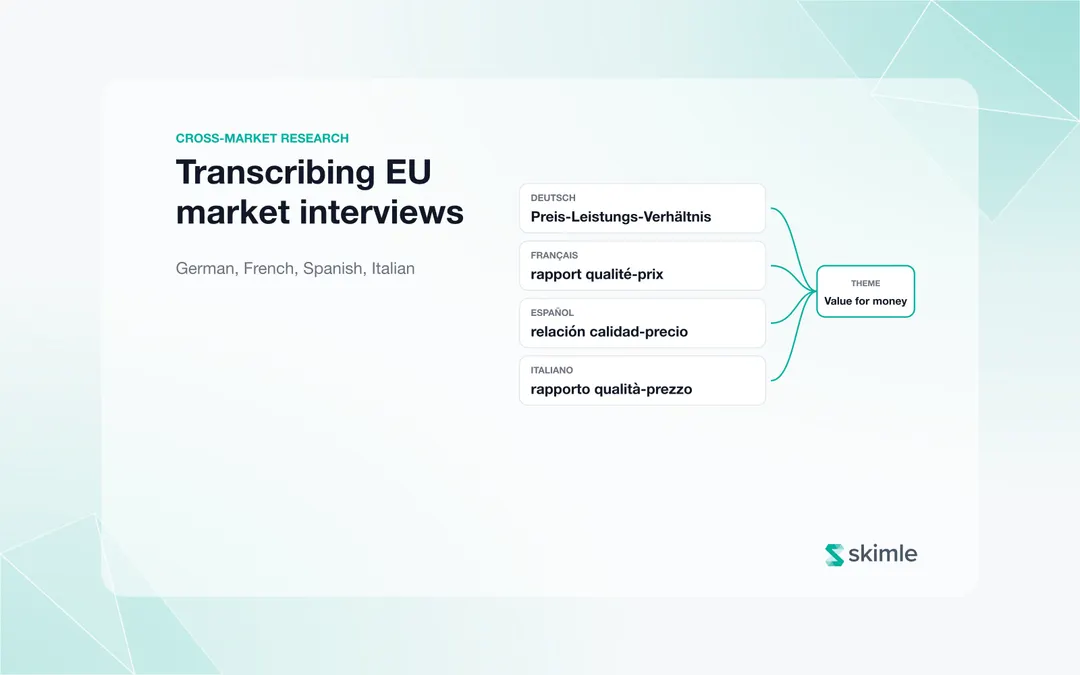
- Analyse all markets together. Modern AI analysis reads meaning across languages, so a German participant's Preis-Leistungs-Verhältnis and a Spanish participant's relación calidad-precio land in the same category without a dictionary.
- Compare by market. Look at which themes appear in every market and which are specific to one, and read the quotes behind each difference.
- Translate only the quotes you publish, and keep the original beside the translation in the appendix.
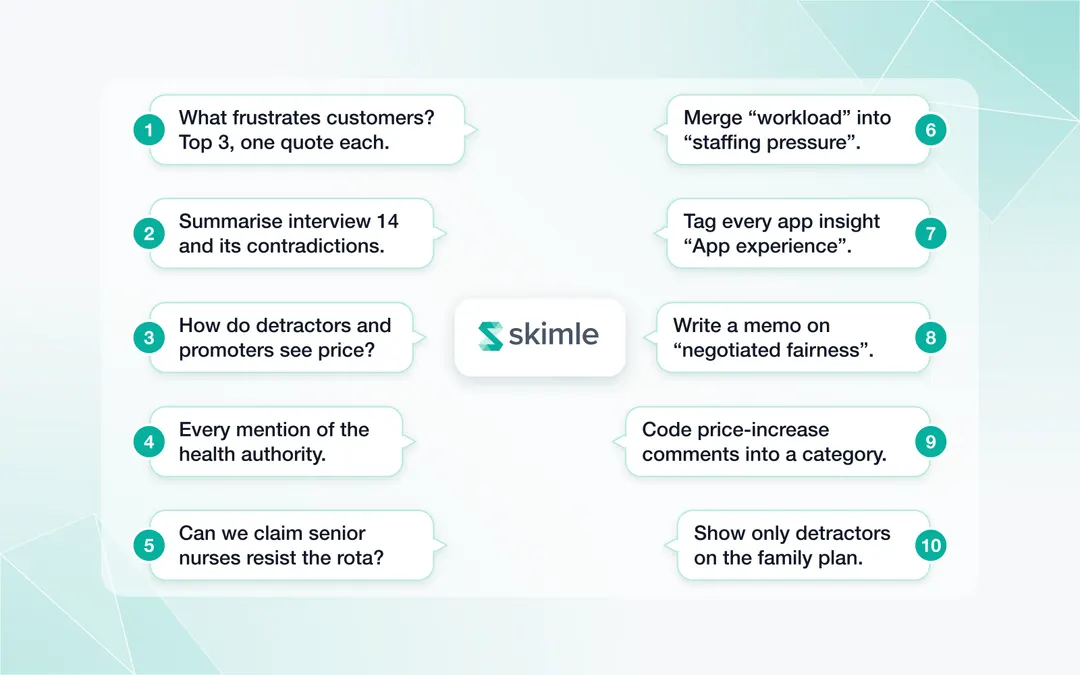
In Skimle, each recording's language is detected automatically, categories and summaries are written in the project language you choose (English, German, French, Spanish, Italian or 24 others), and quotes always stay in the original language, in the app and in Word, PowerPoint and Excel exports. See analysing interviews in multiple languages and how Skimle fits market research teams.
What are the GDPR points for these markets?
All four countries apply GDPR, but local practice adds a few expectations worth knowing before fieldwork:
- Germany: data protection officers and, for employee research, works councils (Betriebsrat) often review the tools used; EU processing and a data processing agreement are usually expected, and interviews with employees may need works council agreement.
- France: the CNIL's guidance on research and on transfers outside the EU is often cited by clients and ethics boards.
- Spain and Italy: clients in health, finance and the public sector commonly ask for EU processing and for recordings to be deleted after transcription.
Skimle processes and stores recordings and transcripts in the EU, can delete each recording as soon as its transcript is ready, and can pseudonymise transcripts consistently across every language before analysis.
What about Dutch, Portuguese and other European languages?
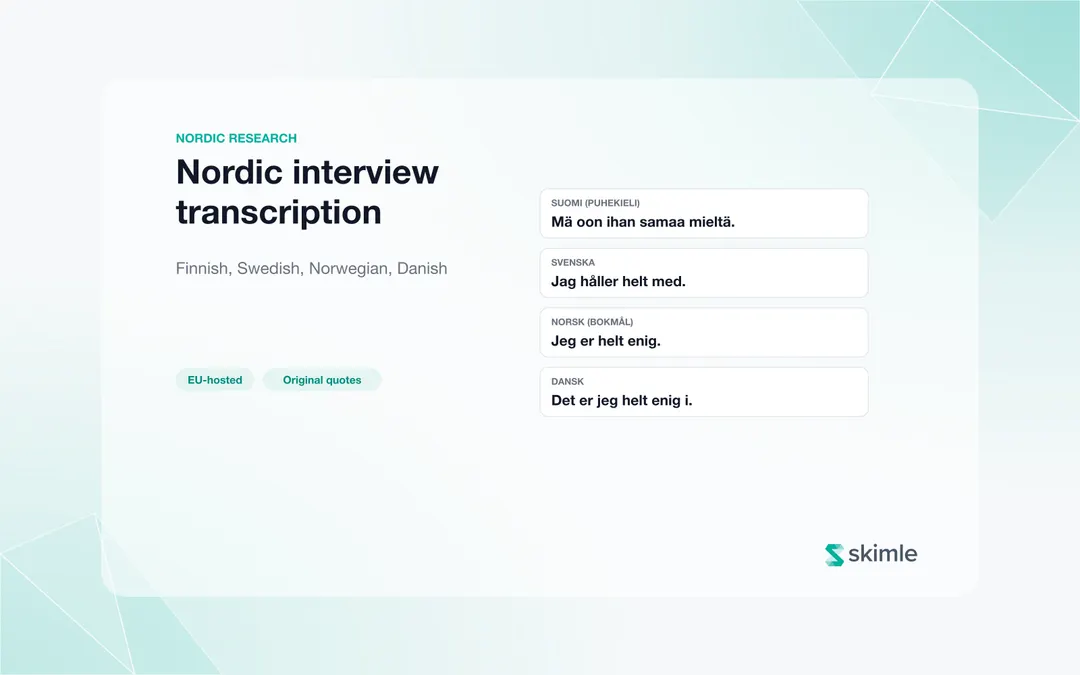
The same approach works for Dutch, Portuguese (European and Brazilian), Polish, Greek and most other European languages, which are also supported for transcription and analysis. Accuracy is generally a little lower than for the four large languages, so test one recording before a full study. For Finnish, Swedish, Norwegian and Danish, see our guide to Nordic interview transcription.
Frequently asked questions
Can AI transcribe Swiss German?
Standard German spoken with a Swiss accent transcribes well. Broad Swiss German dialect is much harder for every engine, because there is no standard written form and little training data. Expect to correct those transcripts by hand, or have participants speak standard German if the study allows.
Should I translate interviews before analysing them?
No. Translating every transcript is slow, expensive and loses nuance. Analyse in the original languages and translate only the quotes you publish. AI analysis now groups meaning across languages, so a German and a Spanish quote about the same issue end up in the same theme.
How many interviews per market do I need?
Usually 8 to 15 per market for a focused study, more if you also compare segments within each market. See how many qualitative interviews you need.
Can the final report be in English when the interviews are not?
Yes. In Skimle you choose the project language for categories, summaries and reports; quotes stay in the language they were spoken in, so a reader can always see the original words.
Running interviews across European markets? Create a free Skimle account: transcribe German, French, Spanish and Italian recordings, analyse them together, and compare markets with every quote kept in its original language.
Related reading:
- Interview transcription software for researchers in 2026: 8 tools compared
- How to transcribe an interview: 5 methods
- Transcribing audio and video interviews with Skimle
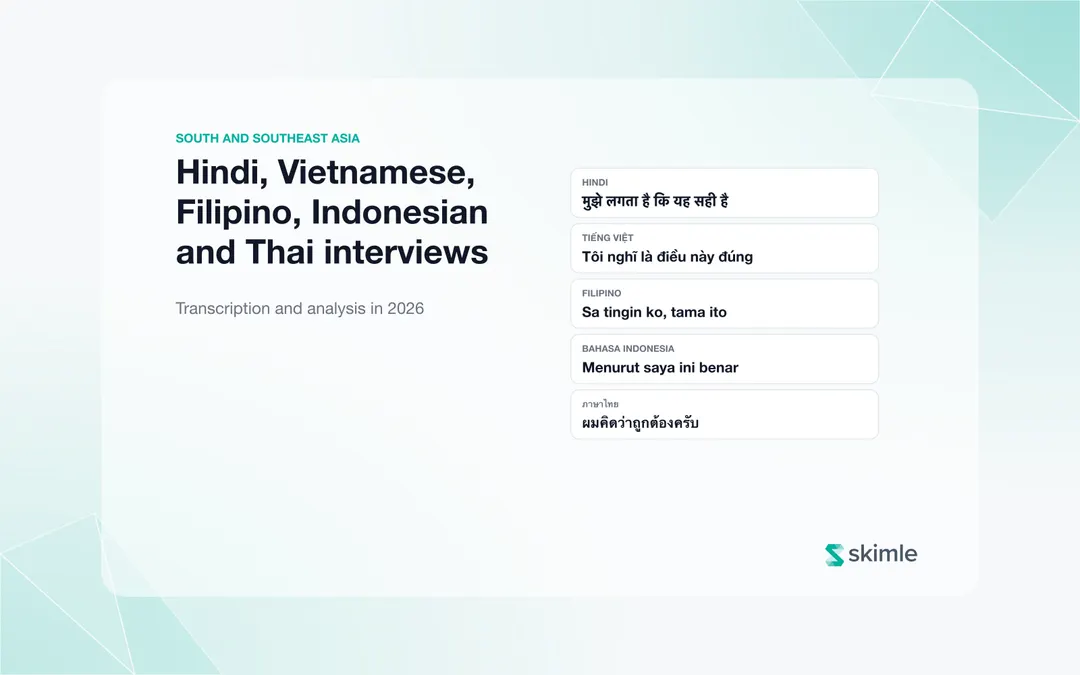
- Transcribing Hindi, Vietnamese, Filipino, Indonesian and Thai interviews
About the authors
Henri Schildt is a Professor of Strategy at Aalto University School of Business and co-founder of Skimle. He has published over a dozen peer-reviewed articles using qualitative methods, including work in Academy of Management Journal, Organisation Science, and Strategic Management Journal. His research focuses on organisational strategy, innovation, and qualitative methodology. Google Scholar profile
Olli Salo is a former Partner at McKinsey & Company where he spent 18 years helping clients understand the markets and themselves, develop winning strategies and improve their operating models. He has done over 1000 client interviews in numerous languages and published over 10 articles on McKinsey.com and beyond. LinkedIn profile