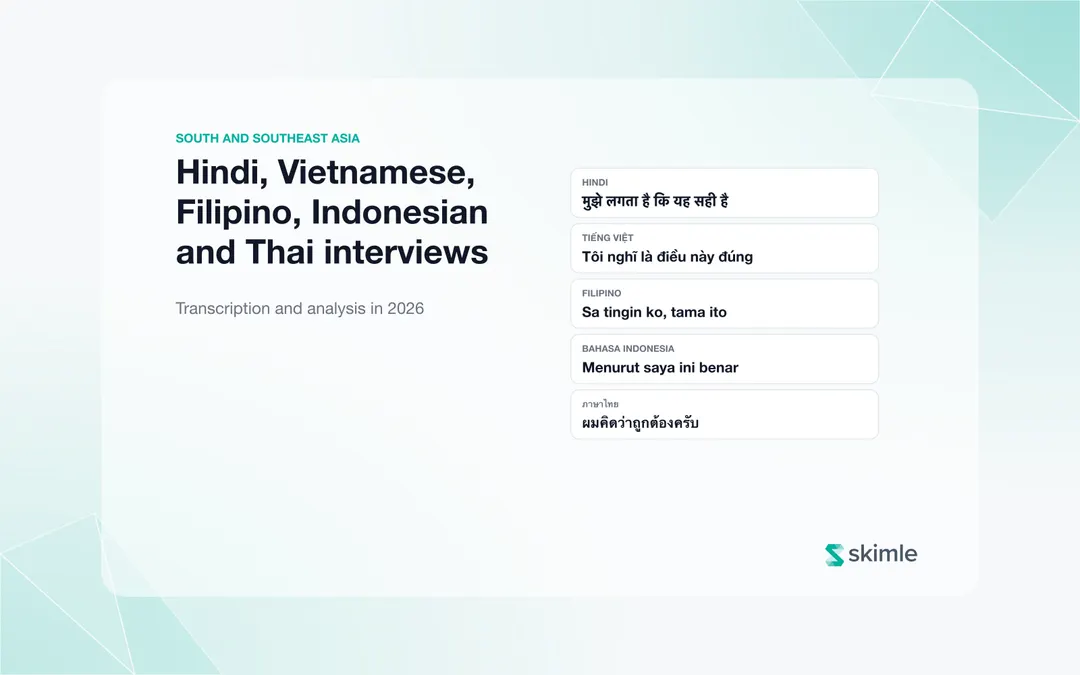
AI transcription now handles Hindi, Vietnamese, Filipino (Tagalog), Indonesian and Thai interviews well enough for qualitative research, and Skimle transcribes and analyses all five. What makes these languages harder than English is not one thing: urban speakers switch to English mid-sentence (Hinglish, Taglish, Indonesian business speech), Vietnamese and Thai are tonal, Thai is written without spaces between words, and much fieldwork in the region is recorded over the phone. Check those points first, keep quotes in the original language, and report in the language your readers need.
This short guide is for researchers, NGOs, development agencies and market research teams running interviews in South and Southeast Asia. For the full tool comparison, see interview transcription software for researchers.
Why group these languages together?
They are not related to each other, but they are often in the same study: a regional customer study across India and Southeast Asia, a development programme evaluation in several countries, or a multinational's employee research in its Asian offices. They also share the practical problems of research in the region: frequent switching to English, interviews done over phone or messaging apps, and less training data for speech recognition than the large European languages have.
What should you check in each language?
| Language | Transcription and analysis in Skimle | What to check in the transcript |
|---|---|---|
| Hindi | Yes; reports can be written in Hindi | English words in Hinglish speech, which may come out in Devanagari or in Latin script |
| Vietnamese | Yes; reports can be written in Vietnamese | Tone marks and diacritics, which change meaning |
| Filipino (Tagalog) | Yes; reports in English or another project language, quotes stay in Filipino | Taglish switching and the spelling of English words |
| Indonesian | Yes; reports can be written in Indonesian | Informal Jakarta speech (gue, lo), regional words from Javanese or Sundanese, English business terms |
| Thai | Yes; reports can be written in Thai | Word boundaries, since Thai has no spaces between words; polite particles (khrap, kha) |
What about Hinglish, Taglish and other code-switching?
Urban interviews in India, the Philippines and Indonesia often switch to English every few words: meeting ke baad hum decide karenge, nag-meeting kami kahapon about sa budget, or timnya harus improve dari sisi engagement. AI transcription handles this unevenly, because it has to decide which language each stretch of speech belongs to. Expect English words to be written in inconsistent ways, and check the terms that matter for your analysis, such as product names, job titles and policy names.
For analysis, code-switching is not a problem. Skimle reads meaning across languages, so a quote mixing Tagalog and English and a quote in English about the same issue end up in the same category. See analysing interviews in multiple languages.
Why are Vietnamese and Thai transcripts different?
Both are tonal: the same syllable with a different tone is a different word. In Vietnamese the tone is written as a diacritic, so a transcript with missing or wrong marks is ambiguous; spot-check a few passages against the recording before trusting a whole set.
Thai adds a second difference: words are written without spaces, and spaces mark phrase or sentence breaks instead. That does not affect reading or thematic analysis, but it does affect anything that counts or searches words, because there is no obvious word boundary. Thai speakers also end many sentences with polite particles (khrap for male speakers, kha for female speakers). In clean verbatim transcription they can be dropped, but keep them in quotes you publish, because they carry politeness and sometimes signal the speaker's gender. See verbatim vs clean verbatim.
How do you get better recordings from remote fieldwork?
Many interviews in the region are done by phone or WhatsApp call, and phone-quality audio lowers accuracy in every language. A few habits help:
- Record on the interviewer's side with a headset microphone rather than the phone's speaker
- Where possible, ask the participant to call from a quiet place, and avoid speakerphone
- For in-person interviews, put the recorder close to the participant, not in the middle of a noisy room
- Record a short test and listen to it before the first interview
Our practical interview setup guide covers equipment in more detail.
What about consent and data protection?
India's Digital Personal Data Protection Act (2023), Vietnam's personal data protection rules, the Philippines' Data Privacy Act (2012), Indonesia's Personal Data Protection Law (2022) and Thailand's Personal Data Protection Act (2019) all treat recordings of identifiable people as personal data. Funders and ethics boards in Europe and the US usually add their own rules. Explain to participants who will process the recording and where, delete recordings once transcribed if you promised to, and pseudonymise transcripts before sharing them. Skimle processes and stores data in the EU, which many international funders accept, and can delete each recording as soon as its transcript is ready.
Frequently asked questions
Can AI transcribe Vietnamese accurately?
Yes, on clear recordings. Check that tone marks and diacritics are present and correct, because a Vietnamese transcript without them is ambiguous. Phone-quality audio and strong regional accents lower accuracy.
Can AI transcribe Thai interviews?
Yes. Thai transcripts are written in Thai script without spaces between words, which is normal for the language. Accuracy is good on clear recordings; check names, English loanwords and anything you plan to quote.
Can I analyse Filipino interviews and report in English?
Yes. Skimle transcribes Filipino (Tagalog), analyses the transcripts, and writes categories and summaries in English or another project language, while quotes stay in the original Filipino.
Can one project mix Hindi, Indonesian and English interviews?
Yes. Each recording's language is detected automatically, all transcripts are analysed together without translating them first, and results are written in the project language you choose, with every quote kept in its original language.
Which other Asian languages does Skimle support?
Besides those above, Skimle transcribes and analyses Chinese (Simplified and Traditional), Japanese and Korean. For other South and Southeast Asian languages, contact us before you start fieldwork.
Running interviews in South or Southeast Asia? Create a free Skimle account: transcribe Hindi, Vietnamese, Filipino, Indonesian and Thai recordings and analyse them together, with every quote in its original language.
Related reading:
- Interview transcription software for researchers in 2026: 8 tools compared
- How to transcribe an interview: 5 methods
- Transcribing audio and video interviews with Skimle
- Transcribing Finnish, Swedish, Norwegian and Danish interviews
About the authors
Henri Schildt is a Professor of Strategy at Aalto University School of Business and co-founder of Skimle. He has published over a dozen peer-reviewed articles using qualitative methods, including work in Academy of Management Journal, Organisation Science, and Strategic Management Journal. His research focuses on organisational strategy, innovation, and qualitative methodology. Google Scholar profile
Olli Salo is a former Partner at McKinsey & Company where he spent 18 years helping clients understand the markets and themselves, develop winning strategies and improve their operating models. He has done over 1000 client interviews in numerous languages and published over 10 articles on McKinsey.com and beyond. LinkedIn profile