Qualitative data analysis software (also called CAQDAS, pronounced "cac-das") is software designed to help researchers organise, code, and make sense of text, audio, and video data. Before the advent of AI-native tools like Skimle, it did not analyse or make sense of the data, only help you code it, but that is now changing.
What does CAQDAS stand for?
CAQDAS stands for Computer Assisted Qualitative Data Analysis Software. The term was coined by professors Nigel Fielding and Ray Lee at the University of Surrey's first Research Methods conference in 1989. Reportedly, the acronym was a deliberate play on the word "cactus," chosen to reflect that using software for qualitative analysis was, at the time, seen as a thorny and contentious idea in the research community.
The term gained wider currency after the University of Surrey established its CAQDAS Networking Project in 1994, funded by the UK Economic and Social Research Council (ESRC). That project provided training, unbiased software comparisons, and a community of practice for qualitative researchers, and its defining principle was that no single CAQDAS package is best for everyone.
Today "CAQDAS" and "qualitative data analysis software" (QDA software, or QDAS) are used interchangeably. This guide uses both.
What does qualitative data analysis software actually do?
Before getting into history and tool types, it is worth being precise about this, because the answer has changed significantly in the last few years.
What traditional CAQDAS does (and does not do)
Classic CAQDAS tools (NVivo, ATLAS.ti, MAXQDA, The Ethnograph) are fundamentally data management and organisation systems. They give researchers a structured environment in which to:
- Import and store documents, transcripts, audio files, images, and video
- Code passages of text by attaching short labels ("nodes" in NVivo, "codes" in ATLAS.ti and MAXQDA)
- Retrieve all passages tagged with a given code, across the entire dataset
- Build relationships between codes, memo analytical notes, and organise codes into hierarchies
- Visualise the code structure and query the coded dataset
What they do not do is read your data and tell you what it means. A 2015 paper in Malawi Medical Journal put this plainly: "the main function of CAQDAS is not necessarily to analyse data, but rather to aid the analysis process." The intellectual work (reading, interpreting, constructing themes, and making arguments) remains with the researcher. The software provides the filing cabinet and retrieval system; you provide the thinking.
This matters because researchers sometimes choose not to use CAQDAS under the mistaken belief that the software will short-circuit their analytical process. The opposite is closer to the truth: well-used CAQDAS supports more rigorous, more auditable analysis than paper-based or spreadsheet approaches.
What AI-native qualitative analysis software does differently
The third generation of tools (see the history section below) changes this picture substantially. AI-native platforms such as Skimle do perform an initial pass of analysis: reading the data, identifying patterns, building a category structure, and linking every insight back to the source excerpt. Researchers then interrogate, edit, challenge, and build on that initial structure rather than building it from scratch.
The distinction matters for methodology: the intellectual control stays with the researcher, but the starting point shifts from a blank document to an AI-generated scaffold. You can read more about how this analysis pipeline works in Skimle's documentation.
A short history of qualitative data analysis software
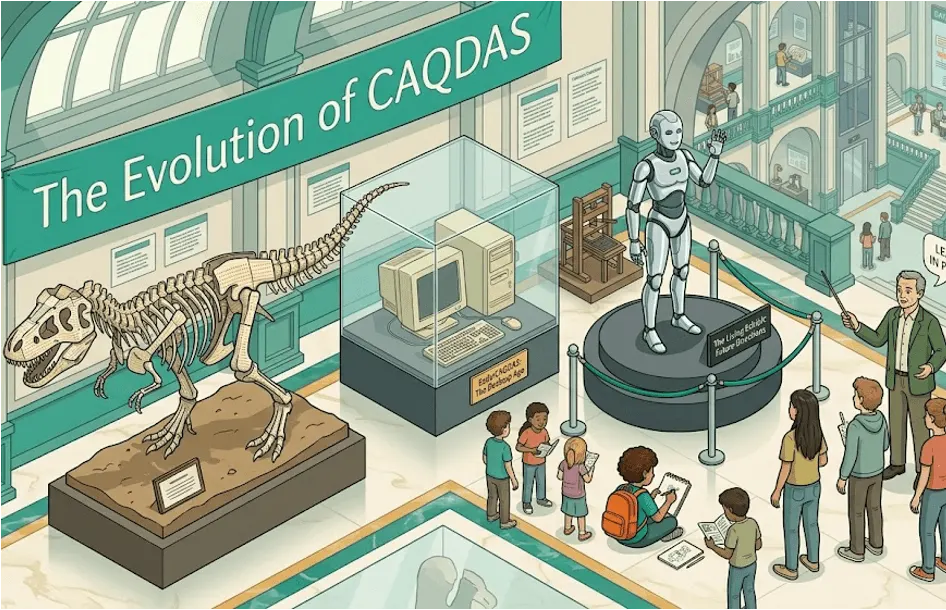
The story runs across roughly four decades and three distinct generations.
Generation 1: Code-and-retrieve tools (mid-1980s to mid-1990s)
The earliest tools solved a specific problem: if you had 30 interview transcripts spread across paper, retrieving every passage where participants mentioned a particular topic was slow and error-prone. Code-and-retrieve software let researchers tag text segments with labels, then pull all tagged segments together in seconds.
The Ethnograph (1985), developed by John Seidel at Qualis Research Associates, was one of the first widely distributed tools. Researchers printed their transcripts, numbered each line, and told the software which line numbers corresponded to which codes. It was labour-intensive but dramatically faster than cutting and pasting paper transcripts.
NUD*IST (Non-numerical Unstructured Data Indexing Searching and Theorizing) was developed from 1981 by Lyn and Tom Richards in Australia. It introduced the idea of hierarchical coding structures, or "node trees," and connected text management to theory-building in a way The Ethnograph did not. NUD*IST would later evolve into the QSR software family and, eventually, NVivo.
ATLAS.ti originated in 1989 as part of the ATLAS project at the Technische Universität Berlin, initiated by Thomas Muhr. The ".ti" suffix stood for "text interpretation." The first commercial release came in 1993. The tool introduced the concept of "hermeneutic units" (a project container linking all documents, codes, and memos) and was particularly suited to grounded theory and interpretive research traditions.
Generation 2: Feature-rich desktop CAQDAS (mid-1990s to early 2020s)
As personal computers became more powerful, tools added multimedia support, visualisation, mixed-methods features, and collaboration functions. This generation expanded into university coursework, government research, and consulting, and the major players (NVivo, MAXQDA, ATLAS.ti) became standard fixtures in research methodology training worldwide.
Characteristic of this generation: deep feature sets, considerable learning curves, desktop-first or cloud-linked architecture, and fully manual coding workflows. Researchers working with 20 interviews could expect to spend weeks on analysis. Over 62% of European Research Council-funded social science projects in 2024 used computer-assisted qualitative tools, a measure of how thoroughly this generation became embedded in academic practice. The learning curves of these tools still dominate user feedback today: in our analysis of 242 public reviews of NVivo, ATLAS.ti and MAXQDA, roughly one complaint in five for each product was about how hard the software is to learn.
AI was eventually bolted on: NVivo, ATLAS.ti, and MAXQDA each added AI-assisted coding suggestions and summarisation features in the 2020s. But these remain secondary to the manual workflow rather than redesigning it.
Generation 3: AI-native platforms (early 2020s onwards)
The third generation was built around AI from the outset rather than retrofitting it. These tools read an entire corpus of documents, apply a consistent coding framework across all of them simultaneously, and present a structured set of findings that the researcher then interrogates and refines. The workflow is qualitatively different: instead of weeks of manual line-by-line coding, researchers spend their time on the higher-order interpretive work.
The trade-off is transparency: AI-native tools must show their workings, linking every theme to the exact passages that support it. Without that audit trail, the analysis is not defensible to a peer reviewer or a client. The two-way transparency requirement (every theme traceable to quotes, every quote traceable to themes) is what separates rigorous AI-native tools from generic "chat with your documents" features.
The three generations at a glance
| Generation | Era | Defining characteristic | Representative tools |
|---|---|---|---|
| Code-and-retrieve | Mid-1980s to mid-1990s | Line-by-line manual tagging, text retrieval | The Ethnograph, early NUD*IST |
| Feature-rich desktop CAQDAS | Mid-1990s to early 2020s | Deep feature sets, multimedia, manual coding with AI add-ons | NVivo, MAXQDA, ATLAS.ti, Dedoose |
| AI-native platforms | Early 2020s onwards | AI builds initial structure; researcher interrogates and refines | Skimle |
What are the main types of qualitative data analysis software today?
The market in 2026 contains four broad categories, each suited to different research contexts.
Traditional academic CAQDAS
NVivo, MAXQDA, and ATLAS.ti. These tools provide the fullest feature sets for manual qualitative coding: hierarchical code structures, multimedia data, mixed-methods support, team coding with inter-rater reliability calculations, and mature visualisation tools. They are the right choice when an institution mandates a specific tool, when a project requires deep manual coding for pedagogical or methodological reasons, or when a researcher needs features like framework matrices or social network visualisation that AI-native tools do not yet provide.
Pricing typically runs from $295 to $595 (€270 to €550) per year for academic licences, with student rates substantially lower. For a detailed comparison of these tools, see our full comparison of qualitative data analysis tools.
Cloud-based and collaborative CAQDAS
Dedoose is the main example: a browser-based tool suited to mixed-methods research teams that need to code collaboratively in real time. It is considerably cheaper than the desktop tools at around $14.99 (€14) per month, though the feature set is narrower.
UX research repositories
Dovetail, Condens, and similar tools are purpose-built for product and UX research workflows: tagging call recordings, building insight repositories, and sharing findings with product teams. They are not designed for the depth of analysis required in academic or large-scale qualitative research, but they are excellent within their narrower scope.
AI-native qualitative analysis platforms
The newest category. Rather than asking researchers to code data manually, these tools read the corpus and generate a structured analysis that researchers then work with. Skimle, built in Finland, is an example: upload transcripts, documents, or survey responses; the platform builds a multi-level theme hierarchy and links every insight to its source; researchers then review, challenge, and extend the findings. The approach is particularly suited to large datasets (50 or more interviews) where manual coding would take weeks. See the guide to how Skimle's analysis works for the technical details.
If you are trying to choose between tools, the best qualitative analysis software comparison and our complete tool comparison both walk through the decision in detail.
Does using software make qualitative research more rigorous?
This question has a long history of debate in qualitative methodology, and the answer is nuanced.
The case for using software rests on three pillars:
Consistency. Applying codes systematically across a large dataset is much harder to do consistently by hand than with software. When you retrieve all instances of a code, you can compare them and check that the label means the same thing across different documents.
Audit trail. When every coded excerpt is preserved in its original context, with timestamps and the researcher's memo notes attached, the analysis can be reviewed, replicated, and challenged. This matters for peer review and institutional review boards.
Scale. Software makes it practical to work with datasets that would be unmanageable on paper: 100 interviews, multi-language corpora, or thousands of open-ended survey responses.
The case against (or the caution) is that software can create a false sense of rigour. A 2022 paper in Organization Research Methods (Harley and Cornelissen) argued that rigour comes from the quality of the researcher's reasoning (the deliberate process of inferring theoretical claims from data), not from following a prescribed template or using a particular tool. Coding data exhaustively in NVivo does not, by itself, produce a rigorous analysis if the interpretive logic is weak.
The practical synthesis: software supports rigour when used by a researcher who understands what rigour means in their methodological tradition. It does not produce rigour automatically. This is equally true of AI-native tools: the AI provides an analytical scaffold, but the researcher's interpretive judgement determines whether the analysis is any good. You can read more about AI's role in qualitative research and the bias risks in AI-assisted analysis.
How is AI changing CAQDAS?
The shift from manual CAQDAS to AI-native tools is the most significant change the field has seen since the move from paper to software in the 1980s.
Three things are changing at once.
Speed. Traditional CAQDAS required 1 to 3 hours of coding per interview hour. A dataset of 30 interviews could represent 60 to 90 hours of manual coding before any interpretive work began. AI-native tools reduce this by an order of magnitude, making large-scale qualitative research practical for teams and timelines that could not previously consider it.
Scope. When manual coding is the bottleneck, researchers routinely sample their data: coding a representative subset and extrapolating to the whole. AI-native tools read the entire corpus, which means minority perspectives and outlier cases are not lost in the sampling decision.
The researcher's role. The move from "researcher codes data" to "researcher interrogates AI-generated structure" is a real methodological shift that the field is still working through. For academic researchers, the key questions are: How do you document this new process for a methods section? How do you maintain reflexivity when the initial coding is not done by hand? How do you demonstrate that you have engaged critically with the data rather than accepted the AI's framing? These are active methodological debates, not settled questions. The guide to using AI in qualitative research for academic researchers addresses these questions in depth.
What has not changed is the epistemological foundation: qualitative research is an interpretive enterprise, and the value of any analysis depends on the quality of the researcher's engagement with the data, whatever tools mediate that engagement.
How do you choose the right qualitative data analysis software?
The short answer: it depends on your methodology, dataset size, budget, and institutional context. Four questions narrow it down:
What is your dataset like? A handful of interviews analysed deeply for a phenomenological study calls for different tools than 200 exit interview transcripts coded for HR reporting. Traditional CAQDAS rewards close, iterative engagement with a small dataset; AI-native tools reward large, consistent corpora.
What does your methodology require? If you are doing reflexive thematic analysis in the Braun and Clarke tradition, or interpretive phenomenological analysis, the researcher's direct engagement with data is part of the method. If you are doing large-scale qualitative coding for a pragmatic business or policy purpose, speed and consistency matter more.
What does your institution or client expect? Some universities mandate specific tools. Some peer reviewers are sceptical of AI-assisted analysis and require detailed methods documentation. Some clients expect findings delivered in a week.
What is your budget? Traditional tools cost hundreds of dollars per year; AI-native platforms vary but often include free tiers for smaller projects.
For detailed guidance, the complete tool comparison covers NVivo, MAXQDA, ATLAS.ti, Dedoose, Dovetail, and Skimle side by side. The best qualitative analysis software post gives opinionated recommendations by use case. If you use a Mac, see qualitative data analysis software for Mac, and if you are working on a tight budget, free qualitative data analysis software covers no-cost and open-source options.
If you are coming from NVivo, MAXQDA, or ATLAS.ti and considering alternatives, the posts on NVivo and MAXQDA alternatives and ATLAS.ti alternatives compare the options directly.
Frequently asked questions
What is the difference between CAQDAS and qualitative research software?
The terms are used interchangeably. CAQDAS (Computer Assisted Qualitative Data Analysis Software) is the academic term coined in 1989; qualitative research software, QDA software, and QDAS are informal equivalents. They all refer to tools that help researchers manage and analyse non-numerical data such as interview transcripts, documents, and open-ended survey responses.
Do you have to use CAQDAS to do qualitative research?
No. Many rigorous qualitative studies are conducted using paper, word processors, or spreadsheets. Software becomes more useful as datasets grow larger, as teams need to work collaboratively, or as an audit trail becomes important for publication or institutional review. For small studies of 5 to 10 interviews analysed by one researcher, the learning curve of full CAQDAS tools may not be justified. For datasets of 20 or more documents, the organisation and retrieval benefits tend to outweigh the setup cost.
Is NVivo the best qualitative data analysis software?
NVivo is the most cited qualitative analysis tool in academic publications, and it remains a strong choice for researchers who need deep manual coding with mixed-methods support. It is not the best choice in every context: it has a steep learning curve, relatively high cost ($295 to $595 (€270 to €550) per year), and a fundamentally manual workflow that makes large datasets slow to process. See the full comparison of qualitative data analysis tools for a use-case-specific answer.
Can AI replace qualitative coding?
AI can perform an initial pass of coding across a large corpus much faster than a human researcher, and AI-native tools do this well. What AI cannot replace is the interpretive judgement that makes qualitative research valuable: deciding what a pattern means, how confident you are in it, how it relates to your theoretical framework, and what you want to argue based on it. The most accurate way to frame it: AI shifts the researcher's effort from mechanical coding to higher-order interpretation.
What is the CAQDAS Networking Project?
The CAQDAS Networking Project is based in the Department of Sociology at the University of Surrey, UK. Founded in 1994 with ESRC funding, it provides training, resources, and unbiased comparisons of qualitative data analysis tools. It has trained over 7,000 researchers since its founding and maintains no commercial ties with any software developer.
Want to find the right tool for your research?
Try Skimle for free and see how AI-native analysis compares to traditional CAQDAS. Upload your transcripts, get a structured analysis in hours, and trace every finding back to the source.
Explore related guides:
- Full comparison of qualitative data analysis tools: NVivo, MAXQDA, ATLAS.ti, Dedoose, and Skimle compared
- How to code qualitative data: inductive, deductive, and abductive approaches explained
- AI in qualitative research: what it can and cannot do
- Thematic analysis: complete guide: the six phases, from familiarisation to write-up
- AI document analysis guide: applying AI to document corpora
About the authors
Henri Schildt is a Professor of Strategy at Aalto University School of Business and co-founder of Skimle. He has published over a dozen peer-reviewed articles using qualitative methods, including work in Academy of Management Journal, Organisation Science, and Strategic Management Journal. His research focuses on organisational strategy, innovation, and qualitative methodology. Google Scholar profile
Olli Salo is a former Partner at McKinsey & Company where he spent 18 years helping clients understand the markets and themselves, develop winning strategies and improve their operating models. He has done over 1000 client interviews and published over 10 articles on McKinsey.com and beyond. LinkedIn profile
Sources
- About CAQDAS - University of Surrey
- CAQDAS Networking Project - University of Surrey
- The Implication of Using NVivo Software in Qualitative Data Analysis: Evidence-Based Reflections - Malawi Medical Journal, Zamawe 2015
- About ATLAS.ti - ATLAS.ti GmbH
- Computer Assisted Qualitative Data Analysis Software - QualPage, 2025
- Qualitative Data Analysis Software Market Size, Forecast 2035 - Business Research Insights
- Rigor With or Without Templates? - Harley & Cornelissen, Organization Research Methods, 2022