The strongest ATLAS.ti alternatives in 2026 are MAXQDA (for traditional manual coding), Skimle (AI-native with full source traceability), NVivo (for complex multimedia projects), Dedoose (affordable cloud-based collaboration), Quirkos (simplest traditional interface), Taguette and QualCoder (both free and open source). The right choice depends on whether you need the traditional manual coding paradigm, want meaningful AI assistance, or are constrained by budget. REFI-QDA export is available from ATLAS.ti so migration of existing datasets to many tools is possible.
ATLAS.ti has earned its place in academic qualitative research over three decades. Its network editor for mapping relationships between codes and concepts is still regarded as the best in the category. Its hermeneutic unit model, mature support for grounded theory and interpretivist methodologies, and a relatively capable Mac and browser version set it apart from other legacy manual coding competitors. Researchers who have mastered it produce work of real rigour.
So why are so many researchers looking for alternatives? The reasons are consistent: licence costs that have risen with each subscription-model shift, a learning curve that remains the steepest of the major three traditional tools, collaboration features that work in theory but require planning and sometimes fail painfully, and AI additions that are sprinkled on top of the old manual coding paradigm rather than rethinking it. Add the subscription model changes of recent years and the calculation has changed for many researchers and teams.
This post covers seven alternatives grouped by what they are best suited for. If you want the full side-by-side of MAXQDA and ATLAS.ti directly, that comparison is covered in depth in MAXQDA vs ATLAS.ti qualitative analysis software 2026.
What does ATLAS.ti do well?
Before the alternatives: what you would be giving up matters.
Network and relationship views. ATLAS.ti's network editor is a real differentiator. You can draw visual maps of relationships between codes, quotations, memos, and documents (useful for grounded theory, hermeneutic analysis, and any work where the relationship between concepts matters as much as the concepts themselves). No alternative listed below matches this.
Quotation-level precision. ATLAS.ti's concept of quotations as first-class objects (with their own memos, linkages, and codes) gives experienced users fine-grained control over how evidence is managed. Each highlighted passage is addressable independently, which supports systematic evidence management.
Theoretical memo integration. Memoing is treated as a first-class activity, not an afterthought. For grounded theory researchers whose analytical process is inseparable from theoretical writing, this matters.
Cross-platform capability. ATLAS.ti's Mac version is more feature-equivalent to the Windows version than NVivo's has historically been, and the cloud (web) version is more capable than MAXQDA's web offering.
Established academic credibility. Methods sections cite ATLAS.ti routinely. In fields where peer reviewers are familiar with CAQDAS tools, this carries weight. For a broader introduction to what CAQDAS tools are and where they fit, what is CAQDAS: qualitative data analysis software explained is a useful starting point.
Why are researchers looking for ATLAS.ti alternatives?
Cost and subscription model changes. Atlas.ti pricing has risen considerably as the company has shifted away from perpetual licences. Pricing at scale is not publicly listed on the main website, so you need to contact sales, which researchers consistently report as a friction point.
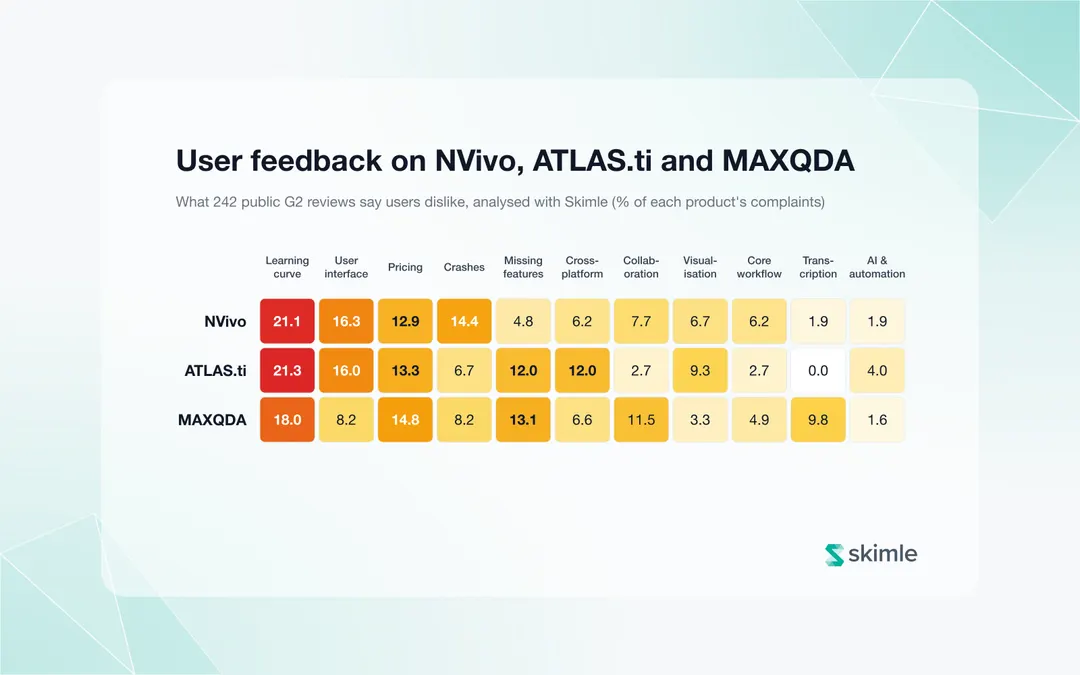
Steepest learning curve of the big three. All three traditional tools (NVivo, MAXQDA, ATLAS.ti) require meaningful investment to use productively. But ATLAS.ti's flexibility (a real strength for experienced users) translates into a more disorienting first experience than MAXQDA's more structured interface. Researchers who need to get productive quickly, or who are managing teams of coders who are not QDA specialists, feel this cost. In our analysis of 242 G2 reviews of NVivo, ATLAS.ti and MAXQDA, the learning curve accounted for 21% of everything ATLAS.ti users disliked, and moving between Mac, Windows, cloud and mobile for another 12%.
AI features are supplementary, not structural. ATLAS.ti has added AI features (auto-coding suggestions, quote extraction, document summaries) in recent versions under the "AI Lab" banner. These are useful for reducing some mechanical friction. They do not change the fundamental paradigm: you still do the initial coding pass. For example exploring alternative ways to code materials or discovering patterns using AI with metadata are not possible.
Collaboration overhead. Multi-user projects in ATLAS.ti work, but they require project file management and deliberate coordination (think early 2000s workflows). Researchers on distributed teams often report this as more friction than cloud-native tools impose.
The 7 best ATLAS.ti alternatives in 2026
1. MAXQDA: best classic tool for many academic researchers leaving ATLAS.ti
MAXQDA is the most commonly recommended destination for researchers looking to leave any of the major traditional QDA tools. It handles the same methodological territory as ATLAS.ti (thematic analysis, grounded theory, content analysis, mixed methods) with a more predictable interface and excellent visualisation tools.
What MAXQDA does better than ATLAS.ti: cleaner, more structured workspace; stronger mixed-methods integration (survey data, quantitative content analysis); better publication-ready visualisations; slightly lower average pricing; and a steeper-to-shallower learning curve transition that most users report as an improvement.
What you lose: ATLAS.ti's network editor is more powerful than MAXQDA's Code Map for complex relationship visualisation. Researchers whose methodology is built around network views of code relationships may find MAXQDA a step back in that specific capability.
For researchers coming from NVivo rather than ATLAS.ti, MAXQDA is also the most common recommendation because the workspace paradigm is closer. The NVivo and MAXQDA alternatives in 2026 post covers this group of researchers directly.
MAXQDA pricing: Generally relatively expensive, but some discount available. MAXQDA pricing 2026 has the full breakdown.
2. NVivo: deepest classic feature set
NVivo's position in 2026 is complicated. After Lumivero's acquisition from QSR International, the community has dealt with version stability issues, licence model changes, and feature regressions that have eroded goodwill significantly among long-term users. MAXQDA and ATLAS.ti have both gained ground from researchers migrating away from NVivo.
With that context stated: NVivo still has the broadest feature set of any traditional QDA tool. Its support for multimedia coding (video, audio, images, social media), complex matrix queries, and large document corpora is unmatched among the traditional tools. If your project requires this depth and your institution provides access, NVivo remains a serious option.
Choose NVivo over ATLAS.ti if:
- Your institution has a site licence and you need multimedia depth
- Your project involves video or social media data at scale
- Your field has NVivo as the specific expected citation in peer review
Choose ATLAS.ti over NVivo if:
- Network visualisation of code relationships is central to your method
- You work primarily on Mac (NVivo Mac still lags in some features)
- You are paying individually and want to avoid NVivo's higher individual pricing
NVivo pricing: Commercial pricing starts above $1,000 (€920) per year. The NVivo pricing 2026: is it worth it? post covers the full picture including academic discounts.
3. Dedoose: affordable cloud collaboration
Dedoose was built by researchers at UCLA for exactly the scenario where multiple coders need to work on the same project from different machines without paying separately for each. It is fully cloud-based, charges monthly rather than annually, includes interrater reliability statistics as standard, and integrates demographic or contextual variables with qualitative codes for mixed-methods analysis.
Compared to ATLAS.ti, Dedoose gives up: network views, theoretical memo sophistication, depth of visualisation, and REFI-QDA compatibility (Dedoose does not currently support REFI-QDA export, which matters if you might need to move your project later).
It gains: straightforward multi-user access without per-seat charges, browser-based access from any operating system, monthly rather than annual commitment, and considerably lower cost for short projects.
Dedoose has no meaningful AI features, which in 2026 is a real limitation. If AI assistance is a factor in your evaluation, Dedoose is the weakest option in this category. The Dedoose review 2026 covers the tool in depth.
Dedoose pricing: approximately $18 (€16) per month for individual researchers; student pricing approximately $13 (€12) per month.
4. Quirkos: simplest traditional interface, good for beginners
Quirkos takes a different visual approach to qualitative coding: each code is represented as a bubble whose size reflects how frequently it has been applied, and you drag-assign passages to bubbles. For researchers who find the traditional codebook-and-tree-structure of ATLAS.ti intimidating, Quirkos's approach is noticeably less daunting.
It handles text-based data, offers both cloud and offline (perpetual) options, includes transcription as an add-on, and supports real-time collaboration on the cloud version. The interface is lighter than any of the major traditional tools and explicitly targets PhD students, masters researchers, and researchers in lower-income contexts.
For researchers who primarily valued ATLAS.ti for deep network analysis, Quirkos does not offer a comparable alternative. For researchers who found ATLAS.ti's interface the problem rather than its features, Quirkos is worth a serious look. It is one of the options covered in the easiest qualitative data analysis software to learn roundup.
Quirkos pricing: $5 (€4.50) per month for students; $13 (€12) per month for academic/non-profit; $23 (€21) per month for commercial. A permanent single-computer licence costs $69 (€63). Cloud plan includes a 14-day free trial.
5. Taguette: free, open-source, no friction
Taguette is a no-cost, open-source text tagging tool that handles the fundamentals of qualitative coding: import documents, highlight passages, apply tags, export your coded material. It runs in a browser, costs nothing, imposes no feature limits or document caps, and requires no installation if you use the hosted version.
What Taguette does not offer: network views, mixed-methods integration, visualisations beyond basic exports, multimedia support, or AI assistance. It is a simple, clean tool for the foundational task of reading documents and applying codes.
For a solo PhD researcher doing small-scale qualitative work on a constrained budget, Taguette removes every financial barrier to entry. For teams doing larger projects or researchers who need more than basic tagging, the limitations will surface quickly. The free qualitative data analysis software in 2026 roundup covers Taguette alongside other no-cost options.
Taguette pricing: free. The hosted version at taguette.org is free with no account caps; a self-hosted option is available for institutions with data sovereignty requirements.
6. QualCoder: free desktop with multimedia and AI but requiring tech knowledge
QualCoder is a free, open-source desktop application (Windows, Mac, Linux) that goes considerably further than Taguette. It handles text, images, audio, and video; organises codes in hierarchical tree structures; generates reports exportable to HTML, ODT, Excel, or plain text; and includes an optional AI chatbot module for exploring data and assisting with coding.
REFI-QDA support is included with caveats: QualCoder aims for compliance with the standard but notes that full compatibility is not yet guaranteed, particularly for audio and video projects. The latest stable release is version 3.8.2 (February 2026), with version 4.0 in development.
For researchers who need more capability than Taguette but cannot or do not want to pay for commercial software, QualCoder is the strongest free option. Its AI features are optional and less integrated than dedicated commercial tools, but their presence distinguishes it meaningfully from other free tools.
QualCoder pricing: free. Licensed under LGPL v3.
7. Skimle: AI-native with full source traceability
Skimle works from a different premise than all the tools above. Where ATLAS.ti (and every traditional CAQDAS tool) is built around the researcher doing the initial coding pass manually, Skimle runs the initial analysis pass first: it reads your entire corpus, extracts themes, and builds a structured category hierarchy with every insight linked to the supporting verbatim quote and back to the source document. The researcher's role is then to review, interpret, challenge, and refine what the AI has found.
The time difference is significant. Qualitative research experts estimate that thorough manual coding of one hour of interview material takes six to eight hours of analyst time. A corpus of 20 one-hour interviews that would take several weeks to code manually can produce an initial structured analysis in Skimle within hours.
Several things follow from this design:
Traceability is structural. Every category in Skimle links to every insight supporting it; every insight links to the exact passage in the source document. There are no floating claims without evidence. For academic researchers documenting AI use for peer review, this chain of evidence matters. The AI in qualitative research guide explains what peer reviewers increasingly expect when AI tools are used.
Manual coding is still possible. Skimle is not "AI only." Researchers can apply codes manually, reorganise the AI-generated category structure, move insights between themes, and add custom analytical notes. The predefined categories mode gives flexibility between bottom-up and top-down approaches, since the categories can come from Skimle's suggestions or from your own framework. You can also export your project via REFI-QDA to continue working in ATLAS.ti or another tool (see REFI-QDA export).
Built-in transcription and anonymisation. Upload audio or video files directly. Skimle transcribes across 100+ languages within the same secure environment as the analysis. Skimle Anonymise handles pseudonymisation of transcripts before sharing. No third-party services, no split billing, no manual import steps. If you are building an end-to-end interview workflow, practical interview setup for researchers walks through how this fits together.
EU-hosted and GDPR-compliant from day one. Skimle is built and hosted in the EU. For researchers working with sensitive participant data, this is a compliance baseline that matters for IRB applications and data agreements.
AI chat across the full dataset. Ask cross-corpus questions and get answers grounded in your specific data, with every response traceable to source. This is not a general-purpose AI answering from training knowledge; it queries the structured representation of your transcripts. The AI document analysis guide and AI for data analysis: text focus explain the broader context of why this approach differs from general LLM querying.
For academic researchers who want to preserve methodological rigour while working at the scale that modern qualitative projects demand, Skimle offers a more defensible approach than bolt-on AI in traditional tools. For consulting and research teams where turnaround matters, the speed advantage is substantial.
Skimle pricing: generous free tier for hundreds of pages of analysis, after that plans starting at €20 per month. See pricing for current plans.
Comparison table: ATLAS.ti alternatives at a glance
| Tool | Annual cost (individual) | AI analysis | Cloud | REFI-QDA | Free tier |
|---|---|---|---|---|---|
| ATLAS.ti | ~$670 (€615) commercial; ~$110 (€100) academic | Supplementary only | Yes (web version) | Yes | Trial only |
| MAXQDA | ~$510 (€465) commercial | Supplementary only | Limited | Yes | Trial only |
| NVivo | ~$295–$595 (€270–€545) academic | Supplementary only | Limited | Yes | Trial only |
| Dedoose | ~$216 (€200) / year ($18/month) | None | Yes | No | No |
| Quirkos | ~$156 (€145) / year ($13/month academic) | None | Yes | No | 14-day trial |
| Taguette | Free | None | Yes (hosted) | No | Yes (fully free) |
| QualCoder | Free | Optional AI module | No (desktop only) | Partial | Yes (fully free) |
| Skimle | Free tier + €20 and up plans | AI-native | Yes | Yes | Free trial |
Which ATLAS.ti alternative should you choose?
The answer depends primarily on three questions: whether you are staying in the traditional manual coding paradigm, what role AI plays in your decision, and your budget.
Stay in traditional CAQDAS if:
- Your methodology requires full manual coding and the AI features of newer tools are not methodologically appropriate for your specific approach
- Your institution has site licences for MAXQDA or NVivo with no budget left for more modern tools yet
- Network views and theoretical memo work are central to your analytical process
- You need the citation weight of an established tool in a conservative peer review field
In this scenario, choose MAXQDA. Its interface is cleaner, the transition from ATLAS.ti is manageable, and it handles mixed-methods work better than ATLAS.ti at similar pricing.
Choose Dedoose if you have a distributed team that needs collaborative coding, a project under 12 months, and a hard budget constraint. Accept the lack of REFI-QDA compatibility and AI features as known trade-offs.
Choose Quirkos if ATLAS.ti's interface was the primary complaint and you do not need network views, deep multimedia, or AI. The visual interface reduces friction considerably for new or occasional researchers.
Choose Taguette or QualCoder if cost is the binding constraint and you are doing solo or small-team text-based work. QualCoder is the better choice if you need multimedia or the optional AI module. Taguette is simpler and requires less setup.
Choose Skimle if you need to process a meaningful volume of interviews (10 or more is where the speed advantage becomes significant and grows from there), want AI analysis with full source traceability, need transcription and anonymisation in the same platform, or are working in a context where GDPR compliance must be demonstrable from the ground up. The NVivo and MAXQDA alternatives in 2026 post covers additional context for researchers considering AI-native tools.
For PhD students and early-career researchers specifically, the best qualitative research tools for PhD students post weighs the specific constraints of academic research at that career stage.
Frequently asked questions
What is the best free ATLAS.ti alternative?
Skimle's genereous free tier allows most researchers to complete their research objectives fast with minimal learning curve and faster path to insights. The paid plans start at €20 and allow analysing larger sets of data.
Can I migrate my ATLAS.ti project to another tool?
Yes, via the REFI-QDA standard. ATLAS.ti exports to REFI-QDA, which MAXQDA and NVivo import. Your codes, documents, and coded segments transfer; some features (network views, memos, specific metadata structures) may not fully carry over depending on the target tool's support for the standard. Starting a new project in the target tool and re-importing documents from scratch typically gives cleaner results for complex projects. The manual coding and REFI-QDA export guide explains the interoperability workflow.
Is ATLAS.ti better than MAXQDA?
Neither is universally better. ATLAS.ti has a stronger network editor for visualising relationships between concepts, which is valuable for grounded theory and interpretivist work. MAXQDA has a cleaner interface, better mixed-methods integration, and publication-ready visualisations. For most researchers, especially those new to QDA software or those doing mixed-methods work, MAXQDA is the more accessible choice. The MAXQDA vs ATLAS.ti comparison covers this in full. The limitation in both is that they are previous generation tools built to just help manual workflows, with no built-in help in analysis using LLMs.
Do I need CAQDAS software at all, or can I use AI tools instead?
It depends on your methodology and context. AI tools like Skimle are built specifically for qualitative research and provide structured, traceable analysis at scale. General-purpose AI tools (ChatGPT, Claude) can assist with specific tasks but do not provide the systematic corpus-level analysis, code management, or source traceability that qualitative research requires. The AI for data analysis: text focus guide explains the distinction between general AI tools and purpose-built qualitative analysis platforms.
About the authors
Henri Schildt is a Professor of Strategy at Aalto University School of Business and co-founder of Skimle. He has published over a dozen peer-reviewed articles using qualitative methods, including work in Academy of Management Journal, Organisation Science, and Strategic Management Journal. His research focuses on organisational strategy, innovation, and qualitative methodology. Google Scholar profile
Olli Salo is a former Partner at McKinsey & Company where he spent 18 years helping clients understand the markets and themselves, develop winning strategies and improve their operating models. He has done over 1000 client interviews and published over 10 articles on McKinsey.com and beyond. LinkedIn profile
Sources
- ATLAS.ti pricing guide 2026 - usercall.co
- ATLAS.ti pricing details - checkthat.ai
- ATLAS.ti student licences - atlasti.com
- Quirkos licences and pricing - quirkos.com
- Delve qualitative analysis software - delvetool.com
- QualCoder documentation - qualcoder.org
- Taguette: free and open-source QDA - taguette.org
- Qualitative Data Analysis Software Market - Verified Market Research
- How long does it take to analyse qualitative data from 10 interviews - ResearchGate
- REFI-QDA standard - qdasoftware.org
- Silver, C. & Lewins, A. (2014). Qualitative Data Analysis Software: A Call for Understanding, Transparency, Conscientious Use, and Reporting. Field Methods, 26(4), 369–377.