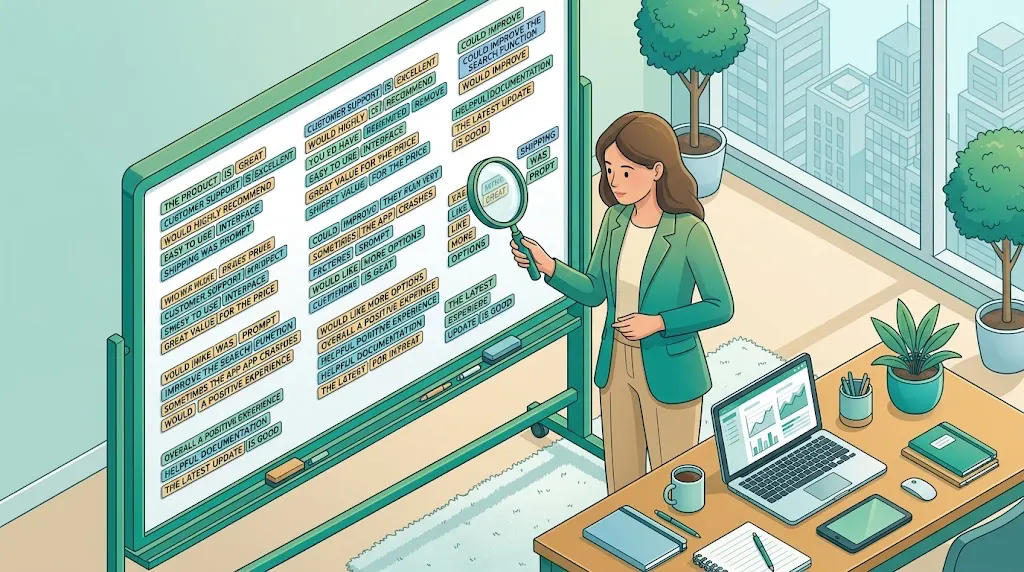
To synthesise customer advisory board (CAB) feedback: transcribe every session, code the discussion for recurring themes rather than relying on memory, tag each point by member and session, and compare themes across sessions and boards before reporting back. Tools like Skimle can process multiple CAB transcripts at once and show which themes recur across sessions versus which came from a single vocal member, with each point linked back to its source.
Most CAB guides agree on the deadline. Synthesise feedback within a week of the session, while the discussion is fresh and before the next meeting buries it. What almost none of them explain is how. The standard advice stops at "build a feedback synthesis table" or "catalogue the feedback and share it with the team," which is a fine instruction for a single 90-minute session with eight attendees and a much weaker one for a company running three CABs a year, each with 15 members, across multiple advisory boards by product line or region.
This is a qualitative analysis problem wearing a different name. A CAB session produces hours of discussion, multiple speakers, follow-up threads, and a facilitator's notes that mix direct quotes with paraphrase. Synthesising it properly means working out which points are a real recurring signal across members and sessions, and which are one person's pet issue that happened to come up when nobody else was talking. Most teams handle this with a spreadsheet, a strong memory, and goodwill. None of those scale past two or three sessions.
Why CAB synthesis is harder than it looks
A customer advisory board is not a single feedback session. It is a recurring programme: the same group of strategic customers meeting quarterly or twice a year, supplemented for larger companies by multiple boards split by product line, region, or customer segment. Each session adds another transcript, another set of action items, and another layer of context that needs to connect back to what was said before.
The Velaris glossary describes a CAB as a select group of customers who provide feedback, insights, and advice on strategy and product direction, distinct from a one-off feedback survey or regular check-in. That recurring, relationship-based structure is exactly what makes synthesis difficult. A single win-loss interview or customer discovery call is a closed unit of analysis: you code it, you move on. A CAB programme is a standing dataset that grows every quarter, and last year's themes need to stay visible when this year's session reopens the same topic.
The volume problem
A single CAB session with 12-15 members running for half a day generates several hours of discussion. Best-practice guidance from CAB specialists at Velaris and Ignite Advisory Group puts the ideal board size at 8-12 members for a focused discussion, with successful boards ranging from 5 to 25. Multiply that by two or three sessions a year, by however many separate boards a larger company runs, and you get a body of qualitative data that nobody can hold in their head by the third year.
The loudest-voice problem
CAB facilitators know the pattern well. One member raises a sharp, specific complaint about a feature gap. It is articulate, it is memorable, and it dominates the post-meeting debrief. Whether three other members quietly nodded along or stayed silent because the topic did not affect them gets lost the moment the meeting notes turn into a summary slide. Without a system that tracks who said what and how often a theme actually recurs, the loudest member in the room sets the agenda, not the aggregate signal.
The cross-session memory problem
The hardest part of CAB synthesis is not any single session. It is comparing this quarter's discussion to the last four, or to the equivalent board in another region. A theme that appears once is an anecdote. The same theme appearing across three consecutive sessions, raised by different members each time, is something a product team should act on. Spotting that pattern requires structured records that can be searched and compared, not a folder of slide decks from past meetings.
How does CAB synthesis differ from win-loss or discovery interviews?
CABs get lumped in with other "talk to customers" programmes, but the goal, cadence, and participant relationship are different enough that the same analysis playbook does not transfer cleanly.
| Dimension | Customer advisory board | Win-loss interviews | Customer discovery interviews |
|---|---|---|---|
| Purpose | Relationship-building plus strategic input on direction | Understand why a specific deal was won or lost | Validate a problem or product idea before building |
| Participants | 8-25 strategic customers, recurring membership | Buyers from individual closed deals, one-time | Prospective or early-stage users, often one-time |
| Cadence | Quarterly or biannual, ongoing programme | Continuous, triggered by each deal closing | Bursty, concentrated around a specific decision |
| Relationship | Long-term, members expect to see their input acted on | Transactional, often a single 30-45 minute call | Transactional, exploratory |
| Primary output | Recurring themes that validate or challenge product direction | Patterns by competitor, segment, deal size | Evidence for or against a problem hypothesis |
| Synthesis challenge | Comparing across sessions and years, not just within one | Comparing across a large sample of one-time calls | Comparing across a smaller, focused sample |
Our guide to win-loss analysis covers the transactional case in depth: a continuous stream of one-time interviews, coded and segmented by deal metadata. CAB synthesis has the opposite shape. It is a small, stable group of relationship-invested members whose input needs to be tracked longitudinally, where the question is not "what segment does this theme belong to" but "is this the third time this group has raised it."
That distinction matters for staffing too. A CAB programme run well is part research function, part account management. The account owner who manages the relationship with a given member is not always the person best placed to spot a pattern across 20 transcripts spanning three years. Separating relationship management from synthesis, while keeping both connected to the same evidence base, is part of what makes a CAB programme mature rather than just well-attended.
What does "synthesise within a week" actually require?
The one-week deadline shows up consistently in CAB practitioner guidance. A Customer Marketing Alliance guide to running B2B CABs describes sending a recap with key takeaways and feedback within a week of the session, followed by cataloguing the product feedback for the development team and reporting back to members later with concrete action plans. The logic is straightforward: momentum decays fast, and members who shared candid input want to see it move before the next session rolls around.
Hitting that deadline with a manual process means someone, usually a customer marketing or customer success lead, has to:
- Listen back through hours of recording or read a long transcript, separating facilitator commentary from member statements.
- Pull out individual points and decide, by judgement, which ones matter.
- Cross-reference against memory of what came up in previous sessions, since there is rarely a searchable record.
- Write a summary that captures the themes without simply listing every comment, which takes longer the more candid the discussion was.
- Route different slices to different teams (product gets capability gaps, marketing gets positioning language, the executive sponsor gets the strategic narrative).
Step three is where manual synthesis usually breaks down. Recognising that "the integration gap" came up in Q1 and Q3 of last year and again this quarter requires either a very good memory or a well-maintained log, and most programmes have neither once they pass their second or third session.
A structured approach to CAB synthesis
The fix is the same one that works for any qualitative dataset that grows over time: stop treating each session as a stand-alone document and start treating the whole programme as a single, searchable body of evidence.
Transcribe every session as a matter of course
A facilitator's handwritten notes capture maybe a third of what was actually said, filtered through whatever the facilitator happened to find interesting in the moment. Recording and transcribing CAB sessions gives you the actual words, which matters when a member's exact phrasing is what convinces a sceptical product team that a concern is real and not a paraphrase that drifted from what was actually said.
Tag every point by member, session, and board
Before any thematic coding happens, each piece of feedback needs metadata: which member raised it, which session it came from, and which board (if the company runs more than one). This is the same principle covered in our guide on discovering themes in the data using metadata variables, applied to a CAB context. Without this layer, you cannot answer the question that actually matters to a product team: is this concern coming from one member, or from four different members across three sessions over the past 18 months?
Code for themes, not just topics
A list of topics mentioned ("pricing," "integrations," "onboarding") is not synthesis. Thematic analysis means identifying what was actually said about each topic, since "pricing" covers very different concerns depending on whether a member is unhappy about the absolute level, the value relative to a competitor, or how a renewal conversation was handled. The same discipline applies here as in any qualitative coding exercise: develop codes that are specific enough to be useful, then group them into themes once the pattern is clear. Our guide on how to code qualitative data walks through the inductive process in more depth.
Compare across sessions, not just within one
Once two or more sessions are coded the same way, the real value appears. A theme that shows up in one session and never again is worth noting but not acting on urgently. A theme that recurs across three sessions, raised by different members each time, with similar language, is a validated signal. This is the comparison that manual synthesis almost never gets to, because it requires holding multiple transcripts' worth of codes in view simultaneously, which a spreadsheet handles poorly once you are past two or three sessions.
Route findings by audience, with evidence attached
A CAB programme typically serves several internal audiences from the same sessions: product wants capability gaps ranked by recurrence, the executive sponsor wants the strategic narrative, and marketing wants the language members use to describe their priorities. Each summary should link back to the specific quotes and sessions behind it, so a sceptical stakeholder can check the underlying evidence rather than take the summary on faith. This is the same principle covered in two-way transparency creating confidence in AI: a finding is only as credible as the path back to its source.
How Skimle handles CAB feedback synthesis
Skimle was built for exactly this kind of qualitative dataset: one that grows session after session, where the question is not just "what did this group say" but "what's recurring across this group, over time, across multiple groups."
You upload the transcript from each CAB session as a document, tagged with metadata for the session date, the board (if you run more than one), and ideally the member who made each statement where that level of detail is available. Skimle's automatic thematic analysis then codes the discussion into a category structure, and because every session lives in the same project, the categories view shows you themes pooled across all sessions you have run, not just the most recent one.
From there, the metadata and variable features let you slice by session or by board: does this theme recur across all three boards, or is it specific to the enterprise segment's CAB? Every theme stays linked back to the insights and supporting quotes that produced it, so when an account owner needs to show a product team exactly which member said what, the evidence is one click away rather than a search through old recordings. That traceability is what lets a CAB programme report "this came up in 5 of 8 sessions across two boards, raised independently by 6 different members" instead of "several members seemed concerned about this," which is the difference between a finding a product team can prioritise against a roadmap and one they can politely set aside.
For companies running multiple boards by region or product line, the same project structure lets you compare boards directly. A concern that is universal across every board you run is a different kind of priority than one that is specific to a single region's customer base, and that distinction is invisible without a structured, comparable record.
If your CAB programme sits alongside other primary research, such as win-loss calls or customer discovery interviews, the same workspace can hold both, while keeping the analysis approach appropriate to each: win-loss and discovery interviews get coded for patterns across a large one-time sample, CAB sessions get coded for recurrence across a smaller, recurring group. Teams running enterprise B2B research programmes more broadly, including board-level reporting, may also find our guide on board meeting preparation useful for packaging CAB findings into an executive-ready narrative.
What this looks like in practice
Consider a SaaS company running two CABs: one for enterprise customers, one for mid-market. Each meets quarterly. After 18 months, the company has eight transcripts across the two boards. A member on the enterprise board raises a concern about API rate limits in session two. It comes up again in session four, from a different member. On the mid-market board, nobody mentions it at all.
Coded and compared properly, this becomes a clear, evidenced finding: a recurring concern, validated by two independent members, specific to the enterprise segment. The product team can prioritise it with confidence, knowing it is not one person's preference. Handled the way most CAB feedback is handled today, in a spreadsheet updated inconsistently across two years and two facilitators, that pattern is invisible. The two mentions sit in different documents, the connection between them depends on someone remembering session two while reading session four, and the segment-specific nature of the finding (present on one board, absent on the other) never gets surfaced at all.
Frequently asked questions
How often should we synthesise customer advisory board feedback?
Produce an initial recap within a week of each session, in line with standard CAB practice, so members see their input acknowledged before momentum fades. Run a deeper cross-session synthesis at least once a year, comparing the current session's themes against the full history of the board, so recurring patterns surface rather than getting buried in a series of one-off summaries.
What's the difference between a CAB feedback table and proper synthesis?
A feedback table lists what was said, usually grouped loosely by topic. Synthesis identifies which topics are recurring themes across multiple members and sessions, distinguishes those from one-off comments, and links every theme back to the specific quotes and sessions that support it. A table is a record. Synthesis is an analysis with a traceable evidence trail.
Should every CAB session be transcribed, or are facilitator notes enough?
Transcribe wherever possible. Facilitator notes are filtered through whatever the facilitator found notable in the moment, which means quieter members and nuanced comments get under-represented. A transcript preserves the actual language members used, which matters when you need to convince a sceptical team that a concern is shared rather than paraphrased into something it was not.
How do we stop one vocal CAB member from dominating the findings?
Tag every point by the member who raised it before coding for themes, then check recurrence across members, not just across mentions. A theme raised five times by the same person is a different finding to one raised once each by five different members, even though both might look identical in a simple topic count. Reporting recurrence by member, not just by mention, is the single most effective check against the loudest-voice problem.
Can the same tool handle CAB synthesis and other customer research, like win-loss interviews?
Yes, provided the tool supports tagging by metadata (session, board, segment) and keeps separate research streams comparable but distinct. CAB sessions and win-loss interviews answer different questions and have different cadences, but both benefit from the same underlying discipline of coding, metadata, and traceable evidence. Running them in the same workspace, like in Skimle, makes it easier to spot when a theme from one programme corroborates a theme from another.
Ready to turn CAB session notes into themes you can act on? Try Skimle for free and see how structured analysis surfaces recurring signal across sessions and boards, with every theme traceable back to who said it and when.
Want to go deeper on related research programmes? Read our guides on win-loss analysis, building a research repository that people actually use, and how to synthesise user research. If you work in product, our use-case page for product managers covers how Skimle fits a broader research workflow. Consultants and investors running enterprise B2B due diligence alongside CAB-style stakeholder programmes may also find our use-case page for consultants and investors useful.
About the authors
Henri Schildt is a Professor of Strategy at Aalto University School of Business and co-founder of Skimle. He has published over a dozen peer-reviewed articles using qualitative methods, including work in Academy of Management Journal, Organisation Science, and Strategic Management Journal. His research focuses on organisational strategy, innovation, and qualitative methodology. Google Scholar profile
Olli Salo is a former Partner at McKinsey & Company where he spent 18 years helping clients understand the markets and themselves, develop winning strategies and improve their operating models. He has done over 1000 client interviews and published over 10 articles on McKinsey.com and beyond. LinkedIn profile
Sources
- What is a customer advisory board? | Velaris Glossary
- Does your company need a customer advisory board? | Customer Experience Dive
- How to run a successful B2B customer advisory board | Customer Marketing Alliance
- Customer Advisory Board (CAB): Definition and Overview | Velaris
- How many customers do you need for a Customer Advisory Board? | Ignite Advisory Group