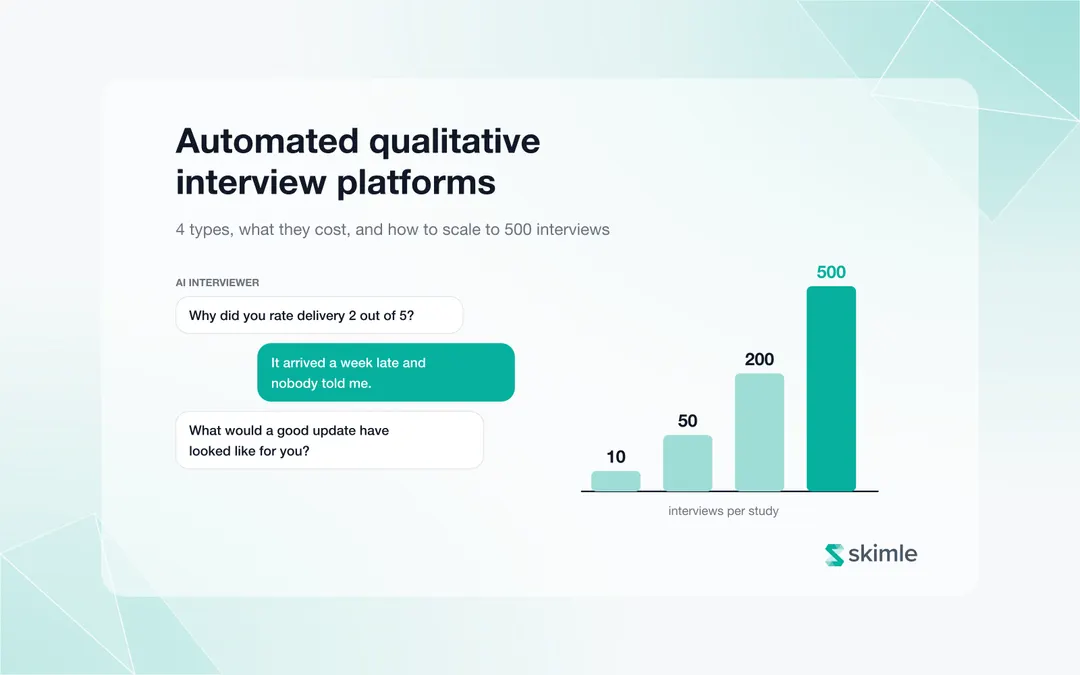
Automated qualitative interview platforms use an AI interviewer to ask open questions, probe vague answers and adapt follow-ups, so one study can reach 50 to 500 people in days. They come in four types: AI-moderated interview platforms, conversational surveys with AI follow-ups, survey tools that hand respondents to an AI interview, and research repositories with interviewing added. Prices range from free tiers and €20 a month to enterprise contracts above $20,000 (€18,500) a year.
This guide answers the questions buyers ask most often when they start looking: what kinds of platforms exist, which ones combine surveys and interviews, what they cost, how to scale without losing depth, and what CX teams should use for churn research. For a tool-by-tool review, see our comparison of the best AI interview tools in 2026.
A note on bias: Skimle makes one of the tools discussed here, Skimle Ask. We have tried to describe every category fairly and to say where another type of tool is the better fit.
What kinds of platforms automate qualitative interviews?
Four types of tool now run interviews without a human moderator. They overlap at the edges, but they start from different places, and that starting point decides what they do well.
| Type | How the interview works | Examples | Strongest at | Watch out for |
|---|---|---|---|---|
| AI-moderated interview platforms | An AI interviewer runs a full conversation from a discussion guide, probing each answer, in text, voice or video | Outset, Listen Labs, Strella, Conveo, Skimle Ask | Depth per respondent, consistent probing across hundreds of interviews | Enterprise tools are sales-led with five-figure contracts |
| Conversational surveys | A survey whose open questions get one or two AI follow-ups | Voiceform, UserCall, many survey tools' AI add-ons | Adding "why" to an existing survey with little change to the workflow | Follow-ups are shallow; analysis is often summaries only |
| Survey-to-interview handoff | Respondents finish a survey, then selected people continue into an AI interview | Peekator | Linking interview depth to survey segments | Two instruments to design and connect |
| Research repositories with interviewing | A repository for past research that can also run AI interviews | Marvin | Teams that already centralise research in one place | Heavier than needed for a one-off study |
A fifth category is often listed next to these but is a different thing: synthetic respondents, where an AI generates answers as if it were a customer. No person is interviewed, so treat the output as hypotheses to test, not evidence. Our guide to fake respondents in AI interviews covers the related problem of bots and low-effort participants in real studies.
Which platforms combine surveys with automated in-depth interviews?
Three designs bring survey questions and interview depth together, and they suit different studies.
- One instrument with both question types. Closed questions (ratings, single and multiple choice, grids) and open questions sit in the same conversation, and the AI probes the open answers and, where useful, the reasons behind a rating. Skimle Ask works this way, with eight question types and branching, so a respondent who rates delivery 2 out of 5 is asked what went wrong while one who rates it 5 moves on. The closed answers become segments you can cut the themes by. This is the simplest design to run, and it keeps every respondent's numbers and reasons in one record.
- Survey first, interview second. Respondents complete a conventional survey and a subset continues into an AI interview that probes their survey answers. Peekator launched this in July 2026, adding AI video and voice interviews to its survey platform. It suits large tracking studies where only some respondents need depth.
- Two separate tools. A survey tool collects the numbers, and an interview tool is used with a follow-up sample. This is the traditional mixed-methods design and still makes sense when the two phases have different samples or timing, but matching the two datasets is manual work.
If you are deciding between a survey and interviews in the first place, AI interviewing vs human interviewing and our guide to open-ended questions cover the trade-offs.
How much do automated qualitative interview platforms cost?
Pricing follows four models, and the model matters more than the headline number because it decides what a second or third study costs.
| Pricing model | How you pay | Published or reported prices (2026) | Suits |
|---|---|---|---|
| Self-serve subscription | Monthly or annual plan, interviews within a usage allowance | Skimle from €20 (about $22) per user per month billed annually, with a free tier; UserCall from $89 (€82) a month | Teams running recurring studies who want to start the same day |
| Usage-capped plan | A plan with a fixed number of responses or answers a month | Voiceform Lite: 200 answers a month after a free trial, larger plans by quote | Small, occasional studies |
| Enterprise annual licence | Seat or platform fee plus usage, through a sales process | Outset: buyer-reported entry around $20,000 (€18,500) per seat a year plus usage. Listen Labs: around $20,000 a year plus $300 to $400 (€275 to €370) per session | Large insights teams with a steady research budget |
| Per study | A priced engagement, often with recruitment included | Strella: around $10,000 to $25,000 (€9,250 to €23,000) per study | Teams buying research as a project rather than a tool |
The enterprise and per-study figures are not published by the vendors. They come from buyer reports collected in competitors' comparison articles (listed in the sources), so treat them as a guide to the order of magnitude rather than a quote.
Two costs sit outside the platform price:
- Recruitment. If the platform has no panel, you pay a panel provider or recruit from your own customers. Recruiting your own customers through an email or in-product link costs nothing but reaches only people you already have.
- Incentives. B2C respondents typically expect a small incentive for a 10 to 15 minute interview; B2B professionals expect more. Incentives can exceed the platform cost on a 200-interview study.
For comparison, a traditional agency study of 15 to 20 moderated in-depth interviews commonly costs tens of thousands of euros once recruitment, moderation and reporting are included, and takes four to eight weeks.
How do you scale qualitative research from 10 to 500 interviews without losing depth?
Running 500 interviews is now easy. Getting 500 interviews' worth of insight out of them is not, and depth is usually lost in one of five places.
- The discussion guide. An AI interviewer can only probe what the question invites. Ask for accounts ("tell me about the last time…") rather than opinions ("what do you think of…"), and keep the guide to 5 to 8 core questions so respondents still have energy for the follow-ups.
- The pilot. Run 10 interviews, read every transcript, and fix the questions that produce one-line answers before you send the link to 500 people. A weak question at n=10 is a wasted question at n=500.
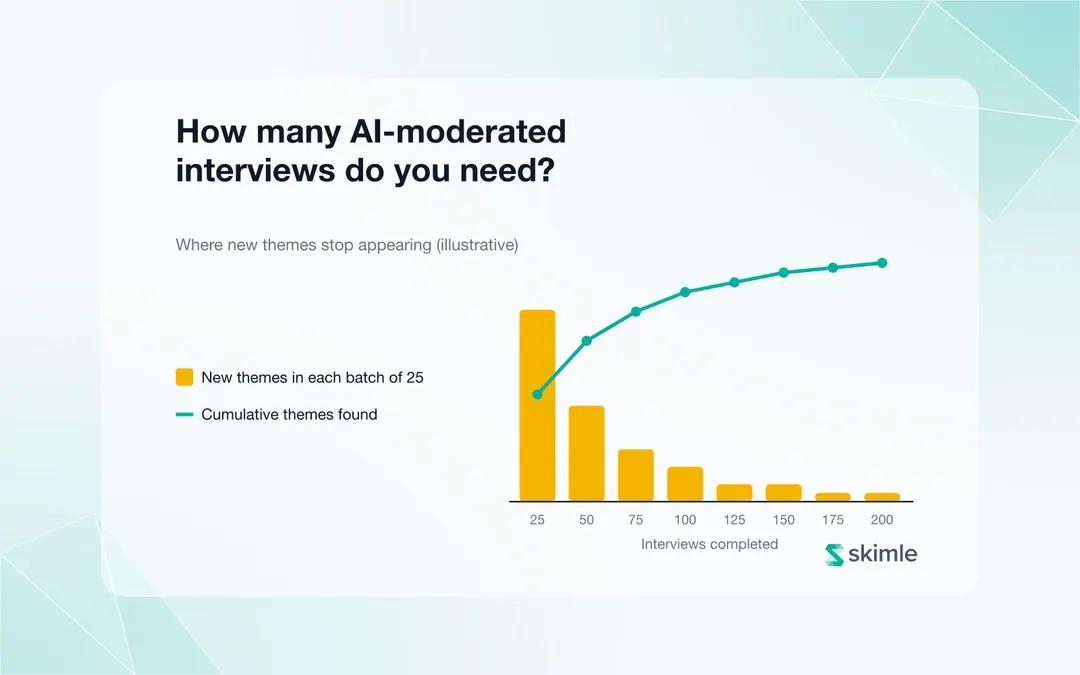
- The sample. Scale only helps if it adds variety. Use closed questions or customer metadata to make sure each segment you care about (plan, region, tenure, churned or retained) has enough people to compare. How many AI-moderated interviews you need covers sample sizing at this scale.
- The analysis. Depth is most often lost here. A platform that summarises 500 transcripts into a page of bullet points has thrown away most of what you collected. Look for analysis that reads every response, codes it, and links each theme back to the quotes behind it, so you can check a theme by reading the people in it.
- The comparison. At n=500 the value shifts from "what are the themes" to "which themes differ by segment". A theme mentioned by 40% of churned customers and 8% of retained ones is a finding; the same theme without the split is a list item. Our guide to discovering themes with metadata variables shows how this works.
Quality control also changes at scale. With 500 respondents you will get some bots, some copy-pasted answers and some people rushing for the incentive, so screen for them before analysis rather than after.
Most automated interview projects stall at step 4: the interviews are collected in days, then sit unread because nobody has a week to code them. Skimle Ask feeds responses straight into Skimle's analysis, where every answer is coded and every theme links to its quotes, so a 300-interview study can be read and checked in an afternoon. See how this fits market research and customer insights teams.
What are the best tools for CX teams researching churn drivers?
For churn, the best tool is the one that reaches customers at the moment they leave, because a churned customer asked three months later remembers a tidier reason than the real one. That points to three requirements:
- An embeddable link. The interview should open from the cancellation flow, a downgrade confirmation or a post-cancellation email, not only from a research panel.
- Branching on the reason. A customer leaving on price needs different follow-ups from one leaving because a feature broke. Closed questions that route the conversation do this better than one open question.
- Segment-level analysis. Churn reasons differ by plan, tenure and usage. The analysis should show which themes are concentrated in which segment, and the quotes behind each.
Self-serve AI interview tools with embeddable links (Skimle Ask, UserCall and others) fit this best, because churn research is continuous rather than a one-off project and a per-study contract makes every new wave a procurement decision. Enterprise platforms suit a large, deliberate churn study with a recruited sample of former customers. For the wider programme, see always-on customer research and our voice of customer research guide.
AI interviewer or human moderator: when does each win?
AI interviewers win on consistency, scale, speed and availability: every respondent gets the same guide and the same quality of follow-up, at any hour, in their own language. Some respondents also find it easier to be candid with an AI on sensitive topics, such as why they left a job, because no person is judging the answer.
Human moderators still win where the interview depends on rapport, reading body language, handling distress, or recognising that the most important thing the person said was not an answer to the question. Senior B2B interviews, sensitive health topics and early discovery work where you do not yet know the questions are still best done by people. Many teams now combine the two: 10 to 15 human interviews to shape the guide, then an AI-moderated wave to test how widely the findings hold. AI interviewing vs human interviewing goes deeper on this.
What are the alternatives to traditional market research agencies for qualitative studies?
There are four, and they are not mutually exclusive:
- Self-serve AI interview platforms. You design the study and the AI runs it. Lowest cost and fastest, but you own the research design and the interpretation.
- Enterprise AI interview platforms with service. Vendors such as Outset and Listen Labs pair the software with research support and recruitment, closer to an agency engagement at a lower cost.
- In-house interviews with AI analysis. Your team runs the interviews, records and transcribes them, and uses an analysis tool to code them. This keeps the human moderator and removes most of the analysis time. See how to analyse customer interviews at scale.
- Freelance moderators. An experienced independent moderator for the interviews, with analysis done in-house. Good for B2B and sensitive topics.
Agencies still earn their fee for complex multi-country studies, hard-to-reach samples and work where the client needs an independent party. For the rest, the choice is mostly about who does the research design: a self-serve tool assumes someone on your team can write a good discussion guide.
How do you choose an automated interview platform?
These seven questions separate the platforms quickly in a demo or a trial:
| Question to ask | Why it matters |
|---|---|
| Can I try it today without a sales call? | Tells you whether a second study will also need procurement |
| Does it mix closed and open questions, with branching? | Decides whether you can segment the findings |
| How does the AI decide when to probe, and can I control it? | Shallow or repetitive follow-ups are the most common complaint |
| Does the analysis link every theme to the quotes behind it? | Without this you cannot check a finding or quote it in a report |
| Can I compare themes by segment? | Where the value of n=200+ lies |
| Where is the data stored, and is it used to train models? | GDPR and client confidentiality; EU hosting matters for many buyers |
| Can I export the transcripts and coding? | Avoids lock-in and supports audit trails |
Frequently asked questions
What is an automated qualitative interview?
An automated qualitative interview is an interview in which software, usually a large language model, asks the questions instead of a human moderator. It follows a discussion guide, asks follow-up questions based on each answer, and records the conversation as a transcript. Respondents usually take part through a link in their browser or phone, in text or voice.
How many interviews can an AI interviewer run at once?
There is no practical limit: interviews run in parallel, so 500 people can take part on the same day. The limits are recruitment and analysis. Most studies that collect hundreds of interviews need structured analysis that codes every response, or the volume is wasted.
Are AI-moderated interviews as good as human interviews?
For structured questions with clear follow-ups, AI interviews can reach good depth and are more consistent across respondents than a team of human moderators. For exploratory work, rapport-dependent topics and senior B2B respondents, human moderators remain stronger. Many teams use both in sequence.
Do automated interview platforms include participants?
Some do. Several enterprise platforms include panel access or recruitment in their contracts, while self-serve tools usually expect you to send the link to your own customers, employees or a panel you buy separately. Check this early, because recruitment can cost more than the platform.
Can I use automated interviews for employee research?
Yes. Exit interviews, engagement follow-ups and pulse checks all work well with AI interviews, and some employees find it easier to be open with an AI than with a manager or HR. See HR surveys with AI interviewers.
Want to see an automated interview from both sides? Create a free Skimle account and set up a Skimle Ask study in minutes, or read the Skimle Ask documentation first. Every response is coded automatically, and every theme links back to the answers behind it.
Related reading:
- Best AI interview tools in 2026: 6 platforms compared
- Skimle Ask: qual at scale with AI interviews that ask why
- How many AI-moderated interviews do you need?
- Market research tools landscape review 2026
About the author
Olli Salo is a former Partner at McKinsey & Company where he spent 18 years helping clients understand the markets and themselves, develop winning strategies and improve their operating models. He has done over 1000 client interviews and published over 10 articles on McKinsey.com and beyond. LinkedIn profile