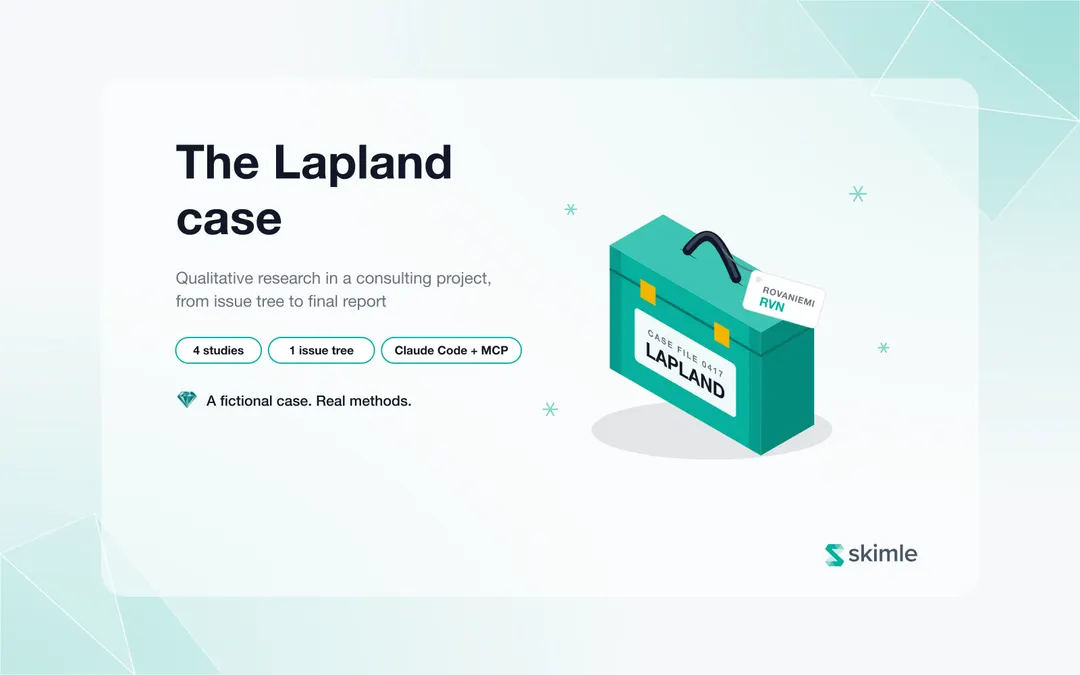
To run the qualitative side of a consulting project with AI tools, start with an issue tree, map each branch to a study that can test it, and keep every study's evidence in one repository where the tree lives. Run interim readouts straight from that repository, revise the tree as hypotheses fall, and pull the verified findings into the final report next to the quantitative model. This case shows the whole cycle in four weeks.
The case is fictional. The tour operator, the village, the consultants and (we are fairly sure) Santa are invented. The methods, the numbers you would expect in a project like this, and the Skimle features are real, and every step is one a consulting team can copy on Monday.
The two-and-a-half-minute film below tells the case as a detective story, from the client's brief to the final deck.
What was the problem?
Tinsel & Thaw Holidays is a mid-sized UK tour operator. For four winters it has sold Lapland packages to British families and couples: a charter flight from Manchester or Gatwick to Rovaniemi, a coach transfer to the village of Pakkasjärvi just above the Arctic Circle, and three, five or seven days of husky rides, reindeer sleighs, a visit to Santa and, the brochure says, "the Northern Lights".
It is a large market. In December 2022, British visitors accounted for nearly a third of all overnight stays by foreign visitors in Finland, according to Visit Finland. Tinsel & Thaw's route should have been a winner. Instead, last season it carried 6,100 travellers, turned over £14.2 million (€16.4 million) and lost £1.9 million (€2.2 million). One trip in five produced a formal complaint, refunds and goodwill payments reached £0.6 million (€0.7 million), and only 4% of travellers booked again.
The commercial director's brief to the consultants was one sentence long: "People come back from the North Pole angry, and I want to know why before I cancel Christmas."
The team was three people from a small strategy firm: Priya, the engagement lead; Tom, an associate who would not be warm again until February; and Aino, an associate who grew up in Kemijärvi and spent the project explaining that minus 24 is "fresh". They had four weeks.
Priya split the work into two workstreams. The quantitative one would rebuild the route's economics: cost per trip, the addressable market, pricing and yield. The qualitative one would find out what was actually happening on the ground and why travellers came back angry. Both associates asked for the quantitative workstream, because in most consulting firms that is still where the glamour is: the model, the charts, the slide the partner presents. Tom won. Aino took the qualitative workstream with one condition, that she could run it in Skimle, and by week two the steering group was asking for her slides first.
How do you build an issue tree for a qualitative investigation?
On day one the team did what consultants do: they wrote the question at the top of a whiteboard and broke it down into hypotheses that were mutually exclusive and collectively exhaustive (MECE, in consulting shorthand): between them they covered every plausible reason the route was losing money.
The first tree had four branches:
- Demand. The trips are too expensive for what they offer, or competitors undercut them.
- Customer experience. Lapland is too cold for British families, and the activities disappoint.
- Operations. Something in delivery (transfers, staff, equipment) goes wrong on the ground.
- Economics. The cost base is wrong regardless of what customers think.
Every client team has a favourite branch. Tinsel & Thaw's was "it's too cold, and we can't fix the weather", which was convenient because it meant nobody was to blame.
The issue tree is the most useful object in a consulting project and also the most neglected. It is drawn in week one, pasted into the kick-off deck and quietly abandoned while the team chases data. The team decided to keep it alive by loading it into Skimle as the project's predefined categories: each branch became a top-level category and each hypothesis a sub-category, so every piece of evidence from every study would be coded against the same tree.
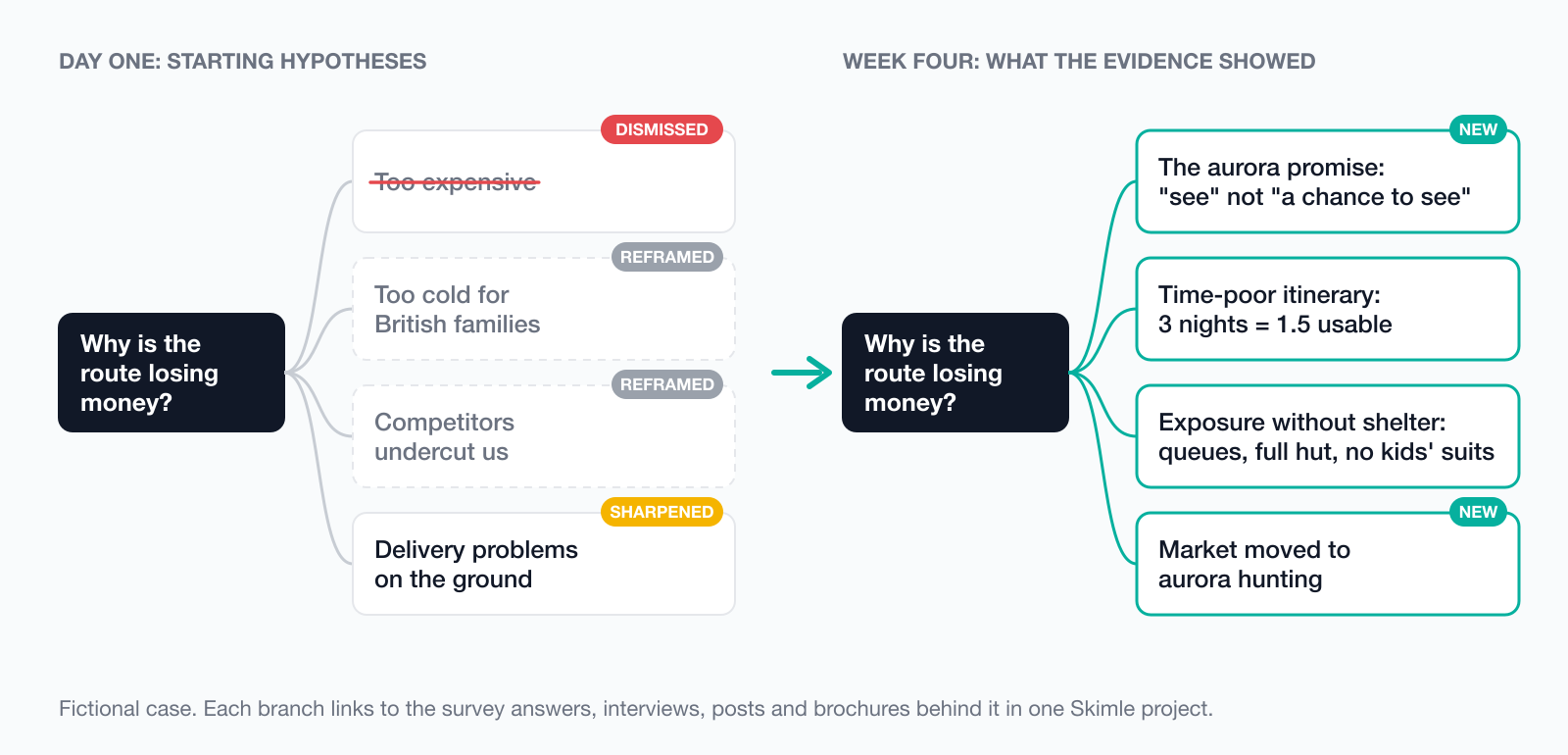
The diagram below shows the tree on day one and the one the team presented in week four. Most of this article is about how one turned into the other.
How do you turn an issue tree into a research plan?
Each branch needed a study that could confirm or kill it. Four studies covered the tree between them, and all four fed one Skimle project:
| Study | Tests which branches | Sample | How it was run | Time |
|---|---|---|---|---|
| Past traveller survey | Experience, demand | 412 of 2,340 travellers from two seasons | Skimle Ask: closed questions plus AI-probed open questions | 9 days |
| Village staff interviews | Operations, experience | 15 staff | 45-minute interviews, recorded and transcribed in Skimle | 2 weeks |
| Social media scan | Demand, experience | 6,800 public posts, 2023 to 2026 | Posts imported as a spreadsheet, one row per post | 1 week |
| Competitor brochure review | Demand | 16 brochures: the client's and 15 competitors' | PDFs with a client or competitor metadata field, coded against a fixed checklist and compared with metadata analysis | 4 days |
Two rules made the plan work. First, every study was coded against the same tree, with an inductive pass on top so evidence the tree had not anticipated could still surface. Second, each study ended in a short readout to the client's steering group, exported from Skimle rather than rebuilt in PowerPoint by hand.
Study 1: what did 412 past travellers say?
How it was done. The team wrote a Skimle Ask interview with nine questions: four closed (trip length, party type, month of travel, likelihood to recommend) and five open ones that the AI interviewer followed up on. A traveller who wrote "it was freezing" was asked where they were and what they were doing at the time; one who gave a 2 out of 5 for the Northern Lights was asked what they had been told to expect. The link went to 2,340 past travellers. 412 finished it, with a median time of nine minutes. The team noted the obvious bias in the methods appendix: unhappy travellers are more likely to answer, so the survey was used to explain the anger rather than to measure how common it was. The complaint and refund data did the measuring.
What they learned. Skimle read all 412 interviews and coded them into nine themes, using the issue tree as the starting categories and adding the ones the tree had missed. The cold was not the problem. Nearly half the respondents mentioned the cold, but about four in five of those were describing the same thing: waiting outside. Queuing for Santa at minus 24, standing by a coach at a fuel stop, or being turned away from a full aurora hut. As one mother put it: "My children have been colder at a Bolton Wanderers match. They've never had to stand still in it for an hour."
The Northern Lights were the real wound. Even on a dark, cloudless night, the Finnish Meteorological Institute puts the odds of seeing auroras at roughly 50% in Lapland's northern resorts, and a winter week brings plenty of cloud. Because the trip length was a closed question, Skimle could cut every theme by it, and the metadata comparison did the rest: 68% of three-night travellers saw no aurora at all, against 21% of seven-night travellers. The anger was about the gap between what they saw and what they had been promised. "The brochure said we would see the Northern Lights," wrote one father. "It did not say 'might'. My daughter asked me if the sky was broken."
The best part of the trip was not in doubt. Nine families in ten named the Santa visit as the highlight, and several described Santa knowing things he could not have known: a child's lost tooth, the name of a goldfish. The team coded these under "magic moments" and moved on. The most common complaint about Santa was that the visit lasted seven minutes.
What changed in the tree. "Too cold" was rewritten as "exposure without shelter", and a new sub-branch appeared under experience: "the aurora promise". The steering group saw this in week two as a 14-slide deck exported straight from Skimle's PowerPoint export, with the quotes on the slides and the full summaries in the speaker notes. The commercial director read the broken-sky quote twice and stopped saying "we can't fix the weather".
Study 2: what did the village staff know that head office did not?
How it was done. Aino ran 15 interviews in Pakkasjärvi over two weeks: five guides, three husky and reindeer handlers, three hosts and chefs, two transfer drivers and two people from what the village calls "Santa's office". The interviews were recorded, transcribed in Skimle in Finnish and English, and analysed together in English. One interviewee from Santa's office asked to be anonymised, which Skimle's anonymisation handled, although the beard came through clearly in the audio.
The team coded each transcript against the tree and then ran an inductive pass. The inductive pass is where the case turned.
What they learned. The staff had known the answers for years.
- The three-night trip is a one-and-a-half-night trip. The charter lands at 21:10, the coach reaches the village at 23:50, and the return transfer leaves at 04:50 on the fourth morning. "They pay for three nights of aurora," said a guide. "They get one and a half, and one of those they spend asleep because they arrived at midnight."
- The aurora hut holds 40 people and the village sleeps 120. Guides cancel outings when cloud cover is forecast above 80%, which is sensible, and run them in rotation, which means a three-night guest may be on the list only once.
- The thermal suits come in adult sizes. A supplier change two seasons ago dropped the children's range, so children wore their own coats. "The parents think Lapland is too cold," said a host. "It is not too cold. Their children are in their school coats."
- Santa's diary is overbooked. Visits are packed into a three-hour window. The interviewee from Santa's office pointed out, with some feeling, that the reindeer refuse to work after 20:00 and the elves have a very clear position on overtime.
One handler's account was coded under "operations" by the AI and moved to "experience" by Aino, who argued that a reindeer refusing to work is a customer experience if you are five. The tree was edited to match, and the note explaining why stayed attached to the category. A reviewer opening the project in week four could see every such decision and who made it.
What changed in the tree. A new top-level branch appeared: "a time-poor itinerary", holding the flight times, the transfer and the hut rotation. "Exposure without shelter" gained the children's suits. If your projects run on this kind of interview programme, see how Skimle supports consultants and investors working from expert and stakeholder interviews.
Study 3: what does the internet say about Lapland?
How it was done. Aino collected 6,800 public posts about Lapland holidays from 2023 to 2026: 2,600 Instagram captions, 1,900 Reddit posts and comments, 1,200 TikTok descriptions and 1,100 posts on X, using each platform's export tools and keeping only public content. Everything went into one CSV file, one row per post with platform, date and engagement as columns, and Skimle imported it with the columns as metadata. Usernames were removed before import. Nobody knew in advance what the internet would talk about, so Aino did not code this study against the tree: she let Skimle's automatic thematic analysis build the categories from the data, then mapped them onto the tree afterwards.
What they learned. The internet likes the cold. Posts mentioning minus 30 were overwhelmingly positive, mostly people boasting about it. What the internet does not like is waiting, and the timeline view showed "Santa queue" complaints spiking every December. The fastest-growing theme was aurora hunting: mentions of aurora forecast apps and "aurora alert" wake-up calls roughly tripled over the three years, and the posts praised operators who chased the clear sky rather than waiting under the cloud. Glass igloos and longer stays were rising too.
What changed in the tree. The demand branch gained a sub-branch, "the market has moved to aurora hunting", which matters because Tinsel & Thaw's model assumed the aurora would come to the guests. The original "UK customers dislike the cold" hypothesis was formally closed, with 6,800 posts' worth of evidence that they mostly enjoy it.
Study 4: how do 15 competitors sell Lapland?
How it was done. Priya collected the current brochures and web pages of 15 competitors selling Lapland to UK customers, added Tinsel & Thaw's own brochure, and uploaded all 16 as PDFs with one metadata field: client or competitor. The brochures were coded against a fixed checklist (aurora wording, trip lengths, transfer time, included clothing, Santa format and price per night), and the spreadsheet view turned the result into a brochure-by-criterion matrix in an afternoon.
The decisive step was the metadata analysis, which compared the client with the competitors theme by theme.
What they learned.
- Both groups talk about the Northern Lights, and about as often. Tinsel & Thaw's brochure mentioned them 14 times; the competitor average was 12. On a word count, the client looked like everyone else.
- They talk about them in different language. Opening the theme showed the difference the counts hid. Tinsel & Thaw wrote in certainties: "See the Northern Lights dance above your cabin." The competitors wrote in probabilities: "a chance to see", "the best odds", forecasts and guides who "chase clear skies". 13 of the 15 competitors framed the aurora as a chance; only Tinsel & Thaw and one other operator promised it outright. That was the promise gap.
- Everyone else talked about the things Tinsel & Thaw left out. Thermal clothing came up six times per competitor brochure on average and never in the client's; 11 of the 15 competitors included suits for all ages. Competitors stated their transfer time (a median of 45 minutes); Tinsel & Thaw's two hours and 40 minutes appeared nowhere, because Pakkasjärvi was chosen for its view, not its road.
- Price was not the problem. Tinsel & Thaw's three-night package was the cheapest per trip and mid-market per night.
What changed in the tree. The price hypothesis was struck out. Competition was reframed: the competitors were not cheaper; they promised less and were closer to the airport.
How did the issue tree change over four weeks?
By week three the tree had been rewritten more than it had been extended. Three of the four starting hypotheses were dismissed or reframed, and the story the evidence told was simpler than the one the team started with:
| Day one hypothesis | Week four finding | Decided by |
|---|---|---|
| Too expensive | Dismissed: cheapest per trip, mid-market per night | Brochures, survey |
| Too cold for British families | Reframed: exposure without shelter (queues, full hut, adult-only suits) | Survey, staff, social |
| Competitors undercut us | Reframed: competitors promise less and transfer faster | Brochures |
| Delivery problems | Confirmed and sharpened: a time-poor itinerary | Staff, survey |
| (not on the tree) | New: the aurora promise, and a market moving to aurora hunting | Survey, social, brochures |
Holding the tree in Skimle mattered for two reasons. Every branch could be opened to show the quotes behind it, so when the client's operations director challenged the transfer finding, Priya opened the branch on screen and read him three of his own drivers. And because a dismissed hypothesis stayed in the project with its evidence attached, nobody could revive "it's just the weather" in week three without someone pointing at 412 survey responses.
How did Claude Code and MCP turn the evidence into the final deck?
The final steering group deck had to combine the two workstreams: Aino's qualitative findings in Skimle and Tom's quantitative model, a Python model of the route's economics by package length, flight slot and refund rate.
Tom connected Claude Code to the Skimle project through Skimle's MCP server. MCP (Model Context Protocol) lets an AI assistant call another application's tools, so Claude Code could read the project directly: the issue tree's categories, the insights under each branch, and the verbatim quotes with their document references. Nobody copied a quote into a slide by hand.
The deck was built branch by branch. For each branch of the final tree, Tom asked Claude Code to fetch the category and its strongest quotes from Skimle, run the model for the cost of that branch, and write the slide. A typical instruction:
Build the slide for the "time-poor itinerary" branch. Get the category summary and the three strongest quotes from the Skimle project, with their references. Get the refund cost by package length from model/route_pnl.py. One slide: the finding as the title, the three quotes on the left with their Skimle references, the cost chart on the right. Use only quotes that exist in Skimle.
Claude Code called the Skimle tools (get_categories for the tree, get_insights and search for the quotes), ran the model, and generated the slide with python-pptx. Twelve slides later the team had a draft deck in which every quote carried its Skimle reference and every number pointed at a cell in the model. They rewrote most of the titles, as consultants always do, but nothing had to be looked up twice, and the reviewing partner could click any quote back to the interview it came from.
The slide the steering group remembered was the third one: "Three themes emerged from the discussions". It set out the reasons people gave, each with the share who raised it and one quote with its Skimle reference: the aurora promise (58% of travellers), a time-poor itinerary (12 of the 15 staff) and waiting in the cold (46% of travellers). The turnaround slide followed, with the money.
The final recommendations were short:
- Stop selling three nights. Make four nights the minimum and move the charter to an afternoon slot.
- Change the aurora promise. Sell "the best odds in Lapland", add aurora alert wake-ups and minibus chasing to clear sky, and offer a free night on a future trip when the sky stays shut.
- End the waiting. Timed Santa visits indoors, a second aurora hut, and thermal suits in every size.
- Fix the transfer. Partner with a lodge 40 minutes from the airport for the first night of shorter stays.
Tom's model put the effect at a swing from a £1.9 million (€2.2 million) loss to a £0.8 million (€0.9 million) profit within two seasons, mostly from lower refunds and a repeat rate moving back towards the 15% competitors report. The aurora, which had been absent for the whole of the team's site visit, appeared over Pakkasjärvi on the night of the final presentation. Aino says that was a coincidence. Tom has his doubts.
What does the case teach about AI-assisted qualitative research in consulting?
Strip out the reindeer and five lessons carry over to any consulting project:
- Keep the issue tree in the repository, not in the deck. When the tree is the coding framework, every study tests it automatically and every revision is visible.
- Run deductive and inductive passes together. The deductive pass tests the hypotheses you have. The inductive pass finds the ones you do not, which in this case was most of the answer.
- Mix study types on purpose. Customers explained the anger, staff explained the cause, social media showed the market moving, and brochures showed the client was the outlier. No single study would have got there.
- Make interim readouts a by-product of the analysis. Exporting a steering group deck from the project took minutes, so the client saw the tree change every fortnight instead of once at the end.
- Let AI draft, keep people accountable. AI did the coding and the first draft. People decided what the evidence meant and signed the report, and every claim could be traced to a quote or a number.
For more on the consulting workflow behind this, see our guides to primary research in consulting projects, consulting research synthesis from calls to deliverable and inductive, deductive and abductive coding.
Frequently asked questions
How do you use an issue tree in qualitative research?
Use the issue tree as the coding framework. Each branch becomes a category and each hypothesis a sub-category, so every interview, survey answer or document is coded against the same structure. Add an inductive pass so evidence the tree did not anticipate can surface, and revise the tree as hypotheses are confirmed or dismissed.
How long does a qualitative research programme in a consulting project take?
A focused programme like this one, with a survey, 10 to 20 interviews, a social media scan and a document review, takes four to six weeks with a team of two or three. AI tools shorten the analysis most: coding and first-pass synthesis that once took a week per study takes a day or two, which leaves time for the interpretation.
Is it acceptable to analyse social media posts in a consulting project?
Analysing public posts is common practice, but follow each platform's terms of service, collect only public content, remove usernames and other identifiers before analysis, and quote in a way that cannot be traced back to an individual. For anything sensitive, check with your legal team before collecting.
How does Skimle connect to Claude Code?
Skimle runs an MCP (Model Context Protocol) server. Once a project is connected, Claude Code or another MCP-capable assistant can list projects, read categories and insights, search the evidence and retrieve quotes with their references, so a report draft can cite the underlying data directly.
Can interviews in different languages be analysed together?
Yes. Skimle transcribes and analyses interviews in many languages and can report the findings in one project language, so the Finnish and English staff interviews in this case were coded against the same tree. See analysing interviews in multiple languages.
Running a consulting project with a qualitative workstream? Create a free Skimle account and load your issue tree as predefined categories, or book a demo and we will walk through the workflow with your own case.
Related reading:
- Primary research in consulting projects: a practical guide
- Expert call synthesis: from call programme to deliverable
- Commercial due diligence with qualitative analysis
- How to conduct effective business interviews
About the author
Olli Salo is a former Partner at McKinsey & Company where he spent 18 years helping clients understand the markets and themselves, develop winning strategies and improve their operating models. He has done over 1000 client interviews and published over 10 articles on McKinsey.com and beyond. LinkedIn profile