Automatic Thematic Analysis
How Skimle performs automatic thematic analysis on your documents.
Automatic thematic analysis utilizes our "Zero Prompt" approach: you do not need to prompt anything, because Skimle will utilize the inherent structure of the documents to form categories.
The analysis creates a top level category called "Identified Themes", with child categories based on the headings and questions in your documents.
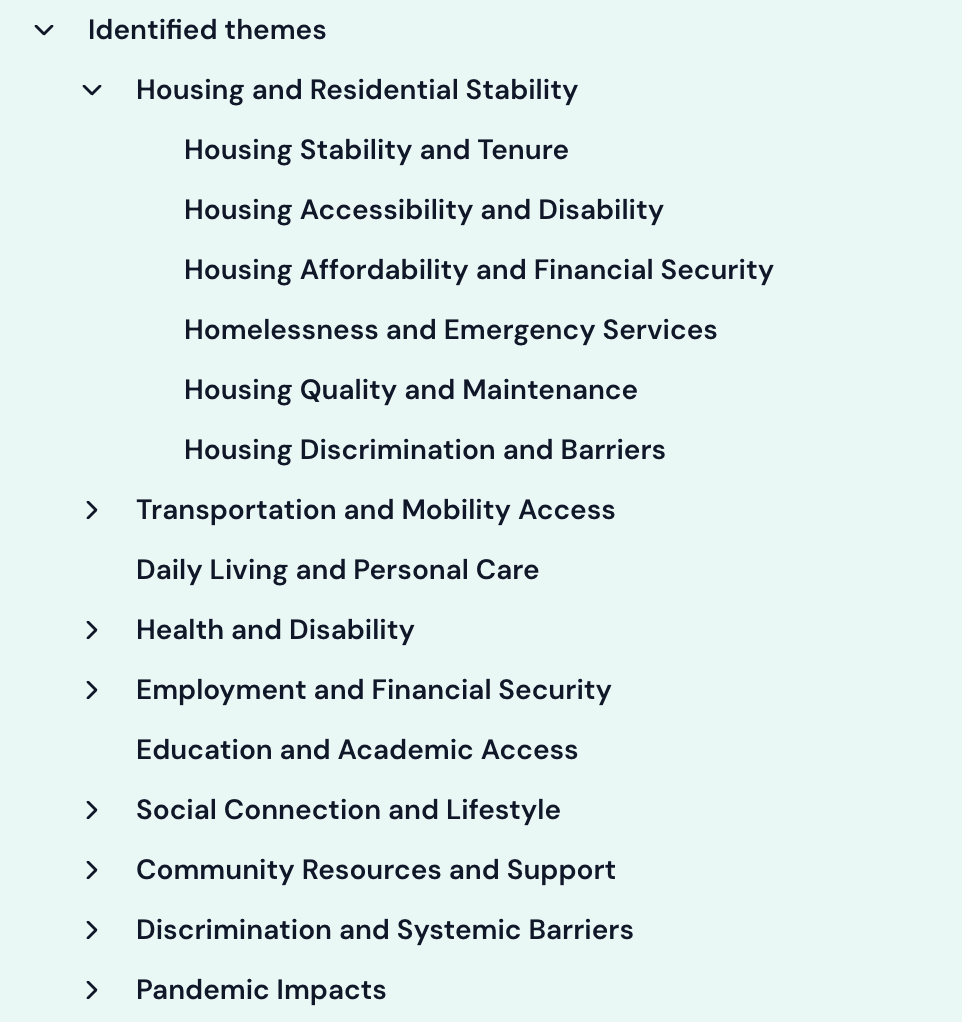
Example output of the analysis, showing a top level category called "Identified Themes", with further categories based on interview questions.
Note: This analysis is ideal when your project documents are structure in a similar way!
Step 1: Identifying themes from your documents
Skimle goes through each of the documents you uploaded, and uses LLM to identify document headings and interview questions.
Step 2: Forming initial categories from cross-cutting themes
Skimle then takes the results of the previous step and forms a set of dozen or fewer parsimonious thematic categories based on the headings and questions identified in the previous step.
Step 3: Extracting insights from your documents
At this stage, Skimle goes through each of your documents and extracts insights based on the top-level themes identified in the previous step.
Step 4: Creating subcategories based on the extracted insights
In the last step, Skimle examines insights assigned to each category and forms subcategories based on the extracted insights.
An example
Automatic thematic analysis suits any project where themes should emerge from consistently structured material. A researcher running a reflexive thematic analysis in the tradition of Braun and Clarke across 40 interviews, for instance, can let Skimle handle the first pass of coding and theming — spending their own time interpreting the results rather than tagging quotes by hand.